


Anatomical Gift Program
ABOUT THE PROGRAM
Thank you for your interest in the University of Delaware Anatomical Gift Program.
Anatomical gift donations are used exclusively for anatomical study at the University of Delaware. We never sell, transfer, or otherwise send anatomical gift donations to other facilities or agencies. All donations made to our program remain at the University of Delaware until the student’s anatomical study is complete, at which time the remains are returned to the funeral home indicated on the Anatomical Gift Donor Form.
If you would like to participate in this very important donor program, please complete and return the Anatomical Gift Donor Form and inform your family or estate of your decision so that they are aware of your wishes. The University of Delaware will be responsible for the costs associated with this program. These costs include transportation, embalming and cremation. Please contact us for a list of all funeral homes who have agreed to participate in our program.
Unfortunately, there are situations beyond our control when anatomical gifts cannot be accepted. Such situations include, but are not limited to, existence of infectious or communicable disease (e.g., HIV/AIDS, Hepatitis, Prion Disease, Tuberculosis, an active outbreak of herpes at time of death, etc.), a body weight in excess of 225 pounds, autopsy, certain surgeries within the past 30 days, severe trauma/decomposition, organ donation (excluding the eyes), and limited storage capacity at the University. We regret that this happens, and when it does, we will inform families as quickly as possible and assist in making other arrangements.
We are sincerely grateful for your interest in making an anatomical gift donation. If you have any questions or need additional information, please do not hesitate to contact us.
Anatomical Gift Information
The study of the human body for medical or scientific purposes has deep historical roots in our culture. Since the time of Hippocrates and later Leonardo da Vinci, health professionals have recognized that to truly learn and understand the structure of the human body, human specimens must be utilized in the course of study. No textbook, anatomical chart, or computer program can substitute for the use of human bodies. The students who have the privilege to use these specimens are training to become future health professionals. The knowledge they will gain in this study will enable them to be much more proficient and skilled practitioners in their chosen profession, and to take better care of their patients.
Students in a human anatomy course dissect the human specimens to learn the various structures. This is carried out in a systematic, supervised, and respectful manner. The dignity of the anatomical donor is always maintained. Everyone involved in an anatomy course fully realizes the importance and value of what they are doing and maintains the absolute highest level of decorum.
The only way human anatomy courses can continue is if human bodies are donated (anatomical gifts). The only human specimens used for study are those that are donated. The benefit to health professionals in training and ultimately, to the patients they will take care of, is indefinable. This contribution to society is the ultimate gift and of immeasurable benefit to the future of quality health care.
Anatomical gift donations for our program can be made by a pre-arranged commitment by an individual with minimal paperwork. Arrangements can be made to return the donor’s remains to the family following the completion of the anatomical study.
No textbook, anatomical chart, or computer program can substitute for the study of the human body through anatomical donation. At the University of Delaware, the students who have the privilege to utilize these donations are training to become healthcare providers. The knowledge they gain will enable them to become proficient and skilled healthcare professionals. Anatomical gifts to our program are used exclusively for anatomical study. We do not carry out any experimentation whatsoever.
Prospective donors should contact anatomical_donor@udel.edu or call (302) 831-4809 to obtain an information packet. The packet will contain a donor form for you to complete and return to us. Your remitted form is considered a "registry," stating you are a prospective donor. Please understand that the signed form is not a contract and does not bind the donor, or their estate, to donate upon death. Once we receive your donation form, we will send you a donor card to keep on hand.
Prospective donors must be 18 years or older to qualify for anatomical donation.
Your donated body may be kept in the Anatomical Gift Program for a period of up to three years before the remains are transported back to the funeral home, where they will be cremated and returned to the family or disposed of at the donor's request.
The following expenses will be covered by the University of Delaware Anatomical Gift Program for anatomical donation:
- Transportation costs (within the state of Delaware)
- Preparation of the donor
- Cremation
Non-covered expenses under the anatomical donation program include (if chosen), but are not limited to:
- Professional consultations
- Document preparation
- Obituaries
- Death certificates
- Religious ceremony arranged with the funeral home
- Merchandise purchased through the funeral home
- Postal fees for the forwarding of cremated remains via the U.S. Post Office to the designated receiver.
For more information regarding expenses not covered in the list above, we suggest you contact your chosen funeral home.
Reasons for which a donor cannot be accepted include:
- Weight of deceased prior to death exceeds 225 pounds
- Current or previous diagnosis of infectious or communicable disease (blood borne or airborne), including an active herpes outbreak at time of death
- Autopsy
- Organ donation (except anything related to the eyes)
- Certain recent surgeries (within 30 days of death)
- Severe trauma/Decomposition
If a donor is transported to the funeral home after passing and it is determined that any of these reasons apply, thus excluding the donor from the program, fees incurred by the funeral home will be the responsibility of the deceased's estate.
Your loved ones can have a service, but a viewing of your body will not be possible.
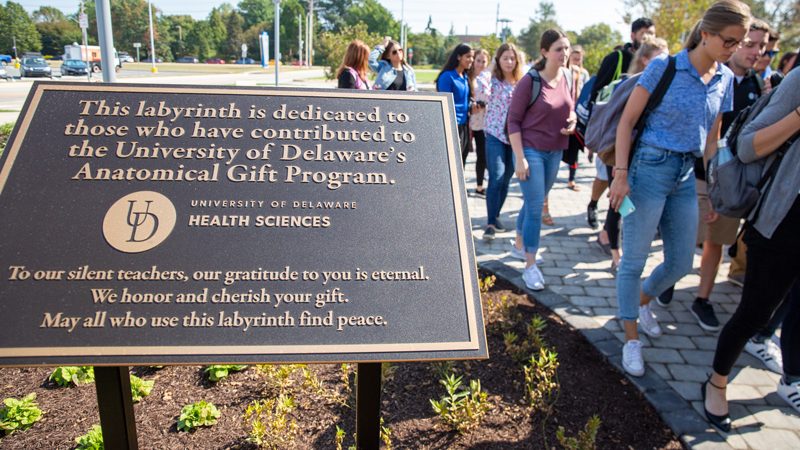
The students host an annual Service of Gratitude for anatomical donors whose studies were completed during that academic year. Families of these donors will be sent an invitation to attend the event.
You should notify your family, close friends, physician, and attorney (if applicable) of your decision to donate your body to University of Delaware Anatomical Gift Program. You should update end-of-life decisions and legal paperwork.
The University of Delaware Anatomical Gift Program welcomes the opportunity to work with all qualified Delaware funeral homes who will agree to participate in our program. Please feel free to contact us for a list of funeral homes who have agreed to participate in our program.
When the time comes, it is important to call the funeral home selected during the registration process. The funeral home will receive the donor's body and prepare for transport to the University of Delaware's anatomy lab. After the class has concluded, the donor will be transported to the funeral home for cremation. The funeral home will contact the next of kin when their family member's ashes are ready to be taken home.
Yes, the Anatomical Gift Program accepts monetary donations at any time, and donors may choose to memorialize someone with their gift. Donations can be made through our support page or by check.
If you prefer to donate by check, please make it payable to the University of Delaware, writing "Anatomical Gift Program" in the memo line. Send the check to Development and Alumni Relations, 105 East Main Street, Newark, DE 19716.
*The period for which donated bodies are kept in the Anatomical Gift Program before being transported back to the funeral home for cremation has increased from up to two years to up to three years.
ADDITIONAL LINKS
Connect


Tower at STAR: 100 Discovery Blvd, Newark, DE 19713 | Health Sciences Complex: 540 S. College Ave, Newark, DE 19713 chs-info@udel.edu Phone: 302-831-1060