



Marine Sciences Summer REU Program

Supported by a grant from the National Science Foundation's Division of Ocean Sciences, this Research Experiences for Undergraduates (REU) program offers undergraduates in STEM an opportunity to conduct guided research internships in marine science.
Under the guidance of a faculty mentor, interns work in a research-intensive atmosphere on a topic in chemical, physical, or biological oceanography or marine biology/geology/ biogeochemistry. The program includes weekly research seminars, professional development presentations, and field trips to nearby coastal marine systems. Interns will also present written and oral reports at the close of the program. For more information, contact Dr. Joanna York at jyork@udel.edu or 1-302-831-7040.
The Summer 2027 program will run for 10 weeks from Monday, June 7 to Friday, August 13. Student support includes a $8,150 stipend, free housing, and travel assistance for the 10-week program.
Who can participate
Participants must be currently enrolled in a program leading to an undergraduate degree, as well as U.S. citizen or legal permanent resident. Students from community colleges and institutions with limited research opportunities are especially encouraged to apply.
Where we study
Research and teaching facilities are located at UD’s Hugh R. Sharp Campus in Lewes, DE. Interns live at the Daiber Housing Complex, which is fully furnished with washer, dryer, air-conditioning and Wi-Fi. The complex is less than 2 miles from the Hugh R. Sharp Campus and within walking distance of downtown Lewes.
How to apply
Please apply via the NSF Education Training and Application Portal (ETAP). Applications are due on February 19, 2027. The application requires:
- Application form
- Short essays
- Unofficial Transcript(s)
- One (1) reference letter
Program Features
Faculty Mentors
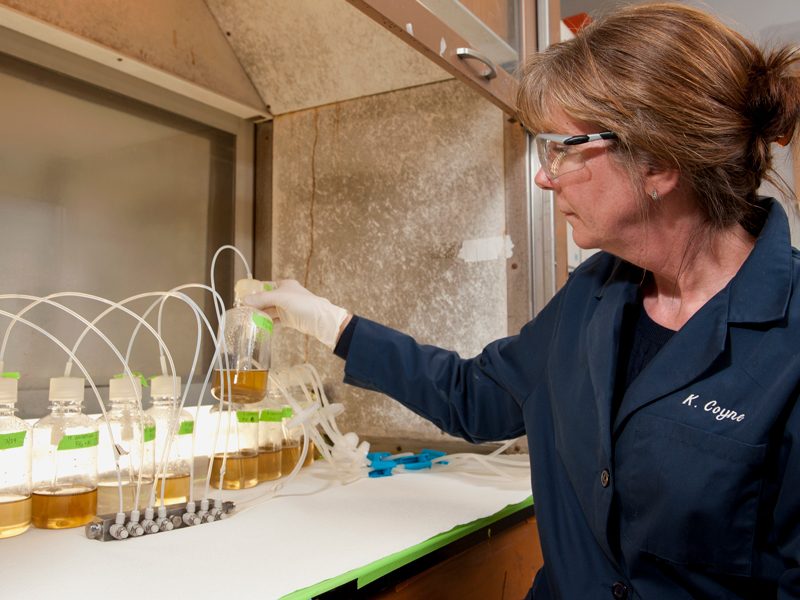
Throughout the ten-week program, students will work with faculty mentors on a research project. Mentors provide guidance in the first weeks of the internship on selection of an appropriate project. Throughout the summer, interns are guided through the process of executing the project, possibly including field work, lab analyses, and other activities. In the final weeks of the summer, students prepare a final presentation and report, again under the supervision of their faculty mentor.

Workshops, Seminars and Field Trips
Students in the Marine Sciences Summer Program are offered workshops and seminars by faculty and research experts at the University of Delaware and throughout the field of marine science.
Workshop, Seminar or Field Trip | Speaker |
Orientation (introductions, program overview, safety, facilities tour) | J. York |
Field Trip: Marsh Walk | J. York |
Meet and Greet with Graduate Students |
|
Honor, Integrity, and Responsible Conduct of Research | J. York |
Field Trip: Rutgers Aquaculture tour with Rutgers RIOS REU students | J. York |
Intern Presentations: Proposed Research | All interns |
Air-Sea Interactions and Breaking Waves | F. Veron |
Small Boat Course | J. Swallow |
Abiotic and Biotic Chemistry at Hydrothermal Vents | G. Luther |
Field Trip: Delaware Bay, R/V Daiber | J. York |
How's that Data Looking? Preliminary Results Discussion | All interns, J. York |
Communicating Results from Scientific Research | D. Kirchman |
So, you wanna get a job someday? | J. York |
Big Fish in a Bigger Ocean- How Do You Study Mobile Marine Predators? | A. Carlisle |
Tour of the Robotics Discovery Lab | A. Trembanis |
Finding New Life in the Deep Ocean | J. Biddle |
Small Boat Practical | J. Swallow |
Going Autonomous: Mapping Coastal Ecosystems | A. Trembanis |
How to Find a Grad Opportunity and How to Pay for It | J. York |
Final Presentations and Lunch | All interns |

Summer Research Projects
Marine Sciences Summer Program interns present their research projects and findings as a part of their experience, giving them both the benefit of conducting research and that of presenting their research, skills that will prepare them for science careers.
| Name | Advisor | Title |
|---|---|---|
Matthew P. | Ed Hale | Spatial Ecology of Northern Snakehead (Channa argus) in the Delaware River Estuary |
Madeline S. | Mark Warner | Measuring thermal stress response in low-light adapted Breviolum using chlorophyll fluorescence |
Bobby R. | Jenny Bigman | Investigating synchrony in fish biomass trends across the West Coast of the United States |
Emily K. | Aaron Carlisle | Using Oxygen Consumption and Acceleration Data to Estimate Field Metabolic Rate for Sandbar Sharks, Carcharhinus plumbeus |
Luke M. | Art Trembanis | Affordable and Scalable SAV Habitat Monitoring: Sonar, AI, and Open-Source Solutions |
Taylor G. | Yun Li | Hidden Upwelling for Nutrient Transport (HUNT) in Global Western Boundary Current Systems |
Karol P. | Andrew Wozniak | Understanding patterns of Spatial and Temporal Variation of Salt Marsh Organic Carbon |
Alice G. | Suni Walter | Methane Madness: Competition and Cooperation in Salt Marsh Methanogenesis |
Branner B. | Suni Walter | Methanogenesis Predictions Based on Thermodynamics |
Jillian Z. | Nick Ray | Minimal Influence of Diet on Internal Nitrogen Cycling in Eastern Oysters (Crassostrea virginica) |
Funding for this Research Experiences for Undergraduates site is provided by the National Science Foundation's Division of Ocean Sciences. The NSF contact for this program is Lindsay Martin. NSF does not handle REU applications; please contact each REU site directly for application information. This program is dependent on availability of federal funds from NSF.