

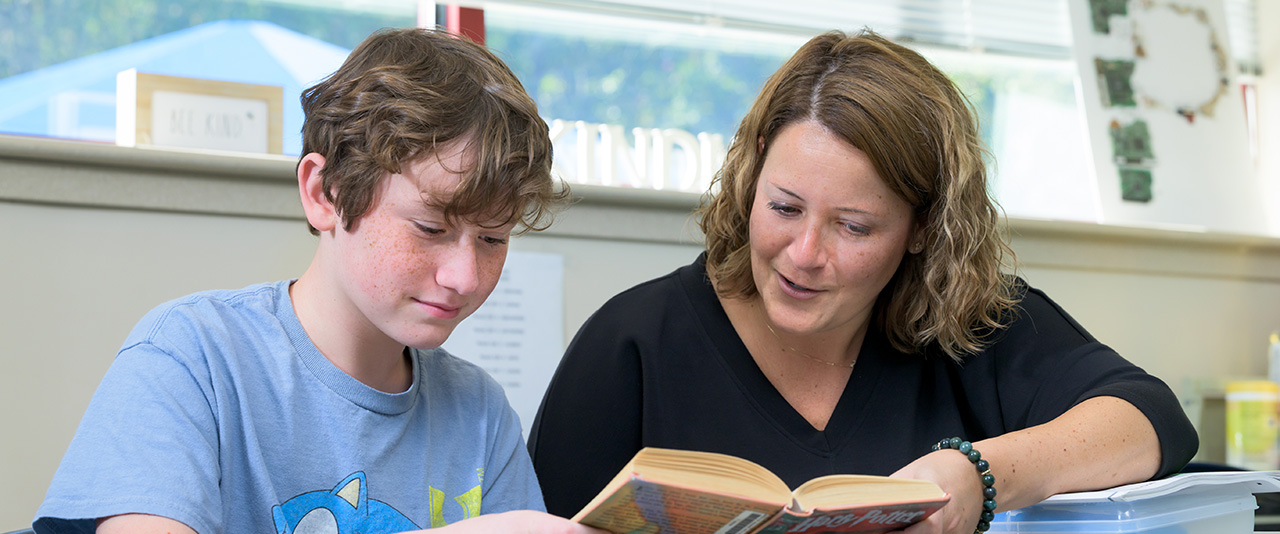
Teacher helping a child to read in a classroom setting.

Online Master of Education in Literacy

Become a qualified candidate for certification as a Reading/Literacy Specialist

The University of Delaware’s fully online and flexible M.Ed. in Literacy will prepare current teachers and educators for certification as a Reading/Literacy Specialist. Designed for practicing teachers and educators, this program includes 10 seven-week classes that can be completed part-time over two years. 


Taught by a team of distinguished faculty in the College of Education and Human Development’s School of Education, you will develop knowledge of the theoretical and evidenced foundations of reading and writing development, plan culturally and linguistically relevant literacy instruction for all students and support students and teachers in the use of digital literacy tools.


You will also engage with colleagues and school leaders to design and participate in relevant professional development opportunities.


The School of Education online education programs are ranked among the best in the nation by U.S. News & World Report.

Program Highlights

The online master’s degree in literacy provides students with a range of knowledge, skills, and experiential training:

- Learn within a fully-online and flexible environment

- Develop knowledge of the theoretical and evidenced foundations of reading and writing development

- Plan culturally and linguistically relevant literacy instruction for all students

- Plan and deliver targeted literacy instruction to both English learners and native English speakers in responsive ways

- Support students and teachers in the use of digital literacy tools

- Engage with colleagues and school leaders to design and participate in relevant professional development

An Award-Winning Program


The University's Online Master's in Education programs are recognized among the top 20 in the nation by U.S. News & World Report, 2025.

Program Benefits

More info about the Online Master of Education in Literacy

Applicants must meet the university requirements for graduate students and complete UD’s online graduate application.


Requirements specific to this program include:

  • Baccalaureate degree from an accredited college or university.

  • Transcripts showing an undergraduate GPA of 3.0 or higher.

  • Transcripts showing a minimum GPA of 3.0 for all graduate courses completed (if applicable).

  • TOEFL or IELTS for applicants whose primary language is not English. The minimum acceptable score for the Internet-based TOEFL is 100. The minimum acceptable score for the IELTS is 7.0.

  • Demonstrated knowledge of the teaching of oral language, reading and writing through previous coursework and teaching.

  • Preference given to applicants with initial teaching certification and classroom teaching experience. Students must have three years of teaching experience by the time they seek certification as a Reading/Literacy Specialist.

  • Prior to enrolling, students who teach outside of the state of Delaware are responsible for verifying their state licensing board’s requirements to determine if the UD M.Ed. in Literacy program meets their state’s requirements for Reading/Literacy Specialist certification.

To apply, please submit these materials:

  • Completed online graduate application

  • Transcripts showing an undergraduate GPA of 3.0 or higher.

  • Transcripts showing a minimum GPA of 3.0 for all graduate courses completed (if applicable).

  • Three letters of recommendation from individuals who are able to assess the applicant’s academic potential. Letters should be from professors who can attest to the candidate’s suitability for graduate study and supervisors who can comment on the candidate’s professional commitment and experience.

  • Three written, 500-word essays responding to the following three prompts:

    • Outline your short-term and long-term career goals and how a M.Ed. in Literacy relates to them.

    • Describe a problem in your professional setting that typifies an issue you would like to pursue as a Reading/Literacy Specialist and why you think it is important to address.

    • As you know, the M.Ed. in Literacy program at UD is offered online. It requires students to be self-initiated learners and excellent time-managers. Additionally, many of the courses require you to apply what you learn to an educational setting with students. Specifically, EDUC 630 and EDUC 763 require you to tutor a child regularly in reading and writing. Describe (a) how you plan to manage your time so you are able to fulfill your course requirements and (b) how you will identify appropriate educational settings so you can fulfill course requirements. Be specific.

This online program is designed to allow students to learn through application.

Therefore, you will be asked to apply your classroom content in an educational setting, assessing and instructing K-12 students using a variety of methods and strategies. You will also be asked to engage in coaching and mentoring opportunities.

Your work must be documented with video and submitted to course instructors for their review.

It is the student’s responsibility to obtain required technology, identify appropriate educational settings, obtain appropriate consent and record and upload videos. Students will receive a consent form template, which must be submitted to their instructor at the time of assignment submission.


Required Courses

The M.Ed. in Literacy requires 30 credits of graduate-level coursework. There are no electives. The required coursework includes:

  • EDUC601 Language Development in the Classroom (3 credits)

  • EDUC 604 Teaching Writing in the Elementary School (3 credits)

  • EDUC 608 Literacy Assessment and Instruction I (3 credits)

  • EDUC 609 Literacy Assessment and Instruction II (3 credits)

  • EDUC 622 The Role of Literacy in Content Areas (3 credits)

  • EDUC 630 Supervised Reading Clinic: I (3 credits)

  • EDUC 631 Organization and Supervision of Literacy Programs (3 credits)

  • EDUC 762 Digital Literacies (3 credits)

  • EDUC 763 Supervised Reading Clinic: II (3 credits)

  • EDUC 740 Literacy Instruction for English Language Learners (3 credits)


Required Exam

Prior to exit from the program, all candidates are required to earn a passing score of at least 165 on the Praxis II Reading Specialist exam (#5302) as mandated by the Delaware Department of Education certification requirements for Reading Specialists.


Required Technology

Technology plays a vital role in the M.Ed. in Literacy program. Candidates will use technology to communicate with instructors, collaborate with peers, document school-based instruction and submit assignments. 

View technology requirements and support for students for more information.


Tuition Information

$844 Per Credit Hour

The graduate tuition plan establishes a base tuition rate of $1,069 per credit, but offers a base rate exception for the M.Ed. in Literacy program.

Base rate exceptions include tuition that is higher or lower than the base due to various factors, including competitive market research, program focus and historical enrollment success and program type (e.g., degree vs. non-degree). Over 90% of our programs fall under the base rate.

The sustaining tuition fee each semester for master’s students is $833 and doctoral students is $1,258. U.S. citizens may apply for Stafford Loans. You must file a FAFSA (Free Application for Federal Student Aid) no later than March 15 (February 1 is preferred) with the Financial Aid Office (302-831-8761) to be considered for a Federal Stafford Loan.

International Students: See ISSS Cost of Attendance for more information.

Steve Amendum

Director, Professor
School of Education
Email: amendum@udel.edu
Office: 103E Willard Hall
Phone: 302-831-1590

Bio: Dr. Steve Amendum is director and a professor specializing in literacy education in UD’s School of Education. He teaches courses related to literacy research, assessment and instruction at both the undergraduate and graduate levels. His research areas include early reading intervention, literacy development and instruction for multilingual learners and evidence-based classroom instruction, as well as professional development for teachers in each of these areas.

Read faculty biography

Christina M. Budde

Assistant Professor
School of Education
Email: cbudde@udel.edu
Office: 121A Willard Hall
Phone: 302-831-8695

Bio: Dr. Christina M. Budde is an assistant professor in UD’s School of Education, where she specializes in literacy and language education. With over a decade of experience teaching elementary school and adult ESL, Dr. Budde is dedicated to understanding and enhancing classroom practices that embrace the cultural and linguistic diversity of students. Dr. Budde’s research focuses on identifying and promoting effective instructional practices that support the language and literacy development of early childhood and elementary-age children from diverse backgrounds. Dr. Budde teaches undergraduate and graduate-level courses related to literacy instruction, language development and teaching multilingual learners.

Read faculty biography

David Coker

Professor
School of Education
Email: dcoker@udel.edu
Office: 127A Willard Hall
Phone: 302-831-3096
Fax: 302-831-4110

Bio: Dr. David Coker is a professor in UD’s School of Education and teaches courses on writing and reading instruction. His research focuses on issues that are central to advancing writing research and improving writing instruction in schools that serve low-income students. These topics include early writing assessment, writing development and effective approaches to writing instruction. Recently, he served as PI of an IES Exploration Goal project investigating writing instruction and student outcomes in first grade.

Read faculty biography

Rachel Karchmer-Klein

Associate Professor, M.Ed. in Literacy Program Coordinator
School of Education
Email: karchmer@udel.edu
Office: 123 Willard Hall
Phone: 302-831-1976

Bio: Dr. Rachel Karchmer-Klein is an associate professor in UD’s School of Education where she teaches courses in literacy and educational technology at the undergraduate, graduate and doctoral levels. She is a former elementary classroom teacher and reading specialist, and earned her Ph.D. in Reading Education at Syracuse University. Her research investigates relationships among literacy skills, digital tools and teacher preparation, with particular emphasis on technology-infused instructional design.

Read faculty biography

William Lewis

Professor
School of Education
Email: wlewis@udel.edu
Office: 121B Willard Hall
Phone: 302-831-0728

Bio: Dr. William Lewis is a professor in UD’s School of Education. His research interests focus on persuasive writing and argumentation, as well as secondary content-area reading and writing. Dr. Lewis’ research has been published in The Journal of Educational Psychology, Contemporary Educational Psychology, The Harvard Educational Review and Reading and Writing Quarterly. Dr. Lewis teaches undergraduate and graduate courses in content-area literacy, English language arts methods, writing and young adult literature.

Read faculty biography

Adrian Pasquarella

Associate Professor
School of Education
Email: apasq@udel.edu
Office: 124 Willard Hall
Phone: 302-831-1118

Bio: Adrian Pasquarella is an associate professor specializing in literacy education in UD’s School of Education. He teaches courses related to literacy instruction, specifically for multilingual learners and leads the Multicultural Education and Literacy Development laboratory at UD. Pasquarella's research areas include language and literacy acquisition and development in linguistically and culturally diverse populations, understanding universal and language-specific aspects of reading and writing, cross-language transfer, reading comprehension, vocabulary knowledge and morphological awareness.

Read faculty biography

Sharon Walpole

Professor
School of Education
Email: swalpole@udel.edu
Office: 101A Willard Hall
Phone: 302-831-2560

Bio: Dr. Sharon Walpole is professor in UD’s School of Education. Dr. Walpole designs and studies the effects of professional development on instruction and achievement in literacy. She works with literacy coaches, reading specialists and administrators to build schoolwide systems to support teachers, especially those working for children at risk. She has extensive school-based experience designing and implementing tiered instructional programs.

Read faculty biography

You can transfer up to 9 credits per University of Delaware policy.

All requests for transfer credit should be directed to the student’s major department using a Request for Transfer of Graduate Credit form. Transfer credits will be accepted provided that such credits:

  • Were earned with a grade of no less than B,
  • Are approved by the student’s adviser and the chair of the student’s major department,
  • Are in accord with the specific degree program of the student as specified by the unit’s Graduate Program Policy Statement,
  • Are not older than five years,
  • Are graduate level courses, and
  • Were completed at an accredited college or university.

Graduate courses counted toward a degree received elsewhere may not be transferred into a degree at the University of Delaware. Credits from institutions outside of the United States are generally not transferable to the University of Delaware.

Learn more about transfer credit by viewing the Graduate College's Registration and Enrollment Policies.

The online Master of Education in Literacy program provides students with three opportunities to begin the program each year: Fall, Spring and Summer.

Please review the chart below for the application deadlines:

Session Application Deadline Session Start Date
Fall August 15, 2025 August 26, 2025
Spring I January 23, 2026 February 2, 2026
Spring II March 25, 2026 March 30, 2026
Summer May 27, 2026 June 8, 2026


Additional program-specific information can be found on the College of Education and Human Development's website.

Frequently Asked Questions

The first step toward applying for this program is to complete your online application through the graduate student Application Management System.

You may start this program in the fall, summer or spring semesters. See application deadlines above. Applicants are considered for admission on a rolling basis, which makes now the perfect time to apply.

Canvas, which is currently used by over 2,000 schools throughout the United States.

This program includes 30 total credit hours.

Yes, graduate departments generally allow you to transfer up to 9 credits per University of Delaware policy. View Transfer Credit for more information.

Ready to Learn More?


Experience what it’s like to earn your Master of Education in Literacy in as little as two years, all from the comfort of your own home.