




From fresh ideas to real returns
Photos by Evan Krape and Maria Errico January 30, 2026
UD Engineering’s senior design sponsors gain innovative solutions and a front-row seat to tomorrow’s hires
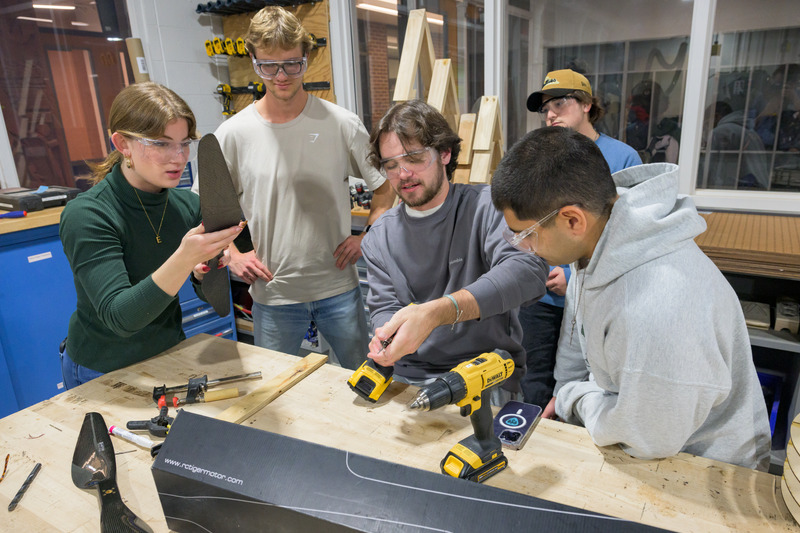
Forty-two senior engineering teams. Thousands of hours of work. Behind every project is an industry or research partner counting on the students’ creativity and skills. By sponsoring the University of Delaware’s senior engineering design projects, organizations gain fresh ideas, tangible progress on real challenges, and early access to the engineers they might hire next.
The Interdisciplinary Senior Engineering Design Program is a combined capstone course that enrolls all seniors in the departments of Mechanical Engineering and Biomedical Engineering and brings in students from other disciplines to supply the skills required by each project. Over the course of the fall semester, small teams collaborate with their sponsors to devise solutions to real-world challenges.
The 2025 efforts were on full display at the Fall Engineering Design Showcase on Dec. 11 in Clayton Hall.
“Every project delivers meaningful insights and time-saving progress that sponsors can build upon, providing companies with fresh ideas and tangible results they can put to use immediately,” said Pamela M. Norris, dean of the College of Engineering. “Sponsors also gain early access to emerging engineering talent, working closely with students and seeing firsthand how they approach real-world challenges.”
Offering fresh perspectives
“We love students because they have new ideas,” said Darryl DuBre, co-founder and director of operations at Marins Inc. “They’re not jaded, engineering-wise, as to what can and can’t be done.”
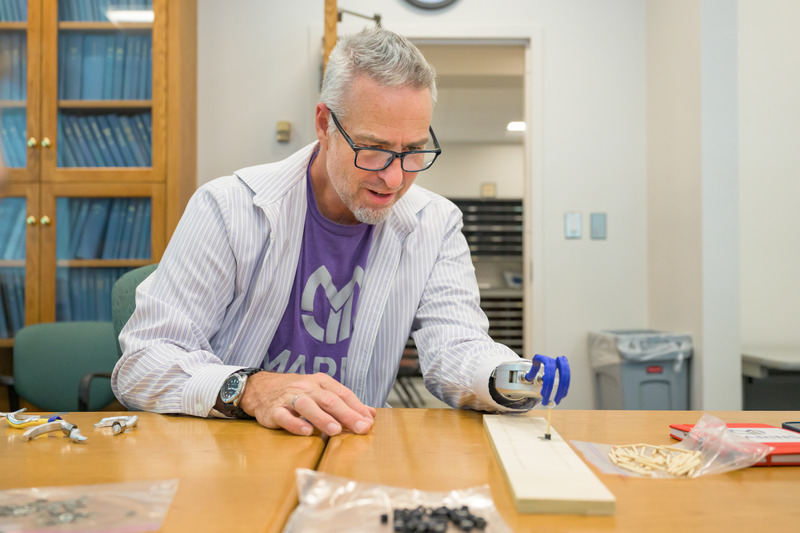
The 2025 Marins-sponsored team was tasked with redesigning the “fingers” of a hook-style prosthetic hand so they could straighten, enabling finer motor tasks such as holding a nail in place to be hammered.
“When we were doing our benchmarking, we researched existing products that had nothing to do with prosthetic fingers. We were looking at switchblades, knives, ratcheting mechanisms,” explained team member Elaine Kachala, a biomedical engineering major. Faculty advisors encouraged students to think creatively when exploring possible solutions.
“Their approach was very well-thought-out and thorough,” said DuBre. “An experienced engineer might have an idea in their mind and go with that first, instead of first taking a look at two or three different ideas and really analyzing how effective each could be in this particular situation.”
The team’s redesign adds small joints that allow users to straighten the fingers by loosening a screw, moving the finger until gear teeth click into place and then tightening the screw. After completing the task, users can return the fingers to the traditional hook shape.
DuBre, an upper limb amputee, conducted user testing with a 3D-printed prototype.
“I think what they developed actually is manufacturable or very close to it, with a few tweaks,” said DuBre. “But their ability to imagine what it could be — not thinking so much about what it should be — is what’s really valuable. That kind of thinking can spark the next major advance.”
Team members acknowledged that there is room for improvement, particularly in terms of ease of use. Their original concept allowed users to switch configurations with the press of a button, but durability issues with the spring-based mechanism led them to pivot to the screw design.
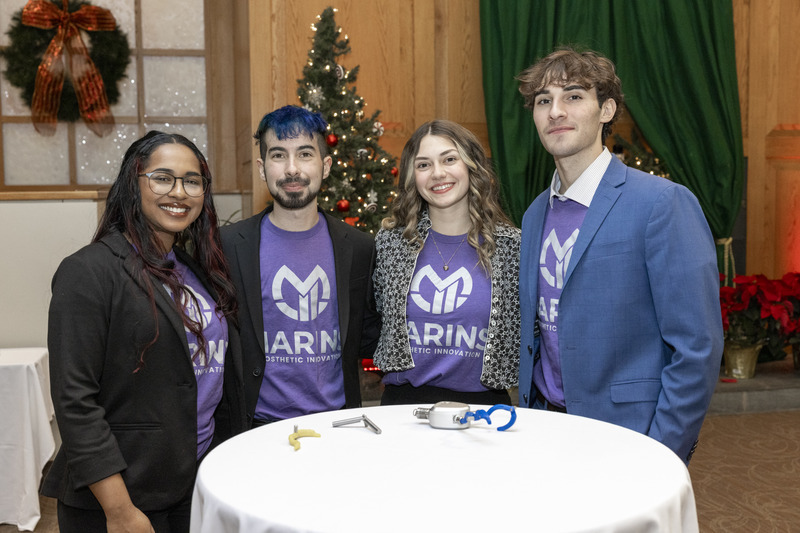
“If I kept working on it, I would focus on taking it from where it is right now — where it's functional and it works — to where it works and it's easy to use, and the user has a really good experience with it,” said team member Logan Feiler, a mechanical engineering major who is minoring in biomechanics.
Even when not perfected, student work gives sponsors a solid foundation to build on.
“Students may not get things perfect, but they'll get it 50% of the way there,” said Michael Seitel, CEO of automation company Norwalt, which has sponsored multiple senior design projects over the years. “Then we take it on and finish it up. And a lot of times — on two or three projects now — we've implemented the work into our production machinery, and it's saved money and made the machines better.”
Moving critical work forward
Some senior design projects focus on addressing practical needs that an organization’s staff lacks the time or bandwidth to tackle. UD’s Center for Clean Hydrogen (CCH) sponsored a senior design team for the second consecutive year to develop a testing device they plan to use in their own labs and share with the broader research community.
Clean hydrogen is produced by splitting water into hydrogen and oxygen using electricity from renewable sources such as solar or wind power. However, the cost of this process, known as electrolysis, remains high. CCH tasked senior design students with developing a simple, reliable and easy-to-use device to test the materials used inside electrolysis systems. Improving the consistency and efficiency of testing could help accelerate advancements in clean energy technologies.
Work on the device began with a 2024 senior design team, two of whom continued on the project beyond the semester. This year’s senior design team addressed gaps and shortcomings to finalize the device, which they dubbed “The Enforcer.” That work earned the team the MVP award at the fall showcase.
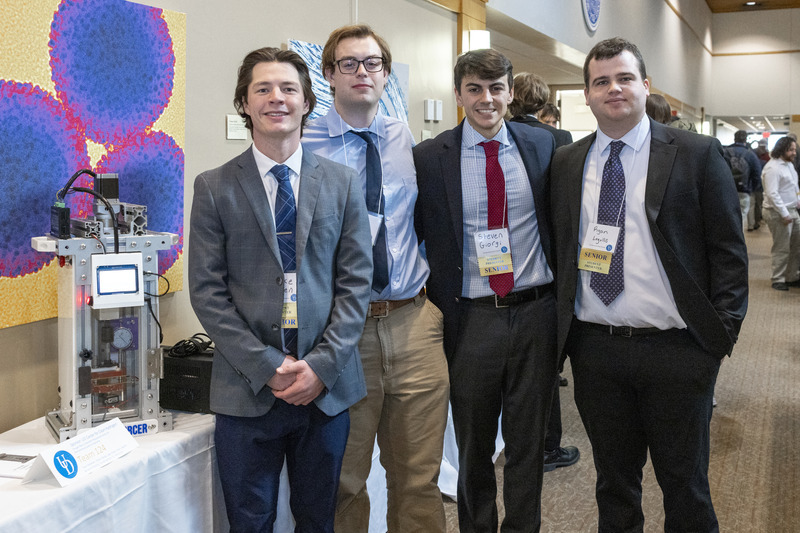
“Our goal was to have a salable product by spring of 2026, and I think we’re there,” said Anil Bika, CCH’s director of workforce development. “These things take time, and we needed someone to buckle down and get it done. And that’s exactly what the students did.”
“The improvements they made are critical for the device to function properly,” added CCH senior scientist Lisa Dunsmore of the 2025 team’s efforts. “They took it from proof-of-concept to an actual usable device. That’s really above-and-beyond for students.”
Demonstrating professional readiness
Beyond technical deliverables, sponsors see senior design as a powerful recruiting and relationship-building tool.
“Senior design offers a great way to solve problems you may not have the manpower to tackle while also evaluating students to see which ones might be a good fit for your company,” said Seitel. “It's a great recruiting process, almost like having an internship where you can see how well they perform.”
Norwalt typically hires one to two UD graduates each year, he added.
Marins Inc. has hired past senior design team members as interns, DuBre noted, and he was impressed by this year’s team as well.
“They’re very thoughtful, and they’re doing it for all the right reasons,” he said. “They’re not just there to get a grade. They’re genuinely engaged.”
“The return on investment is so good,” Bika said of sponsoring senior design projects. “You spend about an hour a week with the students. You get real progress on your product, and you build relationships at the same time.”
For sponsors, senior design delivers far more than a single-semester project. It offers new perspectives on stubborn challenges, steady progress on work that might otherwise stall and a low-risk way to engage with UD’s next generation of engineers.
Contact Us
Have a UDaily story idea?
Contact us at ocm@udel.edu
Members of the press
Contact us at mediarelations@udel.edu or visit the Media Relations website