




Changing the stories of substance use
Photos by Kathy F. Atkinson January 07, 2026
Recent UD master’s graduate collaborates with a community nonprofit fighting substance use disorder
Dan Sweeney has watched family members struggle with substance use and addiction, and is in recovery himself, so he knows that these waters are choppy.
Now Sweeney is using his experience to support others in charting their own paths to recovery by sharing the right messages and resources that are critical to successful outcomes.
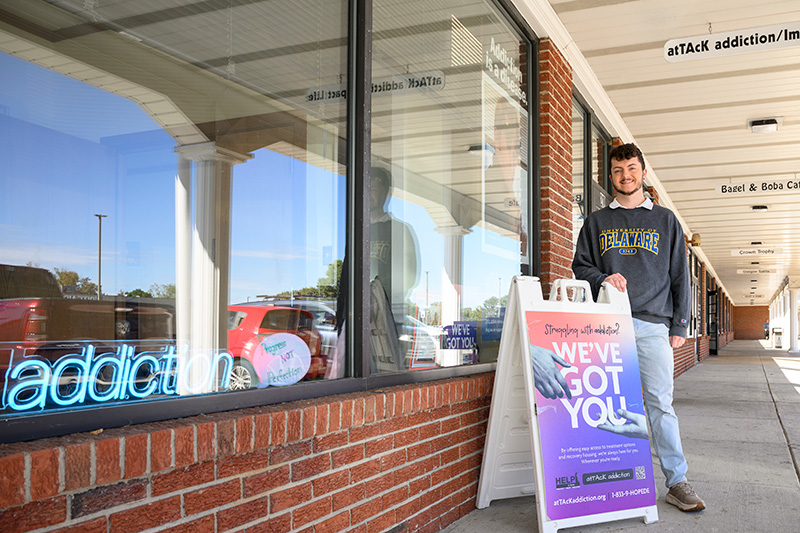
After completing his master’s degree in communication in the University of Delaware’s College of Arts and Sciences in May 2025, he partnered with atTAcK addiction — a local organization dedicated to fighting substance use disorders and the problems they create — to gather insights from the community that will inform the nonprofit’s outreach and counter the persistent narratives of stigma and shame.
With funding as a UD Graduate Community Engagement Summer Scholar, Sweeney spent the summer connecting with atTAcK addiction leadership and staff, attending public events and recruiting community members to share their stories through research interviews.
Programs manager Brandi Parks is one of the first people visitors meet at atTAcK addiction’s resource center in Bear, Delaware. She worked with Sweeney to identify research participants and develop interview questions. Parks said she was impressed by his ability to connect to the community.
“Wanting to learn more about how [substance use] is so stigmatized, and what we can do to change it,” said Parks. “Just his willingness in itself speaks volumes.”
The two also collaborated to imagine how Sweeney’s research could be most useful to the community. Using what he learns from the interviews, Sweeney will produce print and digital materials that support people when they are most vulnerable. His work will supplement the organization’s messaging with anonymized stories of lived experiences.
“[Dan] has a particular interest in identifying the resources that people access along the way,” said Valerie Earnshaw, professor in the College of Education and Human Development’s Department of Human Development and Family Sciences, who serves as Sweeney’s project advisor.

Earnshaw said that there is a “need to keep up with what is working for people and what is a problem for people. Dan's project has the potential to fill the gap in understanding what's working and not working now in 2025.”
What makes Sweeney’s project different is his approach, which is based on strengths, not deficiencies.
“If you just point out what people need, or what they lack, there's not much room for growth,” Sweeney said. “A starting point is to figure out what they're already doing that's positive and fruitful. It is a much happier conversation when we're talking about things that we can celebrate.”
“Stigma is a barrier to every step of the recovery journey,” Earnshaw said. “There is tremendous lingering stigma … both towards the individuals who are in recovery and towards treatments and medical interventions.”
For instance, Earnshaw said, people in treatment for opioid addiction who are taking suboxone may be viewed by family and the public as “trading one drug for another.”
These negative perceptions can hamper recovery, and Sweeney aims to replace the script.

Jill Fredel, atTAcK addiction board member and director of communications, looks forward to applying Sweeney’s research to the organization’s outreach. She anticipates using the stories that Sweeney uncovers to enhance atTAcK addiction’s social media and to inform smaller conversations like those happening at the resource center.
“There are things that we can learn from his research that are going to help us support people who are in active use, who are in recovery and their family members,” Fredel said. “Everybody’s lens is a little bit different. For him to pull it all together in one place, it's going to be enlightening and empowering.”
Fredel, like many of those at atTAcK addiction, has been affected by substance use. The stakes are high, but she is optimistic that Sweeney’s research can help make a difference.
“Many people's lives have been lost to overdose,” Fredel said. “The more understanding we can have, the more lives we can save.”
Sweeney will continue working into the fall semester to conduct interviews and produce materials and content for local outreach.
About Graduate Community Engagement Summer Scholars
Community Engagement Summer Scholars is a long-standing summer program that provides highly motivated students the opportunity to immerse themselves in community-based projects. The program is open to all graduate students and is administered by the Community Engagement Initiative, which works to facilitate and strengthen UD’s identity and impact as an engaged research university and community partner throughout the state of Delaware and beyond.
Contact Us
Have a UDaily story idea?
Contact us at ocm@udel.edu
Members of the press
Contact us at mediarelations@udel.edu or visit the Media Relations website