
Preserving the past, inspiring the future
Photos by Evan Krape and courtesy of Harvard Law School Library December 03, 2025
Award-winning conservator’s ties to Delaware shaped her career and continue to enrich student experiences
Debora Mayer knows how to find hidden things, like using ultraviolet light to reveal that a “copy” of the Magna Carta from the year 1300 is in fact an original document. As the conservator for analytical services and technical imaging at the Weissman Preservation Center, Harvard Library at Harvard University, the UD alumna helped researchers from Harvard and King’s College in London with the discovery that made headlines this spring.
But before Mayer could take part in exciting discoveries, she had to find her own career path, which she did with the help of the University of Delaware Winterthur/University of Delaware Program in Art Conservation (WUDPAC).
One phone call
Mayer didn’t know what she was looking for when she finished her undergraduate degree, but a phone call to the San Francisco Museum of Modern Art (SFMOMA) changed her life.
“I cold-called the museum and asked, ‘What do you do for your paintings?’ and the operator put me through to the conservation department. ‘Conservation Department?’ I thought. I’ve never heard of that. What is that?” she said.
Mayer’s education up to that point had been broad and exploratory: an alternative high school, a year studying in Jerusalem, a handful of art schools. After earning an art degree from the University of Massachusetts in Amherst, she worked as a fine arts master printer and learned how to mat and frame artwork. She even considered following her father’s footsteps in the sciences or pursuing a career in the medical field.
She didn’t know there was a field that combines her love of both art and science until that phone call and a visit with the SFMOMA conservation department, where she saw people surrounded by art, working with their hands and using their scientific knowledge.
“The world just opened up for me,” she said. “It was the most amazing afternoon of my entire life because I saw everything that I like in my world happening in one room.”
From curiosity to career
The conservation staff at SFMOMA continued to mentor Mayer, walking her through the steps she needed to take to enter the field, including pointing her to WUDPAC in the College of Arts and Sciences.
She entered the program in 1979, beginning an enduring connection with UD.
Debra Hess Norris, chair of the Department of Art Conservation, noted: “I have known and admired Debora since she was a graduate student, and beyond her technical brilliance, she is a beloved and respected instructor. She has inspired generations of conservation professionals who candidly reflect on her extraordinary and compassionate teaching in fiber microscopy and analysis.”
Mayer loved the educational and research aspects of the WUDPAC program, and she returned to the Winterthur Museum and WUDPAC as a paper conservator and an educator a few years after finishing the program in 1982.
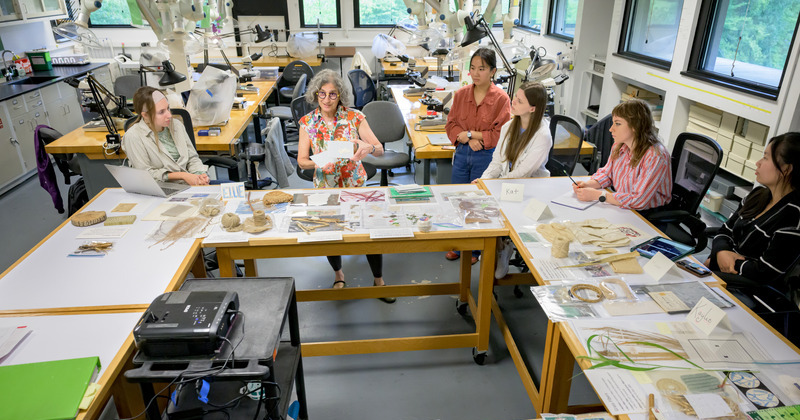
Although now at Harvard, she still returns to Delaware at least once a year to help teach and prepare the next generation of conservators
“I keep coming back because I learn as much as the students do because of the questions they ask. They make me rethink what I know and find new ways to explain things,” she said.
A magnificent discovery

There are more than 25 libraries and collections in the Harvard Library system, and Mayer works with all of them in her role managing the workflow for technical imaging and coordinating analytical services.
When researchers in London contacted the Harvard Law Library about a copy of the Magna Carta in their collection, Mayer was in charge of the technical imaging that allowed researchers to determine that it wasn’t a copy after all - it was an original document.
“The manuscript is written in iron gall ink, which has gotten blurry, so it’s pretty illegible in normal light,” she said.
Using ultraviolet light, Mayer captured readable images, which enabled the researchers to determine the document’s authenticity.
Mayer compared it to looking at a room using a black light instead of a normal lightbulb: It doesn’t change what you’re looking at, it just changes what you can see.
While the Magna Carta discovery was exciting, for Mayer it was also just part of her job.
“The thing about conservators is we see and touch so many amazing things, things of beauty and things of historic importance. I’ve been just as excited to help a musicologist read faded medieval Gregorian notations,” she said. “It means nothing to me, but to this researcher, it’s everything, and that makes me just as happy as working on the Magna Carta did.”
![Spectral imaging expert Bill Christens-Barry and Debora Mayer of the Weissman Preservation Center prepare HLS MS 172 for[SL1] multispectral imaging. Photograph by R.B. Toth Associates](/udaily/2025/december/CAS-art-conservation-debora-mayer-magna-carta-wudpac/_jcr_content/par_col_8_udel/image.coreimg.jpeg/1764780745909/cas-wudpac-4-magnacarta-ms-172-lawlibrary-msi-setup1-rbtoth-story-800x533.jpeg "Spectral imaging expert Bill Christens-Barry and Debora Mayer of the Weissman Preservation Center prepare HLS MS 172 for[SL1] multispectral imaging. Photograph by R.B. Toth Associates")
Lifetime achievement
Mayer was recognized in May for her work and commitment to microscopy, research, publication and mentoring when she received the 2025 American Institute for Conservation Robert L. Feller Lifetime Achievement Award for exceptional contributions to the conservation profession throughout one's career.
Her friend and colleague Hess Norris wrote one of the many nomination letters, saying, “As a leading expert in fiber microscopy, Debora has advanced our understanding of the materials used in papermaking, textiles and art media. Her work has been widely cited and celebrated in the field.”
In her acceptance speech, Mayer remembered the staff in San Francisco who introduced her to the field and gave her life purpose.
“My message to you is to remember to open your doors and your hearts to strangers. I am here in the field of conservation because of the generosity of strangers,” she said.
Art conservation has advanced greatly since Mayer’s discovery four decades ago. Scientific tools such as microscopes have become more sophisticated, and today’s WUDPAC students bring new skills and perspectives. The program, too, has evolved—embracing diverse cultural viewpoints and placing stronger emphasis on leadership and advocacy skills.
Even phone calls are rare compared to the 1980s, but Mayer always welcomes an email or text from a WUDPAC student. Mentoring Blue Hens will always be important to her.
“When I think about the places I love, well, I have so much love for the University of Delaware.”

Contact Us
Have a UDaily story idea?
Contact us at ocm@udel.edu
Members of the press
Contact us at mediarelations@udel.edu or visit the Media Relations website