MAJOR FINDER
Filter by College
Filter by Program Types
Filter by Subject
GIScience and Environmental Data Analytics
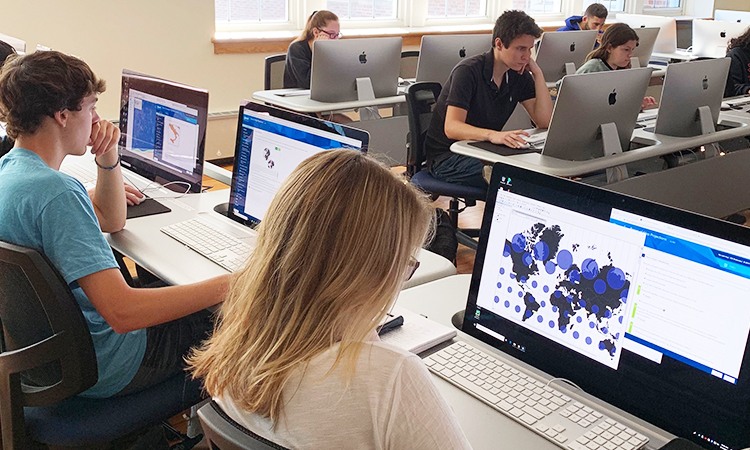
THE POWER OF GEOSPATIAL DATA
To contribute to advances in sustainability and fostering a more equitable society in the future, you will need to learn how to analyze and harness geosptatial data, which is already being generated in every aspect of our society. In this major you will study computer science, electrical engineering, geography and mathematics in a core curriculum that builds strong skills in handling large geospatial and environmental data sets. Having built those foundational skills, you will then develop the deep knowledge and context you will need to succeed in one of five topical concentrations, listed below in Areas of Study. In the capstone course, you will apply data analytics to pressing environmental topics, such as food security, water shortages, climate change and environmental health.
AREAS OF STUDY
- Cybersecurity
- Data Mining
- Environmental Data Science
- Management Information Systems
- Remote Sensing
CAREER OPTIONS
- Environmental Hazards
- Food Security
- Geospatial Information Scientist
- Geospatial Information Technologist
- Homeland Security
- Photogrammetry & Cartography
- Public Health
- Water Security
What’s special about this program?
This major will help you develop in-demand skills, including managing and using large geospatial and environmental data sets, finding meaningful patterns in them, representing their complexity in graphs and tables, and distilling and presenting the coherent and logical stories they tell. These kinds of data science skills were required for 2.35 million job postings in 2015, according to QuantCrunch, a study commissioned by IBM.
Sample curriculum
Courses are recommendations, but subject to change year-to year. Please refer to the UD Undergraduate Catalog for a more accurate four year plan. Students should also reach out to their academic advisor for recommendations.
FALL | SPRING |
|---|---|
ENGL 110 - First-Year Writing | CISC 106 - General Computer Science for Engineers or CISC 108 - Introduction to Computer Science I |
GEOG 372 - Introduction to GIS | GEOG 478 - GIScience and Environmental Data Analytics Colloquium (1/3) |
MATH 241 - Analytic Geometry and Calculus A | MATH 242 - Analytic Geometry and Calculus B |
First Year Seminar | Breadth Requirement (2/6) |
Breadth Requirement (1/6) | Free Elective (1/3) |
Credits: 14 | Credits: 15 |
FALL | SPRING |
|---|---|
CISC 210 - Introduction to Systems Programming | CISC 220 - Data Structures |
GEOG 486 - Cartography: Art & Science of Mapping Data | ELEG 305 - Signals and Systems |
MATH 243 - Analytic Geometry and Calculus C | GEOG 471 - Advanced GIS |
Foreign Language Requirement (1/3) | GEOG 478 - GIScience and Environmental Data Analytics Colloquium (2/3) |
Breadth Requirement (3/6) | Foreign Language Requirement (2/3) |
Multicultural Requirement | |
Credits: 17 | Credits: 17 |
FALL | SPRING |
|---|---|
GEOG 481 - Remote Sensing of Environment | ELEG 404 - Imaging and Deep Learning |
MATH 349 - Elementary Linear Algebra | STAT 475 - Environmental Statistics |
Discovery Learning Experience | GEOG 478 - GIScience and Environmental Data Analytics Colloquium (3/3) |
Foreign Language Requirement (3/3) | Additional Core Requirement* (1/2) |
Breadth Requirement (4/6) | Concentration Requirement (1/4)** |
Breadth Requirement (5/6) | |
Credits: 16 | Credits:16 |
*See program page for approved courses
**Option depends on concentration, see program page for required course
FALL | SPRING |
|---|---|
CISC 437 - Database Systems | GEOG 479 - CAPSTONE: GIScience and Environmental Data Analytics (satisfies Capstone Requirement) |
PHYS 201 - Introductory Physics I and PHYS 221 - Introductory Physics Laboratory I or PHYS 207 - Fundamentals of Physics I and PHYS 227 - Fundamentals of Physics Laboratory I | Additional Core Requirement (2/2)* |
Concentration Requirement (2/4)** | Concentration Requirement (4/4)** |
Concentration Requirement (3/4)** | Free Elective (2/3) |
Breadth Requirement (6/6) (should also satisfy Second Writing Requirement) | Free Elective (3/3) |
Credits: 16 | Credits: 13 |
Total Credits: 124 | |
*See program page for approved courses
**Option depends on concentration, see program page for required course