



Category: Earth, Ocean and Environment
Sharks, Searches and Service
July 01, 2026 Written by Adam Thomas
University of Delaware undergraduate student Kendall Richardson has always loved the ocean and sharks. When she had the opportunity to swim with black-tip reef sharks in Palau during a study abroad program in the winter of 2026, she knew she had to permanently commemorate the occasion.
After heading with her group on an excursion to swim with the black-tip reef sharks, Richardson, an environmental science and public policy double major with a concentration in marine science, and her friends found their way to a tattoo parlor.
“A bunch of the girls wanted to get tattoos, and I thought, ‘I need to get one of a black-tip reef shark,’ so that turned out to be my first tattoo,” said Richardson. “It was the first time I'd ever swum with sharks, but it had been a dream my whole life, and it was such an amazing experience. Growing up, all my friends were terrified of sharks, and I always said I wanted to swim with them. The sharks were two feet from my face, just swimming around us, and it was incredible.”
The study abroad program was led by Mark Moline, the Maxwell P. and Mildred H. Harrington Professor of Marine Studies at UD and a co-founder of Project Recover. Richardson, who had never been off the east coast of the United States before the excursion, said it was amazing to travel to the other side of the world.
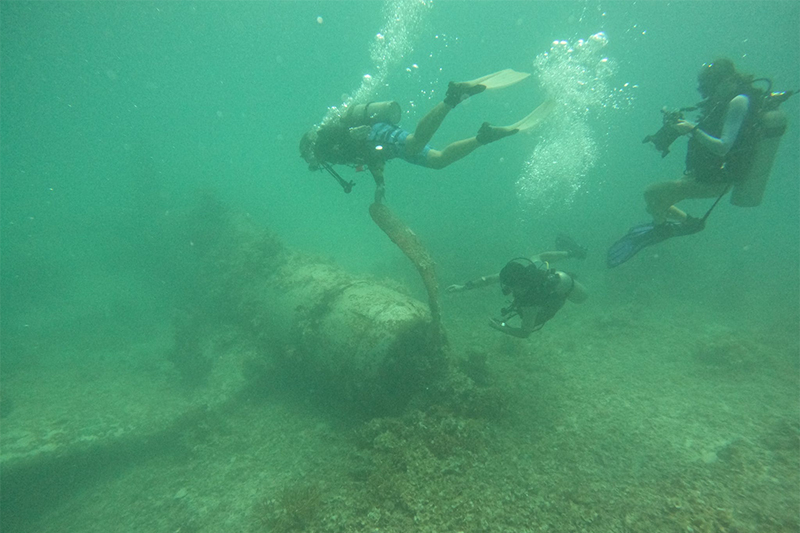
Richardson and the other participants also learned about seafloor mapping using cutting-edge technology, snorkeled to see marine life and underwater artifacts such as World War II planes, and even met Palauan officials, including President Surangel Whipps, Jr.
One of the biggest learning experiences for Richardson was working with Project Recover, a collaborative effort that uses 21st-century science and technology to find and repatriate Americans Missing in Action since World War II.
With that mission in mind, Richardson joined in a trek through the jungle where members of Project Recover conducted DNA research to try and identify missing service members.
“It was very complicated—we had to be covered head to toe so our DNA wouldn’t get into the soil samples that they were collecting,” said Richardson. “They take soil samples to try and extract DNA so they can confirm if anyone was there and hopefully find the family connected to those people to help give them closure about that missing person.”
On the water, Richardson and the other students aided members of Project Recover in their search for missing aircraft.
They watched and learned from Project Recover engineers as they used an Autonomous Underwater Vehicle (AUV) equipped with a sonar scanner to try and locate missing aircraft.
“They send the AUV out underwater in an area they think a plane could be and they do a complete sonar scan of the ocean floor,” said Richardson. “It takes a few hours to do that and all the while, you’re on the boat making sure the AUV doesn’t crash and making sure you still have a signal from the machine. Then it pops up and we would retrieve it.”
Even though her group didn’t locate a missing aircraft, Richardson said the work they did was important as it enables Project Recover to cross off an area of the seafloor where they know no planes are located.
Being involved in the project also helped Richardson discover a love for public service.
“Just knowing you’re part of that effort to find a literal missing person, someone who died in the war, is very rewarding and it feels like you’re helping people,” said Richardson. “It helped me realize how much I like public service. Having that public policy minor is learning how to be a public servant and after graduation, I would love to be able to tie that in with the work I’m doing as an environmental scientist.”