


Category: Events
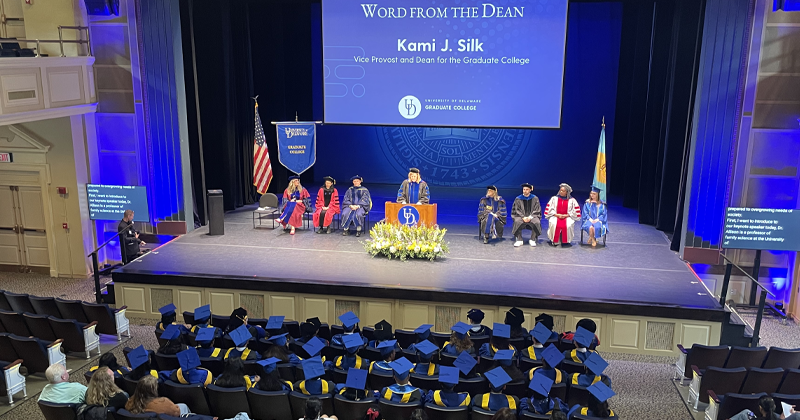
Graduate College Interdisciplinary Convocation celebrates Class of 2026
June 04, 2026 Written by Cori Burcham | Photo by Adam S. Kamras
Before the master’s and doctoral graduates crossed the stage at the University of Delaware’s Graduate College Interdisciplinary Convocation, Allison Karpyn, co-director of UD’s Center for Research in Education and Social Policy and professor of human development and family sciences, acknowledged the invisible steps toward this achievement.
“The graduates did not get here alone, and you know it,” said Karpyn, speaking directly to the graduates’ supportive friends and family in the audience. “To the people who listened to them rehearse the same talk 15 times, who picked up the phone at midnight, handled the dog, baby or made dinner when it wasn’t your turn, and to those who said, ‘You can do this’ when you were not sure that you could — thank you. We could not do this work without you.”
Karpyn’s remarks underscored a core principle of interdisciplinary research: that progress depends on the collective efforts of a team. The students honored at the convocation ceremony on May 21 at Mitchell Hall learned that lesson firsthand, having trained across disciplines, partnered with faculty from different departments and colleges, and approached world challenges collaboratively.
During her welcome remarks, Kami Silk, vice provost and dean for the Graduate College and Edward F. and Elizabeth Goodman Rosenberg Professor, highlighted the value of interdisciplinary work through her experience with the Breast Cancer and the Environment Research Program (BCERP), a transdisciplinary program that brought together a wide range of researchers to study how environmental exposures influence breast cancer.
“The transdisciplinary naming of the BCERP indicated to us all that we were in a different kind of space where science was not only accelerated and shared because of our collaboration, but the types of questions we could ask and attempt to answer were novel because of the expertise around the table,” said Silk.
Similar to the promise in that room, Silk indicated that UD’s seven interdisciplinary graduate degree programs provide a space to discover new, innovative solutions due to the breadth of knowledge and expertise offered by its graduate students. As they leave prepared to enter the professional world, Silk reminded the graduates about the value of their training at UD, emphasizing that a single discipline can’t solve the world’s most pressing problems.
Keynote: Adding “Yes” to Your Vocabulary
Drawing from her own experience, Karpyn encouraged the graduates to say “yes” to opportunities they don’t entirely feel ready for. After earning her doctorate, Karpyn shared a risky move she made early on in her career, exchanging a stable position at a pharmaceutical marketing company for a job at a small nonprofit running farmers markets — a decision that shaped the rest of her career.
“Shortly after I left, the very drugs I had been marketing came under serious scrutiny and were pulled from the market, and at exactly that same moment, the mission of this little organization — getting healthy, affordable fresh food into communities that didn’t have it — was becoming one of the most important conversations in the country,” said Karpyn, whose advocacy on food access and insecurity led her to collaborate with the Obama White House on food policy, improve food in schools, provide public benefits through farmers markets and, ultimately, teach at UD.
The lesson she hoped to impart to the graduates was that the most meaningful accomplishments of her career didn’t arrive as opportunities, but extra work that she was tempted to defer until a point when she had more time and qualifications. While she never regretted saying “no” when it protected her time, family or health, she encouraged the graduates to recognize when the decision was made out of fear or self-doubt; in those instances, she urged them to say “yes” anyway.
“The world you are walking into is quite complicated. The problems you have been trained to think about in education, health, family, policy, science and the human condition are quite real and urgent. They will need the exact kind of careful, curious and courageous thinking that you spent these years here building, and I'm here to say that you are ready, especially if you don't feel it,” said Karpyn.
Candidate Presentations
Microbiology
Opening the presentations from the faculty program directors, Clara Chan, director of the microbiology graduate program and professor of earth sciences, celebrated the third and fourth doctoral students to graduate from the program: Olushola Deborah Awoyemi-Adewumir and Rachel Loughran.
“Both students have achieved the highest levels of scholarship and have also been instrumental in establishing the welcoming, supportive culture that helps define our program,” said Chan, highlighting their contributions to environmental microbiology.
While their research brought them to disparate climates, both doctoral candidates were united in their dedication to furthering research on microorganisms. Awoyemi-Adewumir studied how iron-oxidizing microbes rust the Earth and drive carbon turnover in wetlands, while Loughran researched how cold-loving bacteria contribute to carbon cycling in the soil at Marion Island, Finland and Alaska.
Quantum Science and Engineering
With three new graduates about to enter the quantum computing industry, Matthew Doty, director of the quantum science and engineering program and professor of materials science and engineering, detailed the second quantum revolution that spurred an industry expansion and the formation of UD’s graduate program in 2021.
Following the discovery that quantum mechanics could power computing, communication and sensing devices that outperform conventional technologies, investments in the industry — both from tech juggernauts, like Google and IBM, and smaller startups — began to boom.
“To meet that workforce need, UD launched a new interdisciplinary graduate program in quantum science and engineering, the first program in the country to offer both M.S. and Ph.D. degrees in this emerging field,” said Doty, before introducing the latest master's candidates: Kylee Dean Smith and brothers Michael Manfre and Tyler Manfre. Illustrating the range of career paths, each graduate plans to pursue different segments of the industry, with Smith searching for a position in quantum software, Michael Manfre in quantum hardware and Tyler Manfre in quantum photonics or optical engineering.
Evaluation Science
Sue Giancola, director of the evaluation science program and associate professor in the School of Education, commended graduates Angela Brown and Nadia Thomas on choosing to pursue careers in evaluation science, a discipline that uses data to serve the public. To address the disconnect between politics and policy, evaluation science emerged to provide a neutral, evidence-based assessment on the value of social programs, interventions and policies.
“In our current climate, it is increasingly important that we base decisions about programs and policies on evidence. It is imperative that we systematically assess the efficiency and effectiveness of programs that serve people — and work with program interest holders to utilize data to foster continuous improvement — so programs, the individuals who are served by them and those who invest in them can be confident of their value,” said Giancola.
As evaluators, Brown and Thomas may use their training at UD to inform decision-making within the public, nonprofit or for-profit sectors, joining the network of past graduates and certificate holders.
Data Science
Before presenting this year’s master’s candidates, Timothy Webb, director of the data science program and associate professor of hospitality business management, acknowledged the power of data science in the digital age and the impact graduates can make within the field. Combining the disciplines of mathematics, statistics, programming and domain expertise, data science transforms the abundance of raw data available today into valuable insights across industries.
“It is helping doctors catch diseases earlier, enabling businesses to develop smarter strategies and giving policymakers the evidence they need to act with confidence. In a world overflowing with information, data science serves as the bridge between data and discovery, empowering us to not only understand the present but also to proactively shape the future,” said Webb.
Since it launched in 2018, the data science program has established a growing community of graduates who are helping to shape the future through rational decision-making at companies such as Paramount, Nebula Cybersecurity, JPMorgan Chase and Bank of America.
While 32 graduates were added to that community this year, Pinki Mondal, program associate director, recognized the master’s candidates in attendance, including Daniyar Abykhanov, Tejaswi Adivishnu, Urvesh Bhagat, Vinit Raju Dekkapati, Vamsi Kiran Dimmiti, Gayathri Emuru, Jahnavi Gangishetti, Harshal Laxman Gawas, Ayush Jagani, Brahmendra Jayaraju, Satyavaraprasad Kola, Venkata Bharath Chakravarthi Kudumula, Vasavi Prasanna Kurapati, Pavani Madellabanda, Shardul Ulhas Mehetar, Nivas Panidapu, Akshita Raveendranath Potdar, Senthurapandi Rajendran, Anirudh Raghavendra Rao, Teja Sanagala, Aakarsh Singh, Lakshmi Sudini, Nihaal Surpani, Suma Tata, Abhinav Reddy Terupally, Reshmitha Uppala, Sharath Sen Reddy Vellanki, Keerthi Vemulapally and Kavyasri Vupputuri.
Dean Silk concluded the ceremony by congratulating the graduates on their achievement. “We hope you will apply the wisdom you have gained during your time at UD to address the big challenges of our world. We are counting on you to lead our community, nation and world to a brighter future,” said Silk, wishing the graduates continued success beyond UD.


