



Category: Earth, Ocean and Environment
Creating a Geography for Now
February 02, 2026 Written by Adam Thomas | Photo by Kathy F. Atikinson
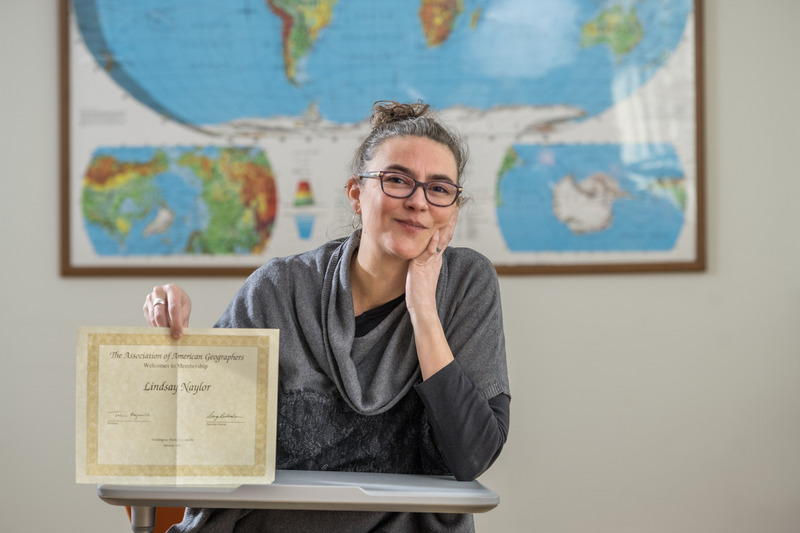
At the height of the COVID-19 pandemic in 2020, University of Delaware professor Lindsay Naylor realized she wanted to write a book that would challenge the status quo in geography and academia at large.
While writing her book, All Geographers Should Be Feminist Geographers: Creating Care-Full Academic Spaces, inspired by work by geographers at the margins, Naylor realized she was tired of hearing the phrase “A change is coming” in academia.
“When you walk around your department, and you feel like you're the only one, and people keep saying, ‘You're helping be part of the change.’ It can feel a bit hollow because if the change is always coming, then when is it ever realized?” said Naylor, associate professor in the Department of Geography and Spatial Sciences. “I want to create a geography for now.”
In her book, Naylor says that professors are currently evaluated predominantly on research and teaching, which leaves out many aspects, such as mentoring and the academic labor involved in service and care.
“I wrote about the Academy more generally, but, really, it's a love letter to geography and an invitation for geographers to be better and more attentive through care and through mentoring,” said Naylor. “It’s also a call to resist the grind of academic culture of produce, produce, produce.”
Care is a critical part of everyday life, but it has remained on the margins in academia. Naylor argues that if caring practices could be instilled in everyday academic life, academics might be able to address some of the more pervasive problems—for example, the treatment of staff, how promotions are prioritized, or the way graduate students are paid—within the university.
Geography, specifically, is positioned to tackle these problems because it is all about valuing differences across space.
“Geography is an interdisciplinary space, and I am suggesting that if we all had some training—like my physical geography colleagues, my geographic information systems (GIS) colleagues—in feminist geography or feminist thinking, we could create these caring spaces across our discipline,” said Naylor. “I think geography is well placed to do this because we study difference and we try to understand and explain difference.”
With regard to taking a feminist approach to geography, Naylor said that, for her, feminism is about creating equity.
“There are a lot of folks who equate feminism with this idea of only studying gender or only being interested in women's rights,” said Naylor. “That's true for a lot of people, but for me, it is more expansive than just an understanding of gender. I think of it as how can we value people across the board.”
Naylor points to a bumper sticker she has in her office that reads: feminism is the radical notion that women are people.
“I kind of expand on that to say, ‘feminism is the radical notion that people are people,’” said Naylor. “So how do we then create spaces in which we value difference?”
As for her hopes for the book, Naylor said, just because it focuses on geography doesn’t mean people from other fields in academia can’t benefit from it.
“It's a very conversational book, and in my wildest dreams, I hope that people will take it seriously and that it won't just be me writing to my bubble,” said Naylor. “I am writing about geography, but you could just as easily slot marine science in there. Anyone at the college, or anyone who's been in the academy, would find this book helpful. It’s a book about creating a careful academy, and anybody could find something useful to implement in their classroom, in their writing practice, in their lab spaces, in their field work, or in their approach to mentoring.”