



Category: Earth, Ocean and Environment
Capturing the Beauty and Survival of Cultures
February 25, 2026 Written by Adam Thomas
Upon first glance, Isle de Jean Charles, Louisiana, and Shishmaref, Alaska, have little in common. One is a narrow ridge of land in the warm southern bayou near the Gulf of Mexico, while the other is in one of the coldest regions of the United States north of the Bering Strait, five miles from the mainland of Alaska. But while these two areas lack geographic similarity, they make up for it in how their communities are affected by climate change and how resilient those communities have been in the face of a changing landscape.
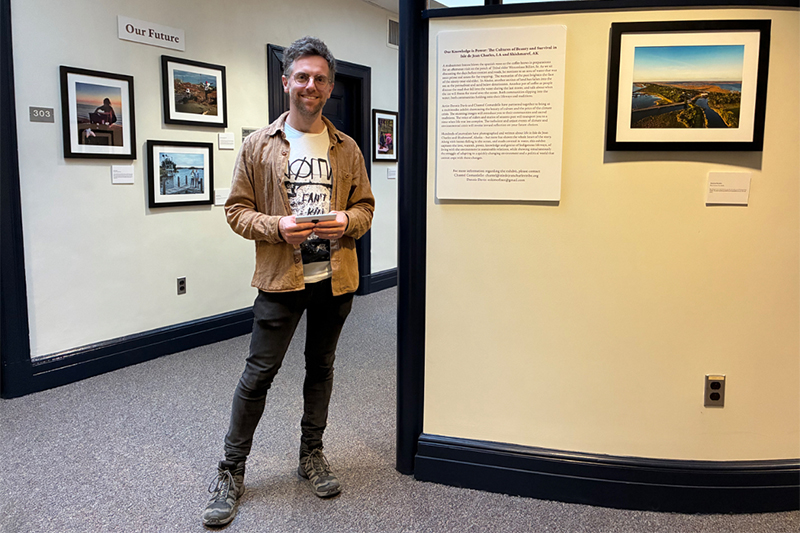
A community-curated exhibition of more than 50 photographs on display in the third floor of Robinson Hall, titled “Our Knowledge is Power: The Cultures of Beauty and Survival in Isle de Jean Charles, LA and Shishmaref, AK,” takes visitors on an intimate journey into the experiences, struggles, and enduring strength of these two coastal communities dealing with social and environmental change.
The exhibit was produced by Chantel Comardelle, a Jean Charles Choctow Nation curator, and Dennis Davis, an Inupiat photographer and videographer, in collaboration with several academic partners and funded by NSF Grant #1921045: Adaptations to Repetitive Flooding: Understanding Cross-Cultural and Legal Possibilities for Long-Term Solutions to Flooding Disaster.
It was brought to the University of Delaware by Nathan Jessee, an assistant professor in the School of Marine Science and Policy and was installed by Jessee and several of his students and UD Climate Scholars. This is the fifth stop for the traveling photography exhibit, which will be on display in Robinson Hall from Feb. 2 to May 14, 2026 and Jessee is coordinating class visits, student-led programming, and guest speakers to create a space of learning within and beyond the classroom about the photos and the scientific contexts of the experiences reflected in them.
For example, under Jessee’s mentorship, 2026 NASA Space Grant Winter Intern and Earth Science Major, Keira Larsen, will soon be installing a supplementary exhibit of four data visualizations she created about sea ice melt, extreme weather, and coastal land loss in the two locations.
Additionally, Jessee’s MAST 367: Coastal Environmental Justice students, Climate Scholars, and UD’s Aquatic Project student organization will all be creating additional materials for the space related to traditional ecological knowledge, marine biology, and climate.
Jessee said it was important to bring the exhibit to UD because it offers opportunities for students studying environmental sciences to learn about the coastal geophysical, climatic, and policy processes they study in the classroom from the perspectives of people who experience those processes firsthand in their daily lives.
“These types of interdisciplinary and community-engaged learning experiences are really valuable for students and enhance their conceptual learning in the classroom,” said Jessee, who has conducted anthropological research alongside Jean Charles Choctaw Nation leaders for over a decade, and is writing a book about the tribal community’s resettlement and their struggle for cultural survival on a changing coast. Jessee also has three photos in the exhibit.
“These opportunities can be useful pedagogically as well as socially,” said Jessee. “They produce more civically minded students who may go on to work in environmental sciences or policy, and so they should be supported in cultivating skills like listening to the perspectives of communities whose lived expertise is often objectified and marginalized within these institutions.”
According to Jessee, media outlets also tend to produce stories that foreground the two communities’ vulnerability to climate change. What Davis and Comardelle’s hard work in the exhibit shows, however, are possibilities that spring from the communities facing these challenges most immediately.
“This exhibit was created and curated by two community members pushing back on narratives of inevitable decline,” said Jessee. “The photos instead highlight the power and the beauty of their traditional cultures and community, the intergenerational knowledge and ecological and familial relations that have long sustained life in these locations, which they are also determined to sustain into the future.”
The photos document a wide range of communal experiences and present the histories of the two communities, their leadership structures, how they obtain food, and the nature of their housing.
While not solely focused on the climate change challenges the two communities face, there is documentation of the broader challenges they face regarding the natural world.
In Louisiana, a century and a half of development has intensified the erosion and sinking of more than 2,000 square miles of coastal wetlands—an area roughly the size of Delaware. The levee system and hydromodification throughout the Mississippi River Delta have kept soil from replenishing the region, and as a result, the land sinks while sea levels rise. On top of that, thousands of miles of pipeline and shipping canals that carve up the area further worsen the erosion.
In addition, both areas have been affected by the oil and gas extractive industries, which have accelerated land subsidence, or sinking, and weakened their natural defenses. In Shishmaref, for example, polar amplification of global warming leads to less sea ice and permafrost melt. With less sea ice and more frequent, larger storms, coastal erosion has been affecting the island.
“While we didn’t want to frame their lives only in terms of the disasters they face, we can't ignore those challenges either,” said Jessee. “In these two places, like elsewhere, environmental change is not abstract. It is the coastal erosion eating away at their home, thinning sea ice, sinking land, extreme storms, changing habitats, and the underlying pollution and extraction that disrupts their subsistence lifeways. The photographs bear witness to these processes as they unfold in everyday life. They also look forward, tracing how each community imagines its future especially through children and kinship ties, through the intergenerational teaching that continues their way of life.”
The exhibit is on display and open to the public throughout the spring semester. Marine Science students, UD Climate Scholars, and the Aquatic Project student organization will be putting together supplemental material and coordinating events in the space during this time.
Co-sponsors include the College of Earth, Ocean and Environment, School of Marine Science and Policy, UD Library, Museums and Press, Center for Environmental Humanities, Gerard J. Mangone Climate Change Science and Policy Hub, Delaware Environmental Institute, Department of Anthropology, Department of Art History, Department of English, Department of Geography and Spatial Sciences, Disaster Research Center, Faculty Senate Committee on Cultural Activities and Public Events, Center for Research in Education and Social Policy, Ocean and Society Initiative, and the Joseph R. Biden Jr. School of Public Policy and Administration.
An artist talk and film screening will take place on Friday, April 24, from 5-7 p.m. in the Trabant University Center Theater, where both Comardelle and Davis will discuss their experiences documenting and curating the exhibit.