



Category: Water Science and Policy
Nudging Toward Sustainability
January 13, 2026 Written by Lisa Walenceus | Cindy Dolan
Water science and policy research on energy defaults and campus policy
Sustainable choices, even on a small scale, add up to a large environmental impact. Rather than relying solely on regulation or financial incentives, behavioral nudges — such as setting eco-friendly defaults — offer a low-cost, freedom-preserving way to promote sustainability. Research shows that "green defaults" can meaningfully influence behavior, leading to increased renewable energy adoption, carbon offsets and lower paper use.
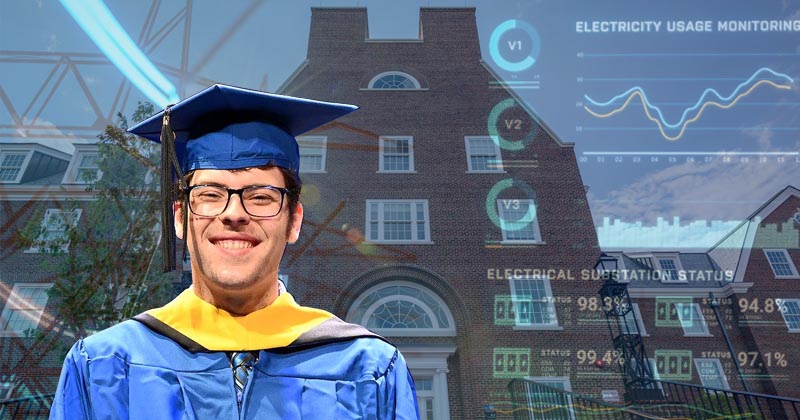
Carl Nelson-Poteet, a recent graduate of the University of Delaware’s interdisciplinary water science and policy program, explored this concept through a practical lens. Under the mentorship of Leah Palm-Forster in the Department of Applied Economics and Statistics, Nelson-Poteet conducted a field experiment for his master’s thesis titled “Nudgeable, to a Degree: An Experimental Examination of Temperature Defaults in University Residence Halls.”
His study, which involved 566 dorm rooms across five residence halls at UD, investigated how subtle changes in thermostat default settings could reduce energy consumption. The results revealed that default effects are shaped by psychological factors such as ease of switching, perceived endorsement and user inattention.
“Carl is passionate about campus sustainability, and he wanted to pursue graduate research that would make a real impact at UD and beyond. The water science and policy program provided him with foundational knowledge and skills while offering the flexibility he needed to pursue his passion project,” said Palm-Forster.
The project’s success was made possible through collaboration with UD’s Residence Hall Energy Study Implementation Team, which earned a UD Distinguished Team Staff Excellence Award for its efforts. Brian Kelley, building systems tech team leader, and Joe Collins, facilities engineer for sustainable energy and engineering, worked closely with Nelson-Poteet to implement the study’s recommendations.
Their work included securing approvals, developing an innovative energy-use equation and remotely adjusting thermostat settings in nearly 600 residence hall rooms during peak months. This hands-on effort resulted in a 36% energy reduction, improving UD’s sustainability metrics and demonstrating the potential for significant carbon emission reductions if scaled.
By showing how small design changes can lead to measurable resource savings, Nelson-Poteet’s work contributes to a broader understanding of how behavioral economics can support sustainable infrastructure and policy development. Adjusting temperature defaults not only reduces energy demand but also supports water conservation efforts by lowering the energy sector’s reliance on water-intensive processes.
“What excites me most is how scalable these interventions are. If we can apply them across campuses or municipalities, the cumulative impact could be substantial,” Nelson-Poteet said.
The water science and policy program at UD, established in 2014, is the University’s oldest interdisciplinary graduate program hosted by the Graduate College. It offers students the flexibility to design their own curriculum in collaboration with faculty, drawing from the full range of academic departments across the University. The program emphasizes a multidimensional approach to understanding water as a foundational element of both the environment and the economy.
“The interdisciplinary nature of the program allowed me to combine economics, environmental science and behavioral psychology in a way that felt both rigorous and relevant,” Nelson-Poteet said.
Gerald McAdams Kauffman, interim director of the water science and policy program, noted during the 2025 graduation convocation where Nelson-Poteet received his diploma:
“Our graduates are doing good things for society — working on projects in Delaware County, Pennsylvania, climate science in Spain, drought in California and water treatment in Wilmington — and it doesn’t take long before they become our next generation of leaders. That is reassuring to me in today’s world.”
Nelson-Poteet’s research stands as a testament to the power of interdisciplinary education and the potential of behavioral science to drive meaningful change in sustainability policy.


