



Category: Travel Award Spotlights
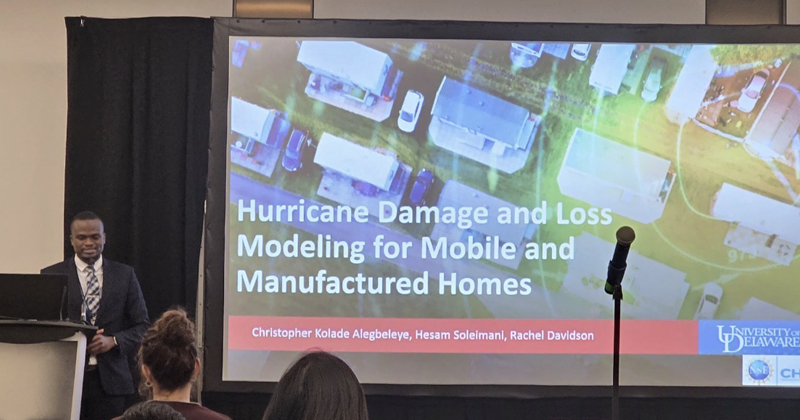
Christopher Kolade Alegbeleye attends 2025 Society for Risk Analysis (SRA) Annual Meeting
January 02, 2026 Written by Christopher Kolade Alegbeleye
Washington, DC
PROGRAM: Ph.D., Civil, Construction and Environmental Engineering
Attending the 2025 Society for Risk Analysis (SRA) Annual Meeting in Washington, D.C. was a rewarding experience for me as a graduate researcher at the University of Delaware. I had the opportunity to give an oral presentation on my research, which focused on hurricane damage and loss risk modeling for manufactured housing, with an emphasis on probabilistic, data-driven approaches to understanding vulnerability and risk in hurricane-prone communities.
In addition to presenting my work, I was honored to receive the SRA Student Merit Travel Award, which helped support my participation in the conference following the submission and selection of my abstract, “Hurricane Damage and Loss Modeling for Manufactured Housing,” for a technical presentation session. Receiving this award was a proud moment and affirmed the relevance of my work within the broader risk analysis community.
My research highlights the importance of incorporating the unique vulnerability of mobile and manufactured homes into disaster risk assessment, mitigation planning, and resilience strategies. Conducted as part of the NSF-funded Coastal Hazards, Economic Prosperity, and Resilience (CHEER) Hub, this policy-oriented work aims to support the development of frameworks that can guide policymakers and practitioners in integrating housing vulnerability into risk-informed decision-making, resilience planning, and long-term community prosperity.
The conference brought together a highly interdisciplinary community of researchers, practitioners, and policymakers spanning fields such as risk analysis, decision science, public health, engineering, economics, environmental science, and policy. I greatly valued the opportunity to exchange ideas, receive feedback on my research, and engage with professionals across this broad spectrum, gaining perspectives that extend well beyond any single discipline.
I am grateful to Dr. Rachel Davidson, the CHEER Hub, the Society for Risk Analysis, and the University of Delaware Graduate College for supporting my participation. Overall, this experience was an important learning opportunity that reinforced the value of interdisciplinary collaboration in advancing risk science and improving decision-making for complex societal challenges.


