



Category: Interdisciplinary Neuroscience
Pre-College Neuroscience Program Transforms Interest into Application
October 08, 2026 Article by Cori Burcham | Photo by PCS Staff
The road to becoming a neuroscience researcher doesn’t always begin with years of study and specialization; it can start before college through access and information that opens the field as a potential career path. Sixteen high school students were introduced to that pathway during the sold-out, weeklong Neuroscience Pre-College Summer Program at the University of Delaware, learning about the brain from faculty and students in the Graduate College’s interdisciplinary neuroscience graduate program.
“High school is not too early to introduce kids to neuroscience in schools and camp. Kids are motivated and able to digest complex topics and then work with them to form their own ideas,” said Emily Dean, a student in the interdisciplinary neuroscience graduate program and an instructor for the new pre-college program.
Philip Gable, director of the interdisciplinary neuroscience graduate program at UD, noted that the pre-college program grew from a collaboration across multiple UD units. Over two years, Gable worked with the Division of Professional and Continuing Studies to explore the program’s market feasibility and with the Center for Biomedical and Brain Imaging to use its facilities for the camp. Along with faculty-led workshops, a core principle of the program was to have graduate students serve as mentors, modeling how to translate an interest in neuroscience into active research.
“That shared experience creates a level of relatable guidance that standard faculty mentoring often can't replicate, making a career in science feel tangible and achievable for the campers. The high school students gain approachable role models who can candidly demystify the academic journey, while the graduate students build essential mentorship skills and reconnect with the early curiosity that brought them to neuroscience in the first place,” said Gable.
Contributing to the neurophysiology instruction led by Amy Griffin, associate professor of psychological and brain sciences, Dean designed and delivered an experiential activity on synaptic integration — when neurons combine incoming signals from other neurons to determine whether to fire an electrical signal. To model this balance, Dean divided the students into two teams representing excitatory and inhibitory neurons for a water relay activity. Students on the excitatory team transferred water using syringes from the “input neuron” beaker to an empty “output neuron” beaker, attempting to reach threshold and fire a signal, while the inhibitory team transferred the water back. The discussion after the activity showed Dean how deeply the students were learning.
“One student asked, ‘Is this related to epilepsy? They have too much excitation and not enough inhibition?’ I was immediately impressed and told her, ‘Yes, that’s exactly right.’ This moment stuck with me because she took a lesson on activity and applied it to something we weren’t close to discussing,” said Dean, noting the student’s excitement at making the connection was her favorite moment of the camp.
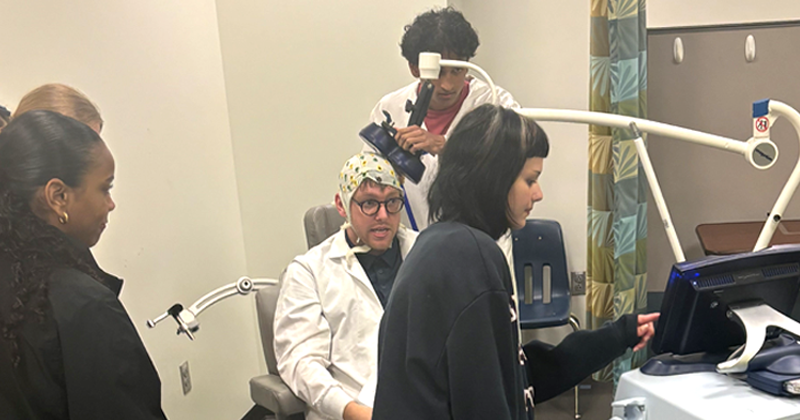
Graduate student Grace Gervino helped lead demonstrations of different neuroscience research methods, such as MRI, EEG and the noninvasive brain stimulation technique transcranial alternating current stimulation. Gervino’s contributions supported an important mission of the camp: to give students the hands-on experience of applying the research techniques. Her favorite part of being a mentor was seeing the students’ genuine excitement for neuroscience, sharing their interest in certain areas of research and ideas for experiments. Since many college students don’t get to implement these techniques until graduate school, Gervino noted this experience unlocked an intimidating aspect of the field and the students’ potential role within it.
“Several said they were interested in psychology or neuroscience but were uncertain because they didn’t see themselves becoming clinicians. I told them I had felt similarly in college and had also not initially realized research could be a career. It was rewarding to show them that these majors can lead to many paths beyond clinical work,” said Gervino.
Whether they were leading activities or assistant teaching, Gervino and Dean both noted the program helped prepare them to become mentors. In addition to a mastery of the equipment, Gervino’s experiences in the lab working with participants of different ages and educational backgrounds gave her practice explaining her research in a way that's accessible to beginners. Beyond academics, Dean has learned from the overall culture of the graduate program.
“At its core, the interdisciplinary neuroscience graduate program and community is supportive; it doesn’t feed competition or isolation. These are traits of a scientific community that we want to pass on to the next generation of scientists, and it allowed me to teach the students in honest and productive ways,” said Dean.
Attending a similar program when she was in high school, graduate student Boshang Yin is proof of the impact pre-college summer programs can have on young students. She credits her experience participating in the Harvard Summit for Young Leaders in China (HSYLC) for guiding her toward her current career.
“I had very little exposure to neuroscience in my high school, so learning about the exciting ongoing research on the human brain at the summer camp inspired me to pursue cognitive science and psychology in college,” said Yin, who jumped at the chance to return the favor.
“Now that I’m on the mentor side, I hope I’ve nurtured the students’ passion for science the same way my mentors once did for me,” said Yin. She plans to join the camp committee alongside other graduate students to help develop next year’s program, which is expanding into two weeklong sessions to accommodate demand and reach more interested students.


