



Category: Fashion and Apparel Studies
From Waste to Value: A Decade of Circular Innovation
May 12, 2026 Written by Natasha Kapadia | Photos by Kathy Atkinson
How the UD x Goodwill partnership is redefining sustainable textiles through research, patents and student-led design
For over a decade, the collaboration between the University of Delaware and Goodwill of Delaware and Delaware County has served as a premier model for community-engaged scholarship. Facilitated by faculty in the Department of Fashion and Apparel Studies, including Professor Kelly Cobb and department Chair Huantian Cao, this partnership operates as a “living laboratory” where academic research explores innovative ways to extend the useful life of textiles and advance more sustainable systems for clothing reuse and recovery.
Throughout that time, UD and Goodwill have developed a replicable framework for material stewardship, securing more than $30,000 for student sustainability internships and supporting student and faculty research recognized in national juried design exhibitions.
By focusing on circular economy principles, the team has launched over eight distinct initiatives centered on reimagining post-consumer clothing and creating new opportunities for reuse, repair and material innovation. This work has been bolstered by significant external support, including a $745,000 National Science Foundation (NSF) grant for the ReSpool project led by Cobb, Cao and Professor Kedron Thomas of the Department of Anthropology, bringing the total collaborative funding to over $900,000.
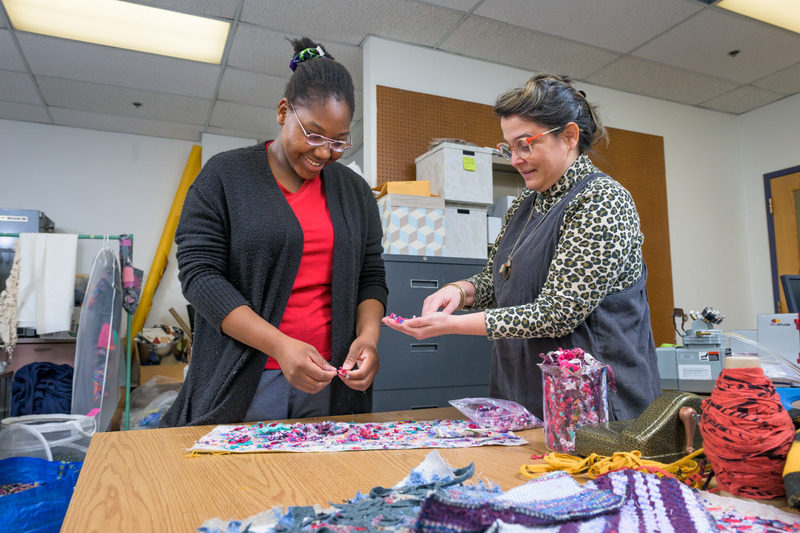
A cornerstone of this partnership is “problem-based learning,” where students engage directly with the scale and complexity of textile recovery and reuse through hands-on work with Goodwill’s warehouse operations. Cao emphasized that this access is vital for moving students beyond the classroom:
“In our textile lab, typically, we work with a swatch of the fabric that is 12 inches by 12 inches or smaller,” Cao highlighted. “But at Goodwill, we are talking about tons of those textiles. How to make our ideas work in a real-world situation is an eye-opening experience for both the students and me."
This hands-on exposure was formalized through a USDA grant between 2016 and 2019, which led to the revision of several fashion courses to incorporate sustainability learning components and the creation of a Sustainable Textile and Product Innovation minor. Students have since engaged in a range of activities, from operating on-site pop-up production labs in retail stores to conducting large-scale textile sorting and characterization studies that support more effective reuse and recycling pathways.
In 2025 alone, more than 80 students participated in a study examining the composition of unsold donated clothing to help inform future systems for textile recovery and circular design. Students also used recovered textiles from Goodwill to create fashion products exhibited in the UD Synergy Fashion Show, the International Textile and Apparel Association (ITAA) conference and the Goodwill ReThink Fashion Show.
The research output of this collaboration has led to significant scientific and creative breakthroughs, particularly in the areas of textile circularity, reuse-centered design and innovative material applications.

Ultimately, the partnership prioritizes student impact and the “ethical transformation” of the fashion system. Cobb said the evolution of these practices starts with changing how the next generation is trained.
“The evolution of sustainable practices in the apparel business starts with the proper education of young designers and merchandisers,” she said. “By educating our community on the negative effects the fashion industry has and offering better options and new scenarios, we hope that our shop will inspire a change in the way that people buy, make, use and celebrate clothing."
Goodwill recently recognized the partnership by naming ReSpool and the fashion department Community Partner of the Year. The honor underscores a shared commitment to continuing this work and expanding innovative solutions in sustainability and community engagement.
This article is part of the Fashion Foundations newsletter.


