



Molly C. Sutherland
Education
- B.S. – University of Maryland, College Park
- Ph.D. – Washington University in St. Louis
- Postdoctoral – Washington University in St. Louis
Teaching
- BISC300: Introduction to Microbiology
- BISC485/685: Microbial Genetics
Research Interests
Cytochromes c are highly conserved proteins found in humans, other eukaryotes, plants, bacteria and Archaea. Their diverse functions and roles in electron transport chains for respiration and photosynthesis are well studied. However, their biogenesis is less well understood, representing a fundamental biological question and the focus of our research. Cytochrome c biogenesis requires covalent heme attachment via two thioether bonds between the heme vinyls and cysteine thiols at a conserved CXXCH motif (Fig. 1). The requirement for heme attachment makes cytochromes c unique among the cytochromes and is generally agreed to provide high stability and unique properties. Despite their diverse functions and roles in the cell, all cytochromes c are biosynthesized by one of three pathways, termed System I (α, γ Proteobacteria; plant and protozoal mitochondria; Archaea; Fig. 2A), System II (Gram +; cyanobacteria; chloroplasts; ε Proteobacteria; Fig. 2B) and System III (eukaryotic mitochondria, composed of a single enzyme called HCCS). The Sutherland lab focuses on the molecular mechanisms of heme trafficking and attachment in Systems I and II.
Current Projects
Utilizing a recombinant E. coli system for Systems I and II, these integral membrane proteins are affinity tagged, purify with endogenous heme and are functional, allowing for biochemical and genetic studies of these pathways. The Sutherland Lab focuses on the following fundamental questions:
- How is heme trafficked by these pathways?
- Can heme binding domains be identified?
- What are the requirements for heme attachment to the cytochrome c CXXCH motif?
Research Group
- Nikita Varde, PhD Candidate in Biological Sciences
- Allison Mattern, PhD Candidate in Biological Sciences, CBI Fellow
- Raymond Tsao, PhD Candidate in Microbiology
- Raisa Sumaiya, PhD Candidate in Biological Sciences, CBI Fellow
- Susan Carroll, RA
- Evelyn McQuaid, undergraduate, NSF REU Fellow
- Tim Heppard, undergraduate
-
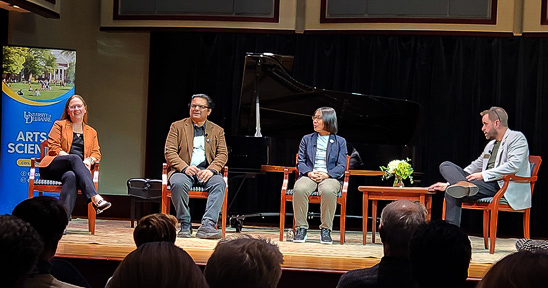
Darwin’s Ideas Continue Driving Discovery
February 24, 2026 | Written by Natasha KapadiaUD faculty showcase evolution’s impact across neuroscience, genetics and microbiology -
UD Biological Sciences Faculty Secure Millions in New Research Funding
February 17, 2026 | Written by Department of Biological SciencesNew research funding to benefit human health, from heart health to pain perception. -
Predicting the Scientific Future
January 28, 2026 | Written by Hilary DouwesJoin the University of Delaware's College of Arts and Sciences for International Darwin Day on Feb. 12 to explore how evolution research shapes our world.


