



Category: Biological Sciences
Darwin’s Ideas Continue Driving Discovery
February 24, 2026 Written by Natasha Kapadia | Photos by Christy Mannering
UD faculty showcase evolution’s impact across neuroscience, genetics and microbiology
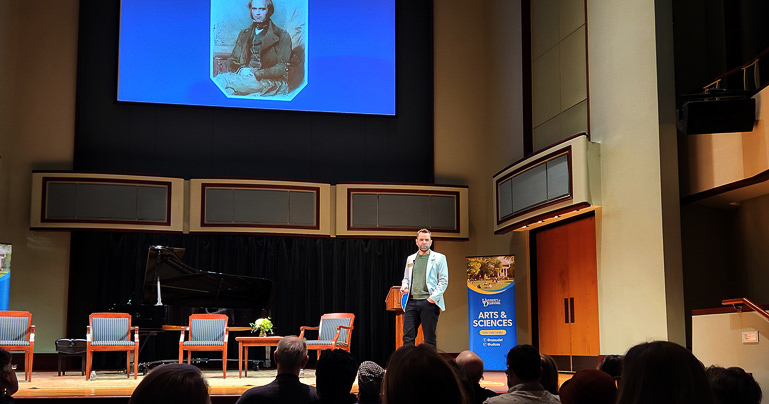
The University of Delaware marked International Darwin Day on Feb. 12 at the Roselle Center for the Arts, bringing faculty from the College of Arts and Sciences together to explore how Charles Darwin’s ideas continue to shape modern scientific research. The event featured a keynote address by Dean Caleb Everett and three faculty flash talks highlighting evolution’s impact across disciplines.
Darwin was a 19th-century English naturalist who developed the theory of evolution by natural selection, fundamentally changing how scientists understand the origins and diversity of life.
In his keynote, “Darwin and Our Understanding of Humanity,” Everett discussed how humans are still evolving today, shaped by both biological and cultural environments.
“His ideas continue to inform not just our understanding of how species evolve but our understanding of how languages evolve,” Everett, who is a professor of anthropology and linguistics and cognitive science, said. Everett shared his research into how humans form the sounds of various languages.
“The sounds that we use across languages are not random,” Everett explained. “They are influenced by the structure of the human vocal tract and by environmental pressures that make some sounds easier to produce and hear than others.” Drawing on cross-linguistic data and physiological evidence, he showed how patterns in global languages reflect constraints of the human body itself.
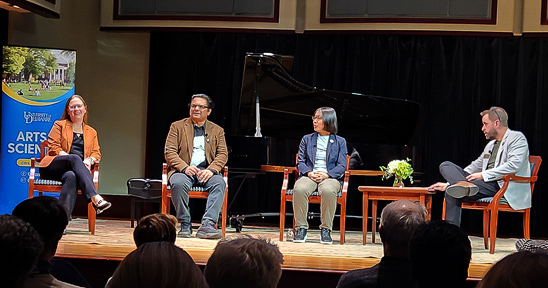
The program continued with three short research presentations from faculty in the Department of Biological Sciences. Neuroscientist Lisha Shao explained how her work with fruit flies can explain how brains assign value to sensory information, such as taste, and how that value is the beginning of the reward system.
“A small brain can reveal big principles,” Shao said. She emphasized that despite their simplicity, fruit flies share fundamental neural strategies with more complex organisms. “By studying brains large and small, we can uncover the shared logic of how the nervous system decides what matters.”
Biologist Salil Lachke followed with research on the genetics of eye development. Using the iSIGHT database, his lab compares lens development across species to identify genes linked to cataracts.
“If Darwin walked in here right now, he would say, ‘Forget about everything else. What have we learned about the eye?’” Lachke, the Alumni Distinguished Professor of Biology, said. He described his presentation as an “elevator pitch” on modern discoveries. Advances in genomics, he explained, now allow scientists to trace how specific genes control lens development across species.
The final talk, delivered by microbiologist Molly Sutherland, focused on the long evolutionary history of essential proteins in bacteria. She described evolution as a process shaped by chance, adaptation and changing environments.
“Evolution isn’t a straight line,” Sutherland said. “Systems often develop for one purpose and then get repurposed to do something entirely different.” She pointed to antibiotic resistance as a modern example of evolution in action, as bacteria continually adapt to survive new medical treatments.
The University of Delaware’s College of Arts and Sciences has participated in International Darwin Day for more than a decade, hosting speakers from a variety of academic disciplines who have attracted a diverse audience from campus and the community.


