


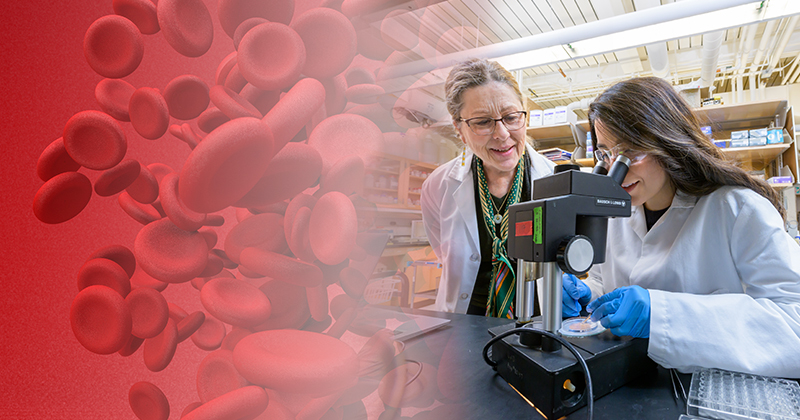
Architecture of cells

Why Biological Sciences at UD?
Why Biological Sciences at UD?
Our faculty and students engage in collaborative interdisciplinary research with chemists, data scientists, engineers, physicists, translational medical research with physician scientists, and initiatives with educators in Delaware, nationally and globally. Faculty research programs are well-funded (over ~$5M annually) by the National Institutes of Health, the National Science Foundation, private foundations and industry partners, and are supported by state-of-the-art UD facilities which include the BioImaging Center, Flow Cytometry/FACS, Sequencing and Genotyping, Proteomics and Mass Spectrometry, Bioinformatics and Computational Biology, Brain and Biomedical Imaging, and Musculoskeletal Multiscale Research Assessments.
Funding
In the latest Higher Education Research and Development (HERD) Survey released by the National Science Foundation, UD ranks 46th out of 670 academic institutions across the United States when comparing non-medical school R&D expenditures. Also, the University is now 77th out of 923 academic institutions in total research spending, and 52nd among public universities. The survey covered the 2024 academic fiscal year.
Location
The Department of Biological Sciences offers a unique combination of state-of-the-art research facilities in a safe and very attractive campus. The University of Delaware, which originated as a private academy in 1743, is located in one of the world's most dynamic scientific corridors. Many major research centers in academic, industrial and federal laboratories are within a 90-minute drive in Philadelphia (44 miles), Baltimore (59 miles) and Washington, D.C./Bethesda (100 miles). New York lies only 133 miles from the Newark, DE campus. A large biotechnology community, including DuPont, Hercules, Siemens, and AstraZeneca, also is located in Delaware.
Facilities and Partnerships
The Department of Biological Sciences occupies Wolf Hall and Building X, which are both located on the main campus and have well-equipped laboratories for research and teaching. Extensive core facilities support research efforts and include a modern laboratory animal facility, confocal and super-resolution fluorescence microscopy, electron microscopy, histology, flow cytometry/FACS, DNA sequencing, spatial ‘omics, RNA-seq and high throughput bioinformatics, proteomics, and whole animal imaging. The Nemours Research Foundation at A.I. duPont Hospital for Children and the Center for Translational Cancer Research which is a partnership between the University of Delaware, The Helen F. Graham Cancer Center and A.I. duPont Hospital for Children/Nemours Biomedical Research provide translational research opportunities.
The University of Delaware has made multi-million dollar investments in education and research, including the Interdisciplinary Science Learning Laboratories for undergraduates, and Building X for the Departments of Biological Sciences, Psychological & Brain Sciences, and Physics & Astronomy, providing our students with state-of-the art teaching and research facilities along with a friendly and enthusiastic environment for learning and science. This infrastructure, along with our award-winning, world-class faculty and laboratory staff ensures excellence both in classroom instruction and hands-on investigative laboratory-based instruction.


