



Category: Art Conservation
Art conservation and photographic histories
June 27, 2026 Written by Lisa Chambers | Photos by Evan Krape, Emma Reuther and Michaela Lott
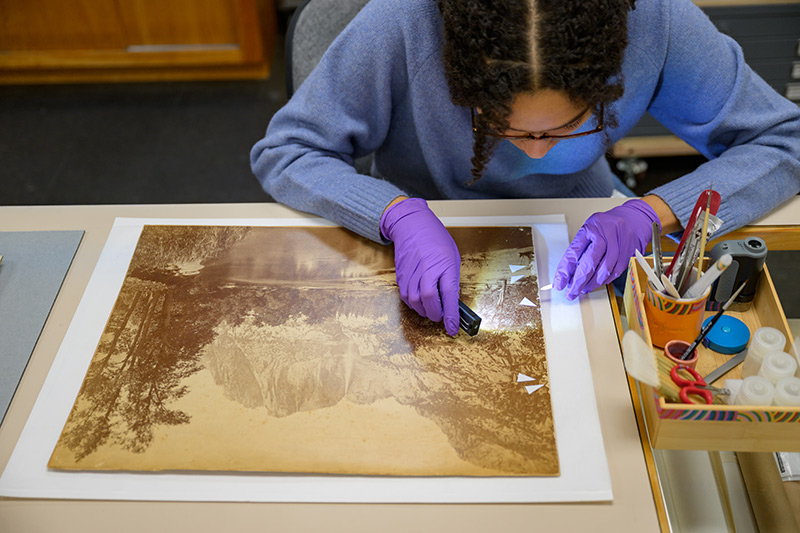
Winterthur/UD Program in Art Conservation fellow Michaela Lott treated a photograph from the Fisk University collection and identified the photographer John Wesley Work Jr. among the faces of Glee Club students preserved in the image.
John Wesley Work Jr. devoted part of his life to preserving African American musical traditions. A singer, folksong collector and professor of music, Latin and history at Fisk University, he helped document songs that might otherwise have been lost. More than a century later, second-year Winterthur/UD Program in Art Conservation (WUDPAC) fellow Michaela Lott helped preserve a photograph of Work and the Fisk Male Glee Club. In college, Michaela developed an interest in photography that led her to conservation and two years as an apprentice in The Metropolitan Museum of Art’s photograph conservation lab, where she worked on the archive of Harlem Renaissance photographer James Van Der Zee. A photograph major with a paper minor, she recently completed treatment of the damaged image of Work, part of a collection loaned to Winterthur by Fisk University. Through her research, she identified the man standing at the center of the second row as Work.
“This photo was creased and torn,” she said. “It needed a lot of work.” Mounted on a black board, it was also missing portions along its edges. The backing had degraded, leaving behind powdery fibers and adhesive residue. Before beginning treatment, Michaela first had to determine whether the image could safely tolerate moisture. “A big part of photograph conservation is identifying the type of photograph it is, because usually that informs what you can do for treatments,” she said.
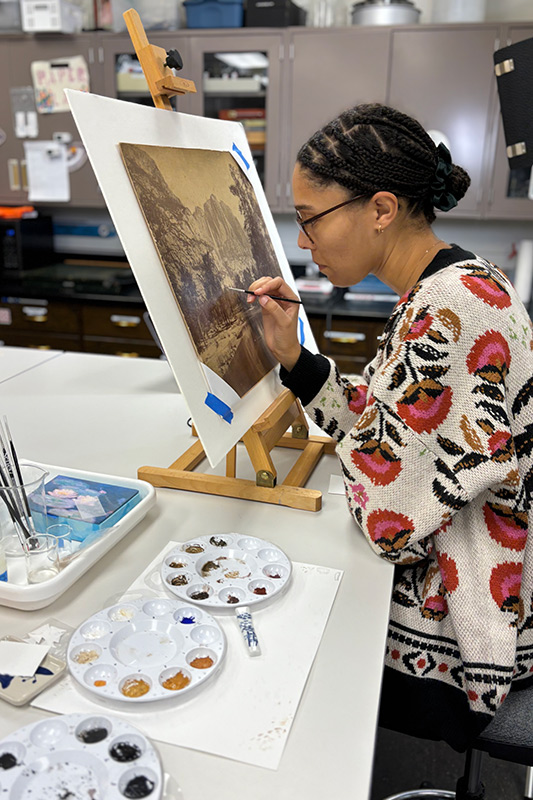
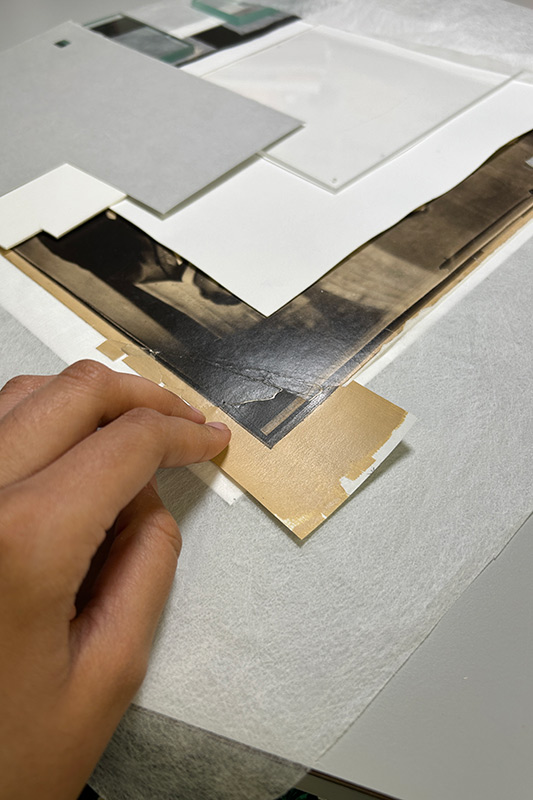
She tested the photograph’s surface with a drop of water and examined it under a microscope and found that “the surface didn’t respond at all,” she said. “Which made me think it might be a collodion photograph.” Unlike gelatin silver photographs, collodion is more stable when exposed to moisture. Michaela carefully separated the photo from its mount with a flat tool, then used water to soften and remove the remaining adhesive from the back, before lining it with Japanese tissue paper for support. “I had never done it before, so I’m really glad it went well,” she said. She then created custom paper fills to replace missing areas, toning them with acrylic paint to blend with the original photograph. The overall goal, she explained, “is to make the damage less distracting, so your focus doesn’t go to it first.” Now stabilized, the photograph is ready to return to Fisk for use by researchers, students and visitors. “I feel very, very grateful to be part of its history,” said Michaela.


