


Category: Art Conservation
Student Blog: Hispanic Society and A.M. Art Conservation
October 12, 2026 Written by Téa Chu Vitale, art conservation major, UD Class of 2029
UD Class of 2029 Téa Chu Vitale, an art conservation major with minors in anthropology and art history, spent her summer honing her skills and working with professional conservators in and around New York City, experiences made possible with support from the Vicki Cassman Undergraduate Award.
This past summer, I had the opportunity to serve as a pre-program intern at the Hispanic Society Museum and Library (HSML), and to return to A.M. Art Conservation, a private studio, with support from the Vicki Cassman Award. These opportunities allowed me to not only improve my skills in a technical capacity, but also to learn from experienced collections care professionals.
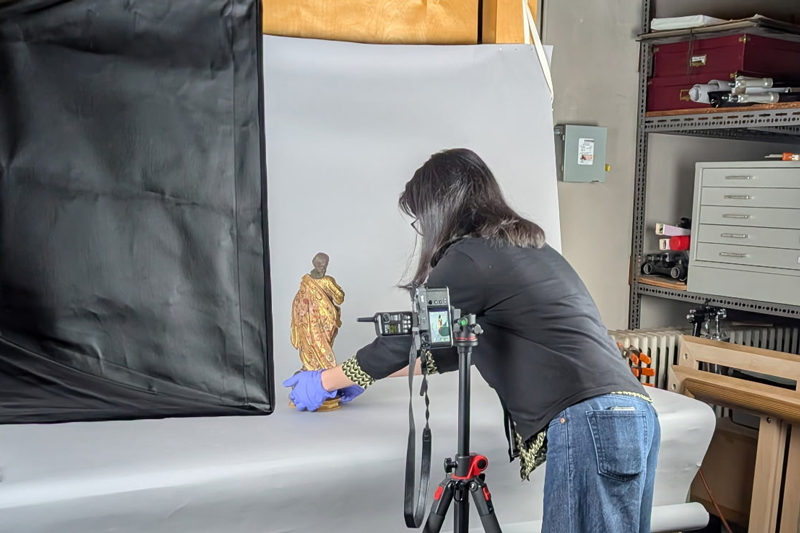
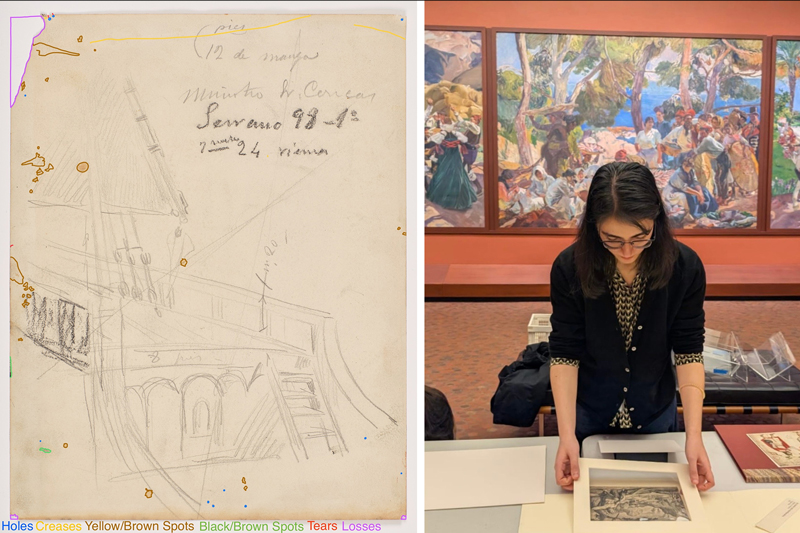
At the Hispanic Society, under the supervision of Hélène Fontoira Marzin, head conservator, and Miriam-Helene Rudd, assistant conservator and alumna of both the WUDPAC program and the undergraduate art conservation program at the University of Delaware, I completed the treatment of a 16th century wooden statuette, condition mapped Joaquín Sorolla sketches for an outgoing loan, and participated in the deinstallation of Sandy Rodriguez’s exhibition Tierra Insurgente. I additionally had the opportunity to learn from IMLS fellows Jordain Williams and Alena Mikhailova, and fellow intern Maria Sanchez.
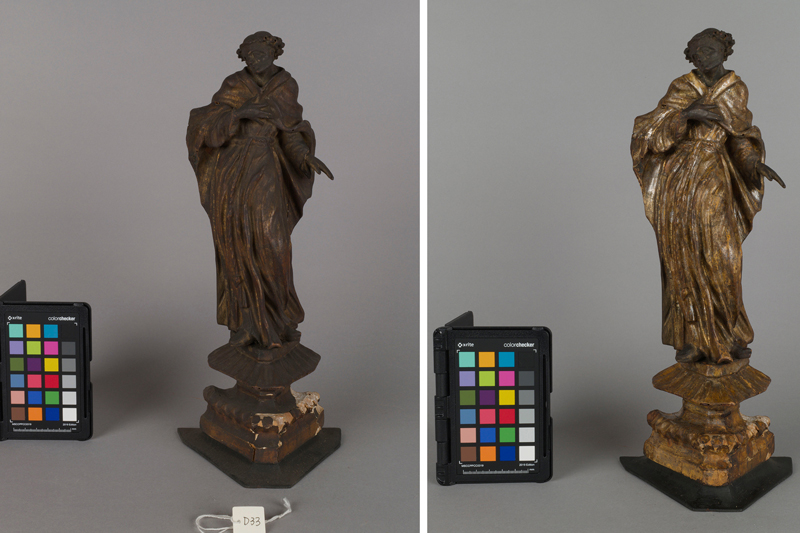
My primary project at the Hispanic Society was the treatment of a 16th century statuette, with the main goal to stabilize the fragile and lifting gesso ground layer in preparation for movement to a different storage location. Surface stabilization was pursued in tandem with cleaning due to the fragility of the gesso layer and was successfully carried out with a solution of rabbit skin glue wicked into cracks and under lifting areas.
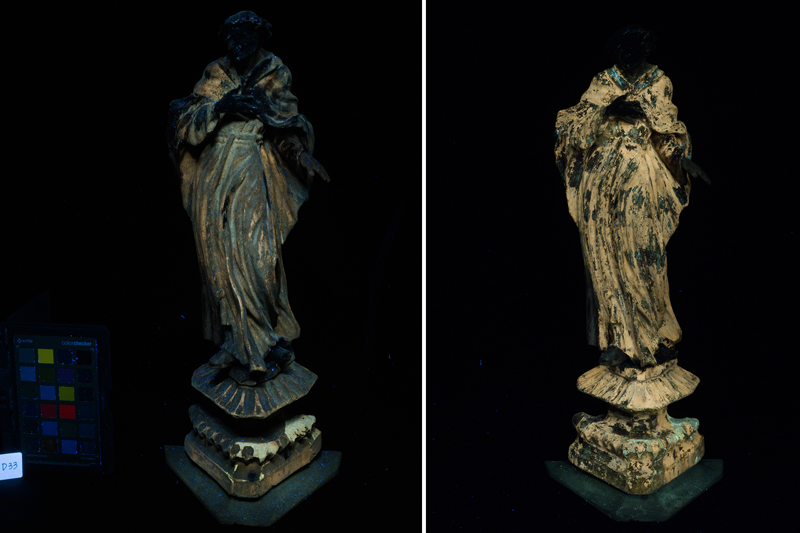
Going into this project, I knew little about the history of the statue, and there was no record of prior treatment. The statue was covered in a layer of grime so thick, it was initially unclear whether it had been gilded, painted, or simply colored black. Early examination revealed visible gilding in the recessed folds of the robes, while the presence of a replacement hand and gold paint reinforced the idea that the statue was gilded. The replacement hand also made it clear that the statue had been previously restored. The gold paint in the restored regions had a grainy appearance and remained dark under ultraviolet light, while the areas of original gilding which were visible fluoresced a bright orange. The orange fluorescence was initially attributed to prior restoration — perhaps a varnish layer applied to consolidate the thin, flaking surface — but this hypothesis was later disproven.
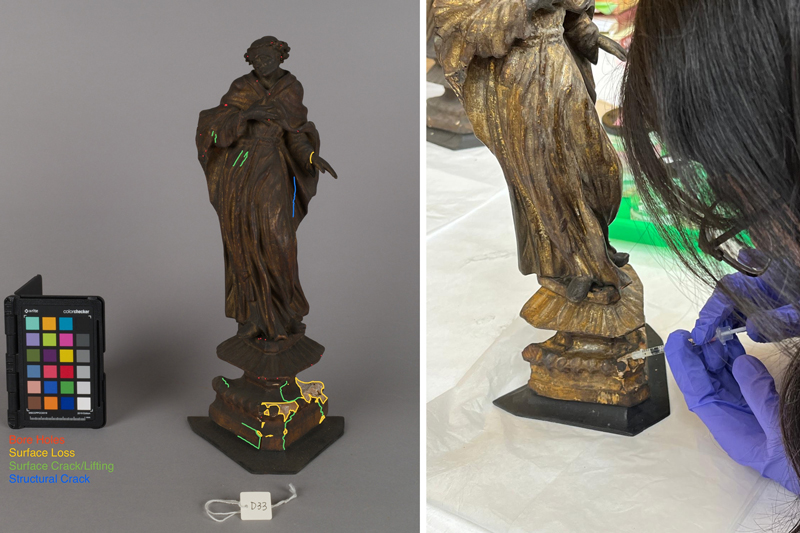
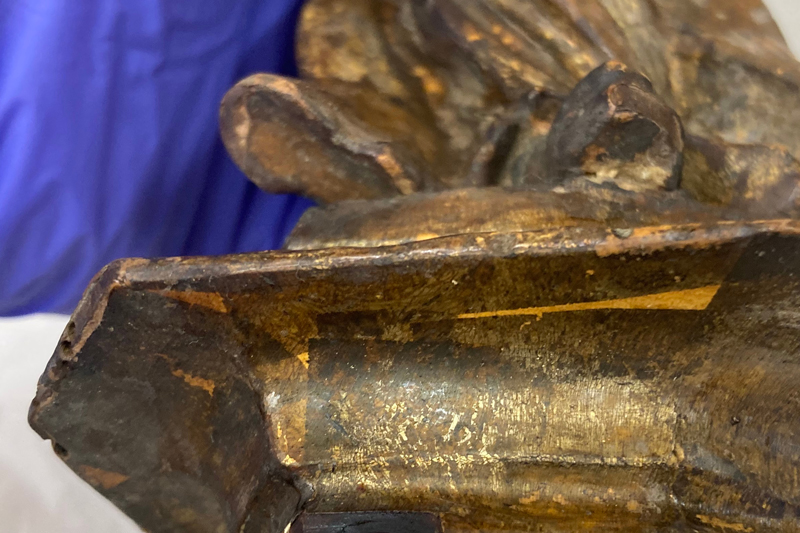
After examination and solvent testing, I confirmed that the statue was gilded, while the thinness of the preparatory ground, lack of red bole layer, and visible outlines of the applied leaf indicated it was likely oil gilded. Further cleaning brought into doubt whether the statue was gilded with gold, as sustained cleaning revealed several small areas of silver across the surface. These were not confined to individual garments (e.g. the cloak or belt), but were scattered randomly, suggesting it was unlikely to be an intentional patterning between gold and silver leaf.
A chance conversation with my fellow intern Maria Sanchez introduced me to the term plata corlada, which we were able to eventually identify as mecca silver gilding, one of many techniques which use cheaper materials to imitate expensive gold. Also called meccatura, this technique involves the use of applied silver or tin in place of gold leaf, which is then painted with a yellow to orange coating — often shellac — to achieve the appearance of gold. Identification of this technique also helped explain the mysterious fluorescence of the surface. The shellac coating, which appears a bright orange under UV light, was not a remnant of a previous consolidation attempt, but instead proved to be a distinctive feature of the statue’s production. (References: Ministerio de Cultura de España. 2026. “Término: Gold effect varnish.” Tesauros del Patrimonio Cultural de España. Jones, Charlotte. “Student conserves rare 17th century frame.” City & Guilds of London Art School. Sánchez Ibáñez, Ana. 2020. “Plata corlada en el retablo mayor de la ermita de San Juan Lorenzo de Cetina (Zaragoza).” Sistema de Información del Patrimonio Cultural Aragonés (SIPCA).)
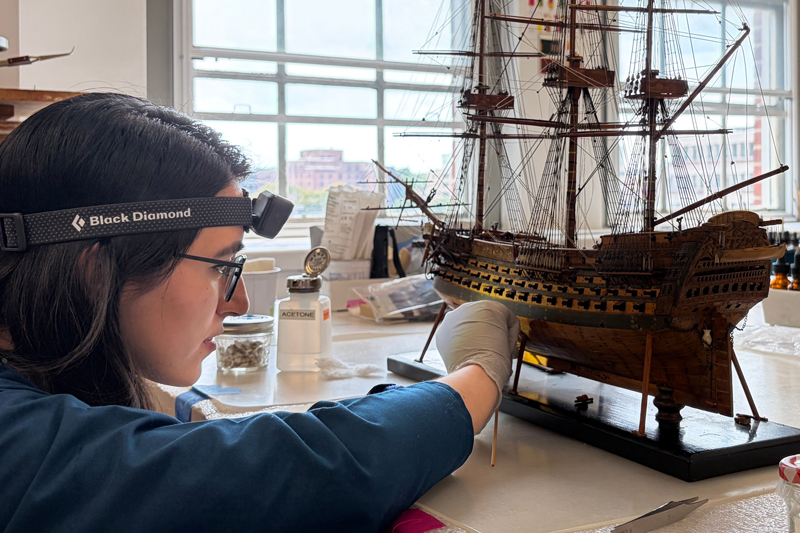
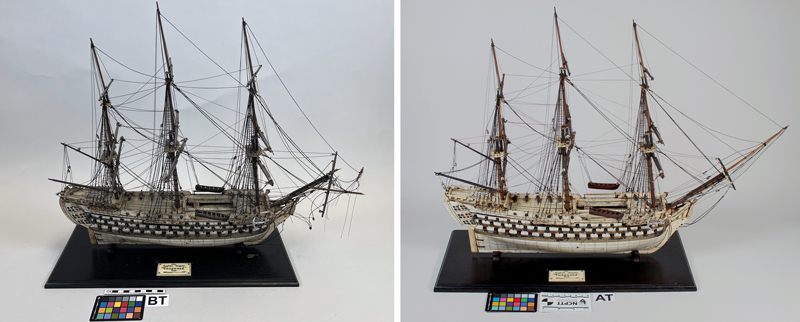
In addition to my experience at the Hispanic Society, I interned part time at A.M. Art Conservation, a private studio in New York with whom I have worked previously. Under the supervision of Anne Léculier King and Rachael Perkins Arenstein, I had the opportunity to complete treatments of two early 19th century model ships made of bone and wood. These treatments consisted primarily of cleaning centuries of accumulated dust and grime, as well as minor stabilization and repair. The bone ship in particular came into the studio with the front bowsprit smashed and rather extensive breakage of the rigging, all of which had to be stabilized, as well as two lead anchors which were cleaned and given a clear coating. These treatments provided valuable hands-on experience with a range of materials, taught me a great deal about ship terminology, and, more than anything, taught me about the patience that conservation demands.
I am immensely grateful to have had the opportunity to engage with such unique objects this summer, and would like to thank the Vicki Cassman Award Committee for supporting this work. I would also like to thank the Hispanic Society Museum and Library for welcoming me into their collections, and A.M. Art Conservation for their continued guidance. My experiences this summer have only made me all the more eager to continue this work in the future, and I am so glad to have been able to meet and learn from so many wonderful people.
The Vicki Cassman Undergraduate Award in Art Conservation was established in 2021 to honor the life and legacy of Dr. Vicki Cassman, former Director of the Undergraduate Program in Art Conservation, the Vicki Cassman Award provides professional development funds for undergraduate students in the Department of Art Conservation. It is given to support projects that embody the spirit of exploration, creativity, and service that Vicki encourage in each of her students. More information about undergraduate student awards, including the Cassman Award, can be found on the UD Department of Art Conservation website.