


Category: Art Conservation
Student Blog: National Museum of the American Indian
February 11, 2026 Written by Caitlyn Fong, WUDPAC Class of 2026 | Caitlyn Fong, Leah Palmer
In this blog post, WUDPAC Class of 2026 Fellow Caitlyn Fong shares her third-year internship experience working with conservators at the Smithsonian’s National Museum of the American Indian and how it is informing her understanding of cultural belongings in museums and community-centered conservation.
This year, I am interning in the objects conservation lab at the Smithsonian National Museum of the American Indian (NMAI). Undeterred by the longest government shutdown in history, my internship has been a deeply enriching experience that is informing my understanding of cultural belongings in museums and community-centered conservation.
My time at NMAI has been a truly unique experience, as conservation and all other departments live out a sincere dedication to the empowerment of Native peoples. In line with this priority, the approach to conservation here is fully directed by the cultural authority of the communities that the objects come from, and much of our time is spent facilitating community access to the collection. Additionally, NMAI’s collection includes exceptionally crafted objects that embody traditional craft practices. I am constantly grateful for the opportunity to closely study and learn from these objects that speak to indigenous communities’ close relationships with natural materials and the land they come from. The things that I am learning inspire my own explorations into crafts like backstrap weaving, beading, and wood carving.
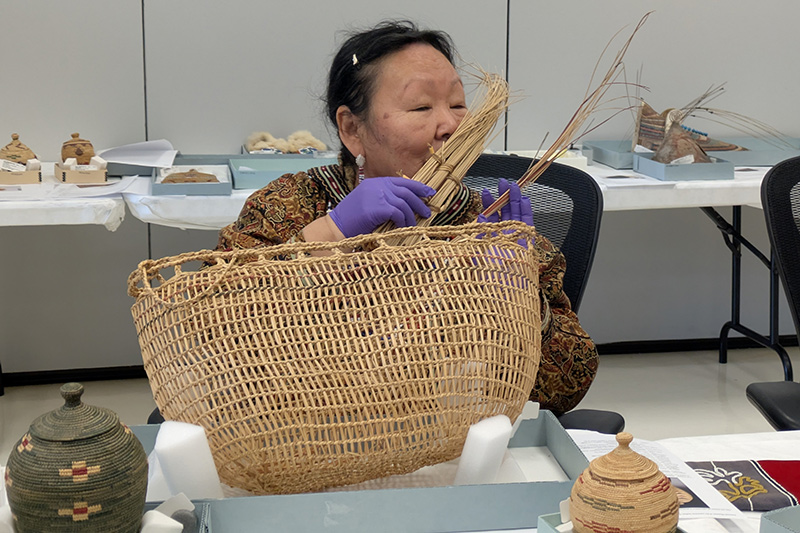
Recently, we hosted a visit from a group of Alaskan Native community members through the Smithsonian Arctic Studies Center. The community members requested to view objects at NMAI from their respective tribes, which we pulled from storage and made accessible to them in a collections space. During visits like these, community members are encouraged to handle and interact with objects. It was a powerful experience to witness the strong connection that our Alaskan visitors have with their heritage items. The ability of material culture to inspire contemporary artists and foster a connection with past relatives struck me throughout the visit. A particularly beautiful moment was when Cup’ik elder Emily Johnston was reunited with masks, baskets and carvings made by her relatives. She identified them right away, and it was a touching moment of connection as she held the objects. Emily also embraced a woven beach rye grass basket that she warmly said smelled just like home.
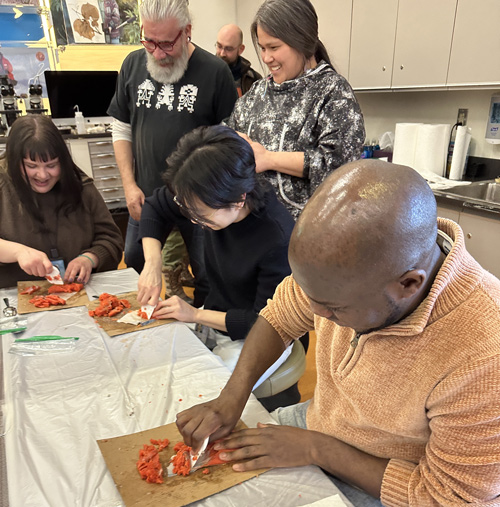
The Alaskan community members also hosted workshops on traditional craft techniques, which allowed me to better understand how items in the NMAI collection were made. The first workshop was on the art of processing salmon skins. I learned how to clean, pin and dry the fish skins to create a rigid, translucent hide, or alternatively, tan and dye the skins to create a flexible leather that can be used to make boots and containers. They also taught us how to weave coiled baskets with beach rye grass. I learned how to start a basket with a knot, and how to split and weave the blades of grass so that the shiny side is on the outside. My beginner attempts at weaving during this workshop greatly increased my appreciation for the skills of the weavers who made the beautiful baskets in the NMAI collection!
Experiences such as these highlight the potential for museum collections to inspire and forge relationships between past and present communities. Community visits happen alongside robust repatriation, shared stewardship and ethical returns projects at NMAI that provide avenues for cultural belongings to return home. I am incredibly grateful to be part of the important work at NMAI and am excited for what else I will learn over the next few months.