


Category: Mathematical Sciences
From Netscape to AI
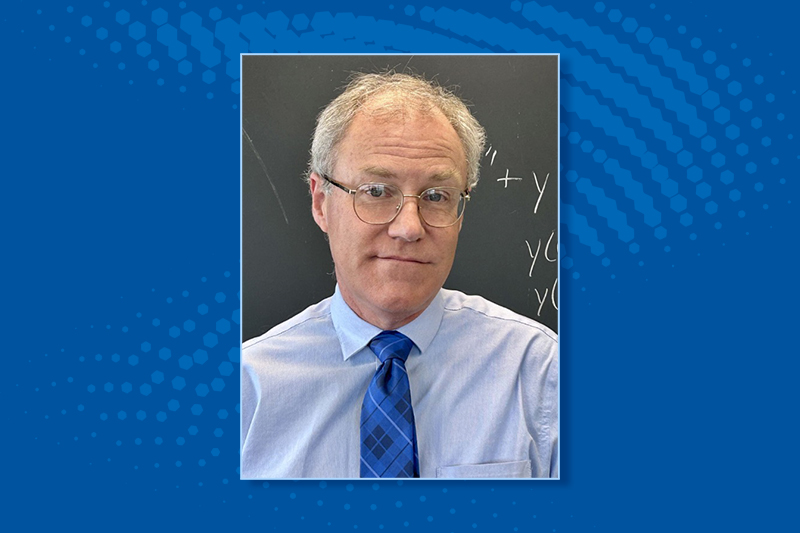
August 09, 2026 Written by David Edwards, retired UD Professor of Mathematical Sciences
Retired UD math professor reflects on how UD evolved during his 30-year career
A university is an evolving organism. When I joined UD in 1997, the focus on applied and industrial mathematics was in full swing and quite foreign to the complex analysts who had joined the faculty 25 years before. Similarly, when I left UD in 2025 new foci have attracted talented faculty who will take the department forward for the next 30 years. And so it goes.
During my nearly 30-year career, I witnessed many changes. We went from 14,000 full-time undergrads to 18,400. Along with that came a doubling of undergraduate programs in the department (from four to eight). One of the new programs is actuarial sciences (ACSC). I was the ACSC “guru” for many years and advised the Actuarial Science Club from its inception. Fortunately, the department now has Professor Gamage spearheading the program, which recently received recognition from the Society of Actuaries.
A cup of coffee used to cost 25 cents until 4 p.m., when the admin would yell “free coffee!” In later years, the department dropped coffee but now offers free coffee again. The department had a ditto machine, though most of us used “Xerox” copies. There was also a typewriter for completing forms and typing envelopes for mailed recommendation letters.
When I arrived, I was responsible for maintaining my Mac because everyone else had SPARCstation terminals linked to the “composers” (which I still have files on). Then everyone started getting Macs, but now with the Google suite, they’re practically terminals again.
In 1997, UD math was cutting edge because we had dedicated computer labs to teach calculus with Maple. We provided information on using Netscape and a whole host of UNIX commands to make everything work properly. Now the labs are gone, everyone has a laptop and AI to compute with.
The size of the graduate program fluctuated in tandem with the economy. I advised three Ph.D. students: Qinghua Zhu, who works on Wall Street; Ryan Evans, who works at NIST; and Matt Zumbrum, who started his career in academia. It was a nice balance among the three main employment options for mathematicians and it’s been a joy to follow their careers.
My research evolved as well: from polymer diffusion to the study of the BIAcore device, concluding with 3-D printing and mathematical finance. I regularly participated in the Mathematical Problems in Industry Workshop, which UD hosted six times. I also helped to direct the Graduate Student Mathematical Modeling Camp, which Professor Fok is now taking into the future.
I spent seven years as associate chair, making sure the teaching side of the house ran smoothly. Students see courses in the schedule and think they just magically self-assemble. They don’t—it takes a lot of work!
Some things never change: my first class ever at UD was 8 a.m. calculus, a common newbie assignment even now. The next semester I taught in McDowell. Every day at the same time I had to stop talking for a minute as a train went by. Then back to the board: over, and over, and over again. It’s hard for me to believe I’ve taught nearly 2,000 students.
When I joined the department, I became a member of the “David set”, containing professors Bellamy, Colton, Hallenbeck, Mason, Olagunju, President Roselle, and probably others lost to memory. Despite the brief addition of IT guru Dave Caldwell, the set is now empty. (Perhaps we can make Yael Davidov an honorary member?)
The Davids were just a small subset of the wonderful faculty and staff I had the pleasure of working with over the years, many of whom became great friends. I learned a great deal from them and I remember them fondly.
I tried to stride off into the sunset but am waylaid in Ohio instead. I’m now working at Kenyon College, so the ties I had hoped to stow away still appear around my neck three days a week like clockwork.
Well, that’s enough ancient history. Back to the board….


