



Category: Psychological and Brain Sciences
Expanding Access, Advancing Care
November 05, 2026 Written by Department of Psychological and Brain Sciences
UD Institute for Community Mental Health celebrates a legislative milestone while expanding clinical training and mental health services across Delaware
When the University of Delaware launched its Institute for Community Mental Health (ICMH) in 2023, its mission was ambitious: to bridge the gap between psychological science and community mental health care. Three years later, that vision is taking shape through a landmark legislative achievement, an innovative graduate training program and a rapidly expanding clinical service network.
A legislative milestone three years in the making
In June 2026, Delaware Governor Matt Meyer signed Senate Bill 208 into law, establishing a new pathway to licensure for master's-level psychology professionals. The legislation represents a major step toward addressing Delaware's mental health workforce shortage and expanding access to high-quality, evidence-based care, which historically only allowed licensure for psychologists, at the doctoral level.
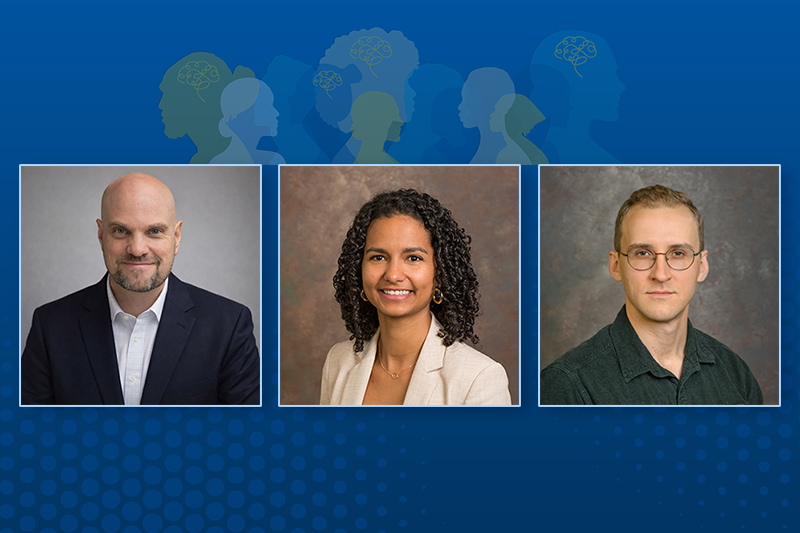
For Ryan Beveridge and Franssy Zablah, this achievement represents the culmination of over three years of advocacy and collaboration with the Delaware Psychological Association, state legislators, University leadership and community partners. Together, these stakeholders championed a solution to a longstanding challenge: the limited opportunities for master's-trained psychology professionals to enter Delaware's clinical workforce.
The legislation is especially meaningful for UD's M.S. in Clinical Psychological Science program, which was developed to prepare scientifically informed clinicians to address critical gaps in mental health care. SB 208 brings that vision one step closer to reality, opening new professional opportunities for graduates while strengthening Delaware's behavioral health workforce.
Where science meets practice
At the heart of the M.S. program is an innovative training model that integrates rigorous education with meaningful clinical experience. Students complete foundational coursework alongside UD's clinical science Ph.D. students, engaging with doctoral-level material in psychological assessment, psychopathology and evidence-based interventions.
The curriculum is intentionally designed so that classroom learning and clinical practice continually reinforce one another. First-year courses in clinical skills and psychological assessment build complementary competencies that students immediately apply with real clients at the ICMH-Clinic. Second-year students deepen their clinical expertise while learning the foundations of clinical supervision, creating opportunities for mentorship and collaboration across cohorts.
“What makes our program unique is how closely our curriculum connects with practical experiences. Apart from learning theories and techniques in the classroom, we get to practice them in real-world clinical settings,” said Vini Dattani, a student in the M.S. in clinical psychological science program.
A growing clinic, a growing community impact
Central to this training model is the ICMH-Clinic, which serves as both a training environment for master's and doctoral students and an increasingly important source of mental health services for the community.
Under the leadership of Zachary Meehan, the clinic has undergone a remarkable transformation, growing from approximately 40 clients annually to serving more than 100 patients each month. The clinic now accepts health insurance, helping reduce financial barriers to evidence-based psychotherapy and psychological assessment services.
This growth reflects Meehan's extraordinary leadership in expanding clinical operations and building strong community partnerships. It also demonstrates the power of integrating training and service: As the clinic grows, students gain richer clinical experiences while the community benefits from expanded access to care.
Extending our reach through community partnerships
Beyond the ICMH-Clinic, the M.S. program is developing a growing network of clinical training partnerships throughout Delaware and the surrounding region.
Under the leadership of M.S. program director, Franssy Zablah, students in the M.S. program now have opportunities to train in school-based mental health centers, community clinics, residential substance use treatment programs, integrated behavioral health settings, university counseling centers, state mental health services and private practices.
These partnerships provide students with exposure to diverse populations and models of care while supporting organizations working to address critical gaps in mental health services, particularly in underserved communities.
Looking ahead
With the passage of SB 208, a growing clinical training program and expanding community partnerships, ICMH is helping shape the future of mental health care in Delaware. Together, these efforts reflect UD's commitment to advancing psychological science, preparing the next generation of clinicians and ensuring that high-quality mental health care reaches the communities that need it most.


