


Category: Art Conservation
Student Blog: Colonial Williamsburg Foundation
May 14, 2026 Written by Binh-An Nguyen | Photos by Binh-An Nguyen and Olivia Bascle
In this blog post, WUDPAC Class of 2026 Fellow Binh-An Nguyen shares her third-year internship experience working with the largest preventive conservation team in North America, caring for the various historic and modern collections and non-collections buildings at the Colonial Williamsburg Foundation.
The Colonial Williamsburg Foundation (CW) is home to the largest preventive conservation team in North America. For 365 days a year, the team cares for the various historic and modern collections and non-collections buildings at CW including: the Historic Area, the Art Museums of Colonial Williamsburg, the Bruton Heights campus and the newly opened Colin G. and Nancy N. Campbell Archaeology Center. The opportunity to work with such a large team and institution provided me with a unique experience of learning about the various roles and responsibilities of a preventive conservator and the preventive challenges they face.
Preventive conservation at its core is about mitigating factors that cause deterioration; factors such as light, incorrect temperature and relative humidity, pests, mold and more. Many of my projects have thus been about addressing these problems and coming up with solutions to better protect collections so that they may continue to be studied and enjoyed for years to come.

One project in particular is about addressing mold growth in collections. This is an Institute of Museums and Library Services (IMLS) funded collaborative research study between the Image Permanence Institute (IPI) at Rochester Institute of Technology, Georgia Southern University and Colonial Williamsburg Foundation. The research project aims to learn more about the specific environmental conditions which promote mold germination and growth, since there are few publications which investigate these in a collections care context. The hope is that the information gained from this study can then be applied to create better guidelines for environmental conditions of museums that balance both the care of mold-susceptible collection materials and environmental sustainability (e.g. helping to be less restrictive with environmental set points in buildings or adapt to historic building envelopes).
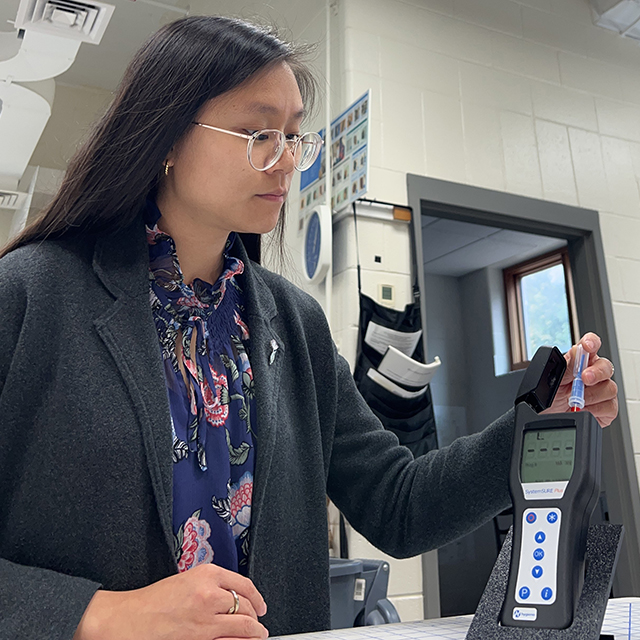
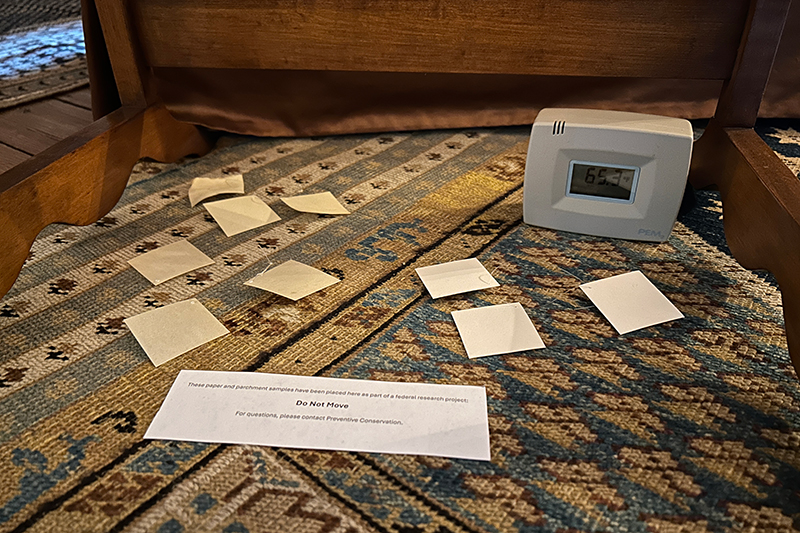
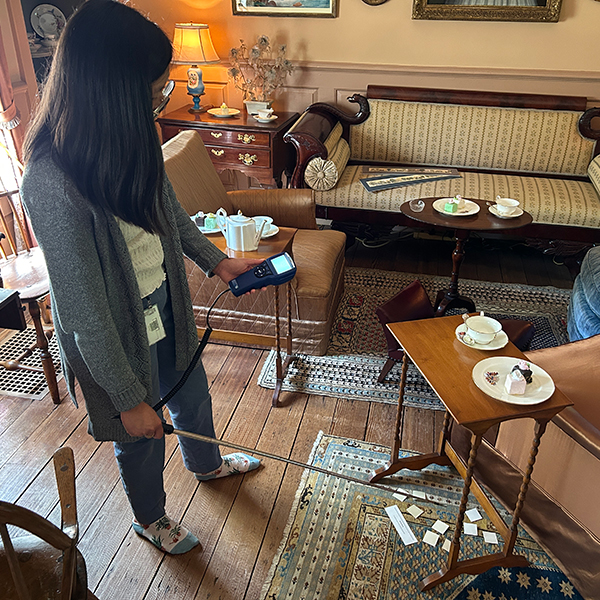
Samples of aged and unaged parchment and paper have been deployed in various sites across CW. Every six weeks the samples are analyzed using a water activity meter and luminometer, and the local air flow around the samples measured using an anemometer. The water activity meter measures the amount of moisture vapor at the surface of the samples. Since we are concerned about mold growth on collection objects (i.e. their surfaces), we want to see what relative humidity levels lead to surface moisture levels which promote mold growth. The anemometer measures air velocity/air flow of an area. By measuring the air flow of the sample locations, we can see if or how air flow affects moisture levels and potential mold growth. The luminometer is a device that tests for biological activity on a surface. We swab sample sets and place those in the luminometer to measure if any biological activity, e.g. mold growth, has occurred.
After all this data is collected for a year, IPI will then analyze the data and determine what specific conditions did or did not promote mold growth. From there, they will hopefully be able to publish better guidelines for how institutions can limit mold growth in their collections. Another added benefit of this study is that it can help inform decisions made around set-points for collection spaces. If we find that mold growth does not occur within a wider temperature and relative humidity range than previously advised, we can act more sustainably by widening our HVAC setpoints.
Being a part of this research project has taught me so much about mold growth, using different scientific instruments and designing a research experiment. Furthermore, this project alone is just a drop in the bucket of the many amazing projects I have gotten to lead or participate in here at CW, such as leading environmental data review meetings, investigating dust composition at the museum, hosting wet salvage training for library staff and so much more. I am incredibly thankful for all the knowledge that everyone in the Preventive Team and the Conservation Department at CW has imparted to me during my internship. Huzzah!