



Biology Students Explore Victorian London
March 06, 2026 Written by Department of Biological Sciences
Winter Session study abroad examines the 1854 cholera outbreak through science, history and literature
While many University of Delaware students spent January at home, 24 traveled to England for a Winter Session study abroad exploring the science and culture of Victorian London.
The trip marked the fourth biology-focused study abroad program and the first centered on London and cholera.
A Tale of Two Disciplines
Students explored London’s West End as part of an interdisciplinary program examining how science and society intersected during the 1854 cholera outbreak. The program paired two courses that approached the crisis from scientific and cultural perspectives.
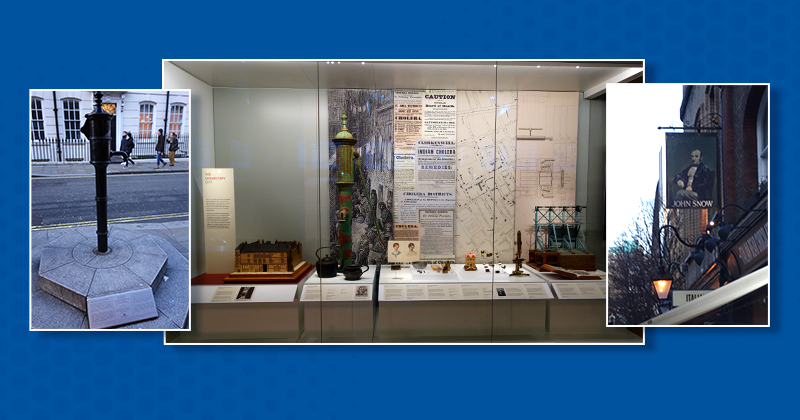
In SCEN 310: Exploring Science in Context, taught by Christopher Trimby, assistant professor of biological sciences, students studied the groundbreaking work of Dr. John Snow. The London physician traced the source of the outbreak by mapping cholera cases across the city, ultimately identifying the Broad Street pump as the source.
Students walked the same streets where Snow conducted his investigation and debated competing theories of the disease while role-playing historical figures from the era.
At the same time, students took ENGL 338: Studies in Victorian Literature, taught by Siobhan Carroll, associate professor of English and a specialist in British literature from 1750 to 1850. The course examined how Victorian writers grappled with rapid social change, including the rise of cities and modern science.
Students explored how literature of the period helped shape two emerging figures in society: the detective and the scientist. Reading fiction alongside scientific accounts, they saw how art and science influenced each other during a time of profound cultural change.
Bridging the Lab and the Library
Fourteen of the 24 participants were biology majors, joined by students from psychology, neuroscience and the College of Health Sciences, bringing a range of perspectives to the program.
One participant said tracing the cholera epidemic across London made history feel immediate and tangible. Another said the experience deepened their appreciation for how recently many advances in science and medicine occurred.
Beyond the Classroom
London itself served as a living laboratory. Students visited several sites tied to the outbreak and the broader Victorian era, including:
The Old Operating Theatre, where they learned about surgery before anesthesia.
Soho, site of the famous Broad Street pump.
The Florence Nightingale Museum, dedicated to the founder of modern nursing.
Down House, the home of Charles Darwin.
A performance of Oliver!, bringing Victorian London to life on stage.
The next program, planned for Winter Session 2027, will take students to Paris to study the history of the first human blood transfusions.


