Category: Art Conservation
Art conservation and historical voices
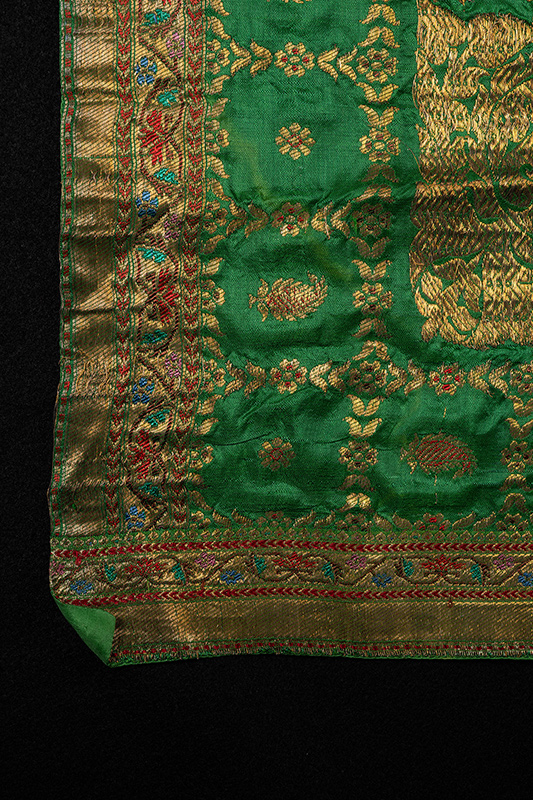
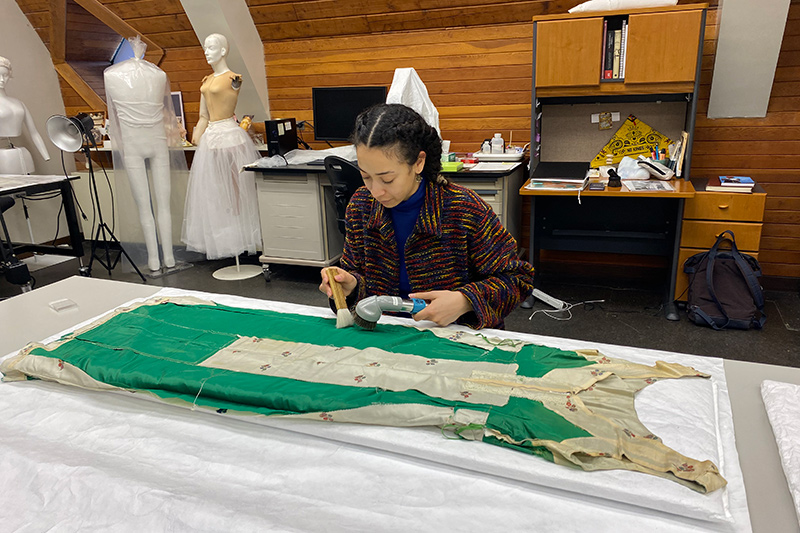
March 31, 2026 Written by Lisa Chambers | Heather Hansen, Allejandra Chavez and Nat Caccamo. Dress and shawl are courtesy Philadelphia Museum of Art, Gift of the estate of Marian Anderson, 1995
For second-year Winterthur/University of Delaware Program in Art Conservation Fellow Allejandra Chavez, textiles are about more than fabric. She is now working on a piece of history that feels personal: an ivory silk gown that had belonged to the celebrated contralto and civil rights figure Marian Anderson.
For Allejandra Chavez, textiles are about more than fabric. “Most of them have a story connected to the wearer, to the maker, to the owner,” she explained. And in the field of textile conservation, “There’s such a strong history of the work being done by women, and their not being respected as conservators because they were seen as seamstresses—but we do more than sewing.”
A second-year textiles major in the Winterthur/University of Delaware Program in Art Conservation (WUDPAC), Allejandra grew up in Maryland and came to conservation following a high school field trip behind the scenes of Baltimore’s Walters Art Museum. She went on to major in chemistry and studio art. Now she is working on a piece of history that feels personal: an ivory silk gown that had belonged to the celebrated contralto and civil rights figure Marian Anderson and was a gift to the Philadelphia Museum of Art from Anderson’s estate.
The singer wore the dress during her tenure as a United Nations Goodwill Ambassador in the late 1950s, when she traveled through India, Africa and Europe. “At first glance I could tell it was a dress she wore often,” Allejandra said. “It wasn’t a show piece or something she wore once and put away. She loved it.”
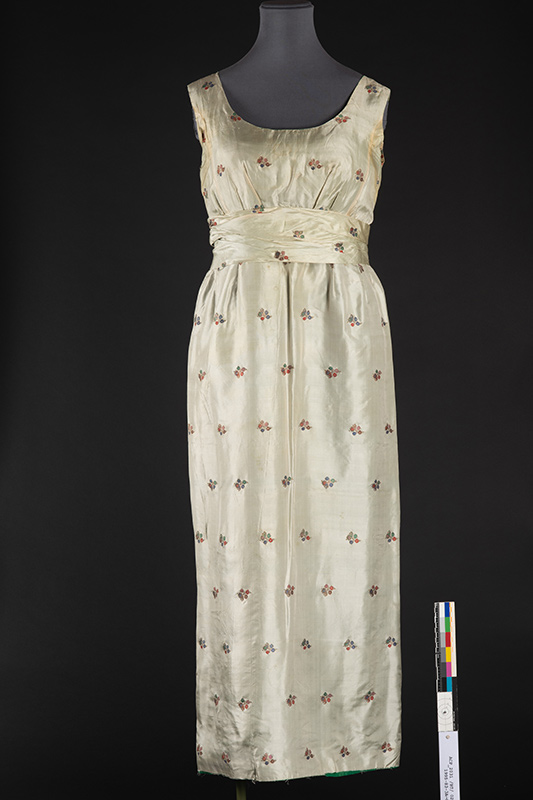
The sleeveless, scoop-necked gown arrived at WUDPAC with staining under the arms and across the front, a worn hem and a repaired pleat in the back. A long accompanying sash was in three pieces, with a decorative fabric brooch missing. Allejandra began by researching historical photos of Anderson in the dress. To understand how the sash was attached, she said, “I needed to see how she wore it.” To reduce the stains, Allejandra is testing low-moisture agarose gels that draw out staining while minimizing the amount of water introduced to the delicate silk. For the damaged hem and missing brooch, she will custom-dye plain-weave silk to match the original and use conservation stitches—“that are stabilizing but also minimally intrusive,” she explained—to secure fragile areas.
The goal is to bring the dress to an exhibitable state—to let it tell its story again. Working on an object connected to African American history has meant a lot to Allejandra. “I’m learning history that is important and relevant to me and to museums,” she said. She has listened to recordings of Anderson’s 1957 performance in New Delhi, India, and the 1939 Lincoln Memorial concert Anderson gave after the Daughters of the American Revolution barred her from singing at Constitution Hall. Said Allejandra simply, “It’s great to hear.”