


Category: Art Conservation
Student Blog: Cleveland Museum of Art
June 26, 2026 Written by Daisy Diamond, WUDPAC Class of 2026 Fellow | Photos by Max Andrejco, Daisy Diamond and Argenis Apolinario (courtesy of VoCA).
In this blog post, WUDPAC Class of 2026 Fellow Daisy Diamond shares her third-year internship experience at the Cleveland Museum of Art, working with a collaborative team of conservators and learning about the preservation of everything from craft techniques to contemporary art.
I am excited to share a few highlights from my yearlong internship at the Cleveland Museum of Art (CMA) in the Eric T. and Jane Baker Nord Family Conservation Suite. The museum’s collaborative conservation department has offered distinctive opportunities to learn about the materials, techniques and philosophies of many conservation specialties. Although my broad training at CMA and through the Winterthur/UD Program in Art Conservation (WUDPAC) has prepared me to care for inorganic and organic materials from a variety of contexts, I am especially delighted to learn more about preserving craft techniques and contemporary art.
I trained as a welder before pursuing conservation, so metalworking has always held a special place in my heart. I find it fascinating to consider how makers have navigated—and continue to navigate—the intersection of industrial processes, the inherent instability of materials, including corrosion and patina formation, and the unique qualities of different metals.
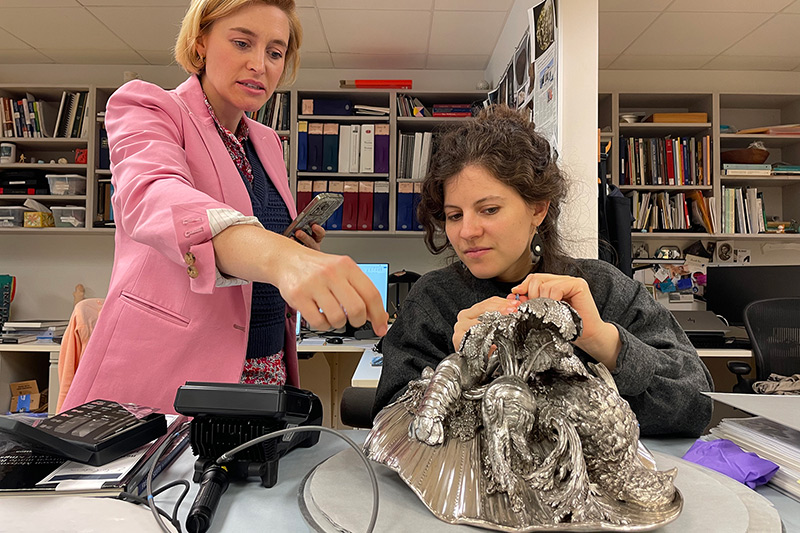
During my internship, I worked alongside objects conservators Beth Edelstein and Colleen Snyder on the treatment and technical examination of Juste-Aurèle Meissonier’s Covered Tureen on Stand (Pot-à-Oille) (1977.182). Ada de Wit, curator of decorative arts at CMA, described it to me as one of the most important examples of French silver. I am honored to have contributed to an upcoming exhibition catalog focused on the tureen.
Our examination included close observation, conversations with Cleveland-based casting experts, borescope imaging, literature reviews and X-radiography. Through this work, we clarified evidence of the manufacturing methods used to create the tureen’s hollow-form and life-cast elements.
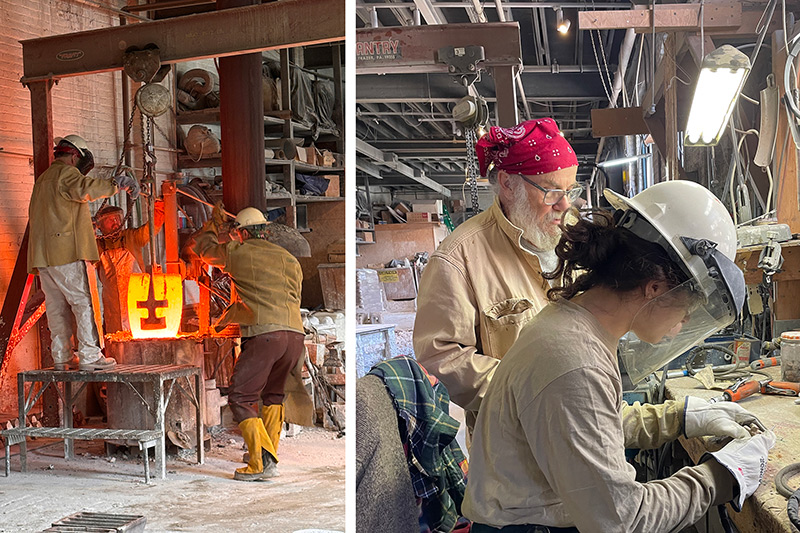
I also tried lost-wax casting in collaboration with John Ranally at Cleveland-based Studio Foundry. After working through each step of this complex process with an expert, I can finally say with confidence that I understand lost-wax casting!
The same qualities that draw me to craft-based technical analysis have also shaped my passion for the care of contemporary art. I enjoy learning how artists use materials and how, or whether, they account for the ways their work may age. Because contemporary artworks are often made with nontraditional materials, aging and change can happen on a compressed time scale.
During my first two years in WUDPAC, I explored these ideas through a major treatment of a plastic shadow puppet. I also worked with the Robert Rauschenberg Foundation to research materials and preservation approaches for the artist’s Cardbird I–VII (1971) series.
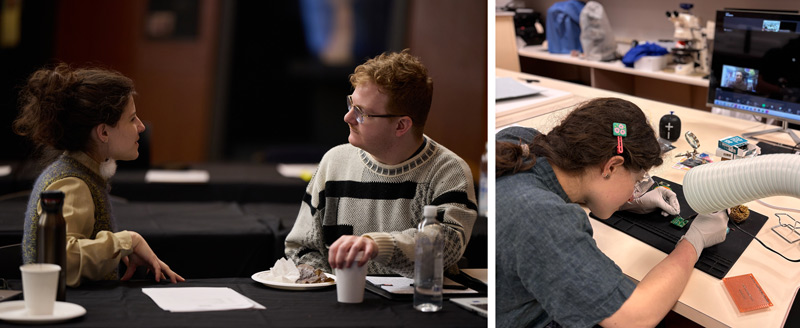
At CMA, I have built on these contemporary art conservation experiences by exploring time-based media (TBM) preservation. This learning journey included participating with Jacob Emmett in the annual TBM Stewardship workshop hosted by Voices in Contemporary Art (VoCA). Emmett is an associate registrar at CMA and a member of the museum’s Time-Based Media Committee. My participation was generously supported by WUDPAC’s Rowntree Research Award in Contemporary Art.
I have applied many insights from the workshop at CMA. My work has included conducting condition examinations of TBM artworks, researching and soldering a replica microcontroller as a long-term preservation strategy for Lynn Hershman Leeson’s Giggling Machine (1968; Scott Mueller Collection 3.2026) and interviewing Ohio-based multimedia artist Ann Hamilton about video works featured in her recent exhibition at CMA.
Although I am now in the final stretch of my internship, I am excited to stay connected with the friends I have made in Cleveland, the generous and brilliant mentors who have guided me and the ideas I have encountered here. Thanks for reading about my experiences!