



Category: Art Conservation
Art conservation and fragile images
February 12, 2026 Written by Lisa Chambers | Photos by Evan Krape, Sarah Purnell and Emma Reuther
The tension between permanence and disappearance makes a 19th-century transferware print a fitting project for Emma Reuther, a paper major in the Winterthur/University of Delaware Program in Art Conservation.
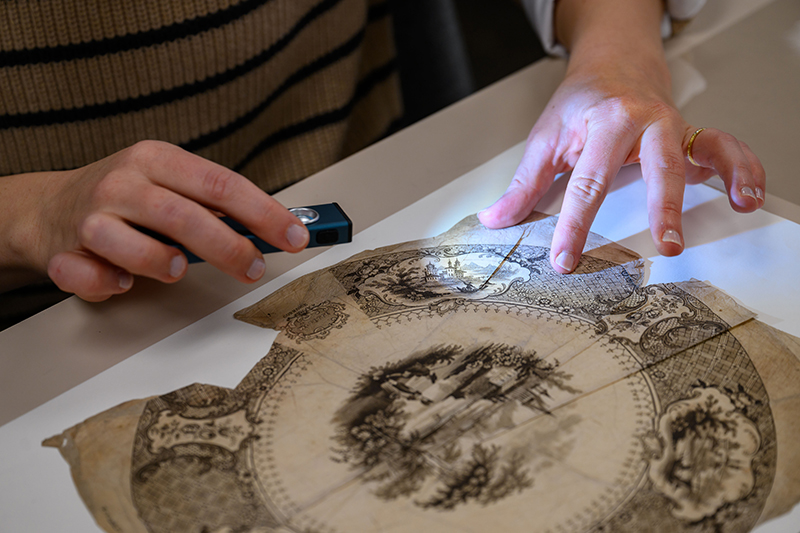
At first glance, Emma Reuther’s conservation project appears to belong to the world of ceramics. The delicately detailed, romantic landscape scene was designed to decorate a plate—transferred onto clay, glazed and fired. But the object Reuther is conserving isn’t ceramic at all. It’s a rare tissue-paper transferware print, an ephemeral step in a manufacturing process in which the paper typically disappears.
That tension—between paper and ceramics, permanence and disappearance—makes the print a fitting project for Reuther, a paper major in the Winterthur/University of Delaware Program in Art Conservation (WUDPAC). Her path to conservation grew out of a desire to combine different interests: art and science. A biology major from Dallas, “I wanted to be around art all the time,” she recalled. A conversation with a friend while marveling at the mosaics of Ravenna, Italy, introduced her to the field. “It was just this light-bulb moment,” she said. “This combines all the things I’m passionate about.”
So does her current project. Created in mid-19th-century England, the print was produced by J & G Alcock, a pottery firm based in Staffordshire. Transferware images were made using a complex and fleeting process. From an etching or engraving on a copper plate, “The paper is printed with warm ink and then immediately flipped onto a plate, rubbed with soapy water, and the paper washes away—kind of like a temporary tattoo,” Reuther explained. The ink remains when the plate is fired. For the paper, “it’s an inherently destructive process,” Reuther said, and intact examples are uncommon.
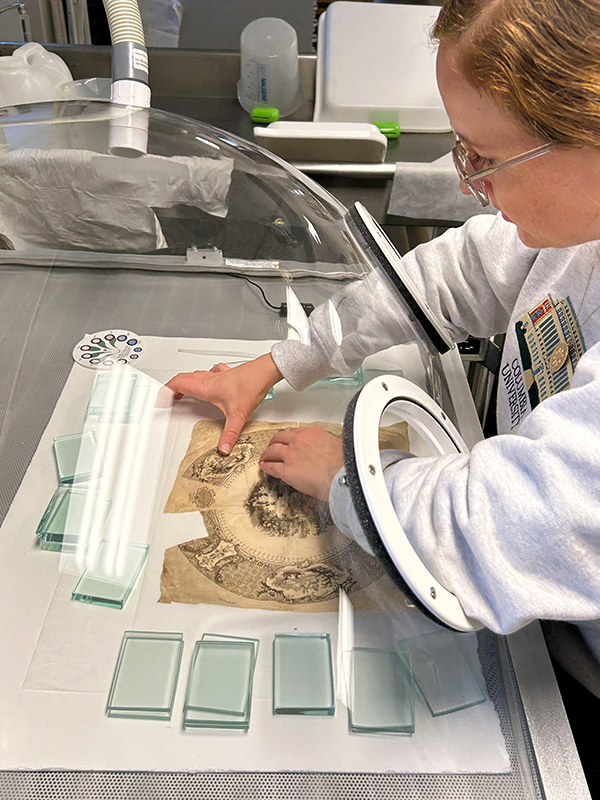
When she received the fragile tissue, it was deeply creased and punctured with small losses. She surface-cleaned it under a stereo binocular microscope using brushes and small pieces of cosmetic sponges. “From there, I humidified it and flattened it on a suction table with a dome,” she explained, allowing her to precisely control moisture exposure using ultrasonically generated mist. To mend tears without introducing potentially destructive water, she precoated very thin Japanese tissue with adhesive so she could reactivate that with ethanol and acetone and patch the holes. “It’s a nice way of doing mends when you want a lot of control.”
Now stabilized and rehoused in a clear sleeve, the transferware print captures a moment that usually vanishes—linking paper and clay, art and chemistry. “Paper is my passion, but I do ceramics as a hobby,” Reuther said. “It’s been fun learning about this type of ceramic that you see everywhere and now I know the process behind it.”


Left and center: The William Gallimore Transfer Print, c. 1820–1840, before and after treatment, shown in transmitted light (Col. 216, Acc. 71x166.34). Right: The transfer print alongside ceramics from the Winterthur Collection.


