



Category: Art Conservation

Student Blog: Fine Arts Museums of San Francisco
February 27, 2026 Written by Sam Lee, WUDPAC Class of 2026 | Photos courtesy of Allison Brewer, Cyntia Karnes and Katey Leard
In this blog post, WUDPAC Class of 2026 Fellow Sam Lee shares her third-year internship experience working with the conservation experts and collections at the Fine Arts Museums of San Francisco, including work with a rare collection of negatives that document the aftermath of the 1906 earthquake.
For my last year at WUDPAC, I have been interning in the paper conservation lab for the Fine Arts Museums of San Francisco (FAMSF). FAMSF is composed of the Legion of Honor, which houses the paper lab, and the de Young Museum, where the textile, paintings and objects labs reside. As a paper specialty with a minor in library conservation, I have a penchant for archival collections but wanted to expand my experience into an art museum for my third-year internship. Being from the San Francisco Bay Area, FAMSF posed a natural fit.

This internship has allowed me to experience the far-reaching impacts conservators have in museums. I have participated in exhibition deinstallations and lab tours, written condition reports for incoming and outgoing loans and conducted monthly gallery maintenance and pest trap checks. Although maybe not the most glamorous or widely visible parts of the job, I have seen the vital contributions conservators make to maintaining the beloved collections and exhibitions at FAMSF.

Of course, I have also been busy working on treatments! I recently completed treatment of “The Death of Seneca,” an engraving on paper created by Simon Francois Ravenet II after a painting by Luca Giordano.
The print had a significant amount of surface soiling, which we were concerned might transfer to other objects through handling. The print also had a tideline along the bottom edge and numerous previous hinges and repairs. After determining that the hinges and repairs were water sensitive, we decided to wash the print to address many of these condition issues together. This treatment would also help to chemically stabilize the paper by removing acidic compounds that had built up in the paper and would contribute to its degradation. After washing, I was able to practice techniques for aesthetic compensation in order to reduce the appearance of ink loss and dirty tear edges. I am grateful that this project presented me with the chance to learn new treatment techniques and is now ready to be hinged for a future exhibit!
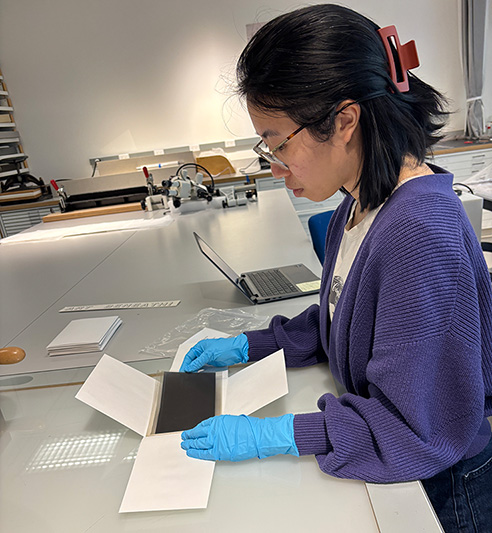
I have also started working on a survey with Collections Care Associate Katey Leard of cellulose nitrate and acetate negatives by San Francisco based photographer Arnolde Genthe. This collection of negatives documents the aftermath of the 1906 earthquake and acts as a rare primary source of its devastating impact. Severe cellulose nitrate degradation causes permanent loss of the image, so identifying which negatives have nitrate film bases and if they have preservation copies is the cornerstone of the project. I have really enjoyed the opportunity to gain more experience with photographic materials and look forward to more exhibition work and exciting treatments in the upcoming months!


