



Category: Women and Gender Studies

Learning Beyond the Classroom
April 14, 2026 Written by Natasha Kapadia | Photos by: Evan Krape and courtesy of Bailey Blewitt
Note: Author Natasha Kapadia is a senior political science and communication double major.
For many students, learning happens in lectures, textbooks and discussions. For Bailey Blewitt, a senior double major in psychology and women and gender studies (WGS), learning included an added layer of sitting with victims of abuse and assault, hearing their stories and understanding the lived realities behind the theories.
Her understanding of gender-based violence began in research, where she worked with Professor Angie Hattery to analyze interviews and data from women navigating the criminal legal system. The work provided a critical foundation, but was largely text-based; the stories were anonymized and processed through an academic lens. It wasn’t until she encountered survivors in person, through classes like Women and Violence and a winter session study abroad trip to Thailand, that the work took on a new meaning.
“There was a moment in class when a survivor shared her story,” Blewitt recalled. “That’s when it stopped being research. These weren’t just stories on paper anymore, these were real people.”
That moment marked a turning point. Blewitt took advantage of as many hands-on experiences as possible, doing internships and working in advocacy settings, mental health environments and police-based victim services through the department’s domestic violence prevention and service (DVPS) practicum. The experiences gave her direction and taught her how to navigate and challenge systems of power and violence.
That shift is what Bailey credits WGS with doing best, bridging the gap between theory and lived experience.
“The program doesn’t just introduce frameworks,” she explained. “It builds on them year after year, while consistently grounding them in real-world application.”
Now, as a teaching assistant for a course that once left her overwhelmed and emotional, Blewitt sees the same transformation unfolding in a new group of students. Where she once sat as a sophomore trying to make sense of difficult realities, she helps create a space where others can process, question and grow. This experience, combined with her research, advocacy and fieldwork have ultimately reshaped her goals, moving her away from individual-level care and toward institutional change, where she hopes to address the structures that allow harm to persist in the first place.
Below Blewitt talks about her experience as a WGS major and the lessons she’ll take with her after graduation.
Kapadia: I’m a student of political science and communication, and most of our learning occurs inside the classroom. What has it been like to move from studying issues like gender-based violence to working directly with people affected by it?
Blewitt: When you’re just studying something in a classroom, it can feel distant, even when you know it’s serious. But sitting with people, hearing their stories in their own words and witnessing both their pain and their resilience, completely changes your perspective. It makes you realize how urgent this work is. It also makes you rethink what it means to “understand” something. I used to think understanding came from reading and analyzing, but now I know it also comes from listening, being present and recognizing people as more than what’s happened to them. Those interactions stay with you in a way that textbooks never do.
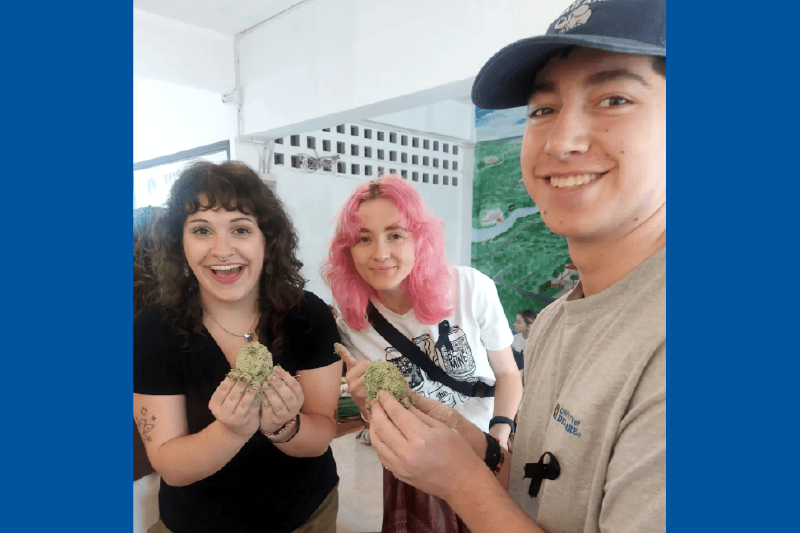
Kapadia: During your study abroad in Thailand, you visited rural communities and met women with disabilities. Was there a moment on that trip that changed the way you think about your work in gender and disability advocacy?
Blewitt: We were visiting a rural community near Chiang Mai and met women with disabilities. I was surprised by how well-integrated they were in their communities, participating in local events and being valued for their contributions, rather than being sidelined because of their disabilities. One woman told me that she didn’t feel treated differently, which was so different from what I expected based on my studies and the research we’d read. Seeing how her community intentionally included and supported her was eye-opening and inspiring. It made me realize that there are different ways of approaching advocacy, ways that focus on inclusion and empowerment and it reinforced for me why I want to work on gender and disability issues at both the personal and systemic levels.
Kapadia: How has being part of WGS changed the way you engage in conversations with others?
Blewitt: WGS has really taught me humility. I used to approach conversations from a place of feeling like I knew what was right and I think that made me more reactive and less open to listening. I’ve learned that people’s perspectives come from their experiences, and if you want to have meaningful conversations, you have to understand that. Now I’m much more intentional about listening, asking questions and meeting people where they are instead of trying to prove a point. It’s not about “winning” a conversation, it’s about creating space for understanding. I think that’s one of the most valuable skills I’ve gained.
Kapadia: As a political science student, I get to see and interact with national speakers through events like the Soles Lecture. Women and Gender Studies hosts the Ida B. Wells Lecture each year. What impact has having the chance to engage with nationally recognized speakers had on you?
Blewitt: When I found out we were going to engage with Chanel Miller this year, I was honestly speechless. I had already read her book and had known about her story since my freshman year, so it felt surreal. I remember thinking, “This is the best thing ever.” It also made me think about how I could make that experience meaningful, not just for myself, but for her too. We ended up creating a puppet show as part of our project, and she actually talked about it during her talk and even drew our characters when she signed our books. That whole experience didn’t feel real. It also changed how I approached her work, because instead of reading it passively, I was thinking about how to connect with it and what I would want to ask her. Opportunities like that make the work feel a lot more real and personal.


