




Beyond survival
March 30, 2026 Written by Hilary Douwes | Photos by Evan Krape
Chanel Miller relates story of trauma and resilience at Ida B. Wells Lecture
Author and artist Chanel Miller’s smile lights up her whole face and her laughter is infectious. As she recounted a story from her undergraduate days about an assignment she and a fellow art student did that involved hiding in a campus recycling bin, she started to giggle, and the audience at the University of Delaware giggled with her.
“I don’t know why I told you that story,” she said, laughing, once she was finished. The crowd, which filled most of the seats in Mitchell Hall, laughed and applauded.
Her openness made it hard to believe that for many years Miller was known to the world only as Emily Doe, survivor of a brutal rape at Stanford University in 2015 and author of a powerful victim impact statement that changed the world’s conversation about sexual assault. She reclaimed her identity four years later with the bestselling memoir Know My Name.
Miller shared her journey of healing, and how she used writing and art to process trauma and to encourage curiosity and self-awareness, as the speaker at this year’s Ida B. Wells lecture. Hosted by the Department of Women and Gender Studies, the annual event honors the pioneering journalist and civil rights advocate Ida B. Wells.
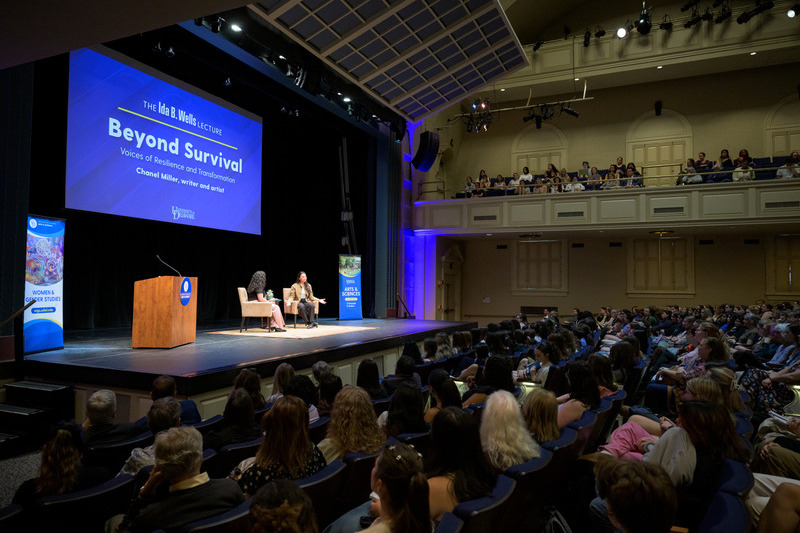
“Overnight you're like, where did everything go? Where did my sanity go? Where did my relationship to my body go? Where did my safety go?” she said about the aftermath of the attack and her recovery. “Now I just have to go find out where everything went, and I just felt like I was tasked with this mission I didn't ask for.”
Despite feeling betrayed by the justice system when her attacker was only sentenced to six months in jail, and seeing her story being played out in the press, Miller said writing helped her find the person she was before the attack.
Telling her story honestly was a relief after her experience at the trial.
“I felt like I had to uphold this impossible image of goodness when I was testifying,” she said.
Her advice for overcoming trauma? Keep your own story in the forefront, regardless of what others are saying. You are in control of your own narrative and can find your old self again.
“Stay close to what you know. You have to be careful not to drift far for long from what you know to be true for yourself,” she said.
From scholarship to storytelling
Before the lecture Miller met and engaged with students at an interactive showcase of presentations, performances and multimedia displays by the department’s senior capstone class. The students used their creativity and artistic abilities to explore five topics found in her book, such as voice, justice and the power of narrative.
“We told them they needed to produce something real,’” Professor Angie Hattery said during the event’s opening remarks. “Not just something that gets turned in and disappears online, but something they would be proud of.”
One group performed a puppet show exploring how origin stories shape society’s understanding of women. The performance juxtaposed the biblical story of Adam and Eve with an Indigenous creation story about SkyWoman.
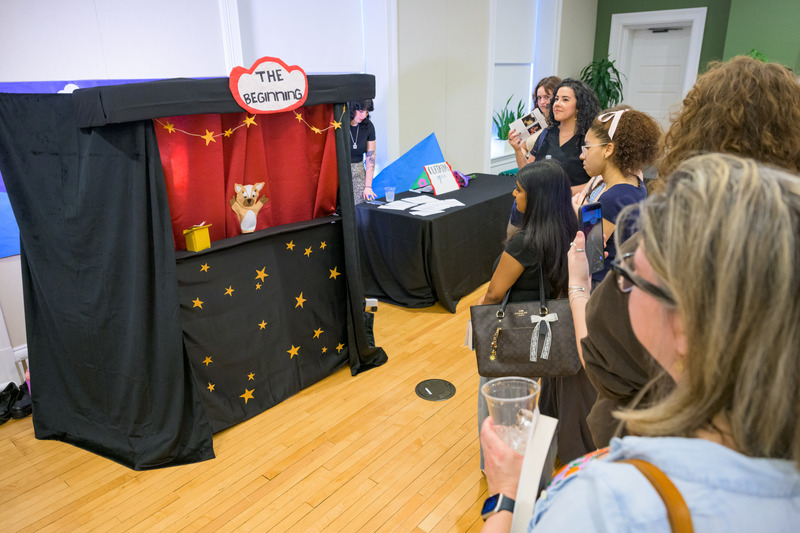
“We wanted to show that the stories you tell at the beginning really matter,” senior Bailey Blewitt said. “They shape how you build everything afterward.”
Another group created a dollhouse-style installation examining the impact of immigration enforcement. Through miniature scenes — including a classroom where students wonder why a classmate is no longer there, and a park that is missing a neighbor who feeds the pigeons — the display depicted moments of absence.
“Even in the smallest things, there’s impact on communities around us,” senior Kathryne Maguire, who is also majoring in communication, said. “It affects everyone’s relationships and everyone’s lives.”
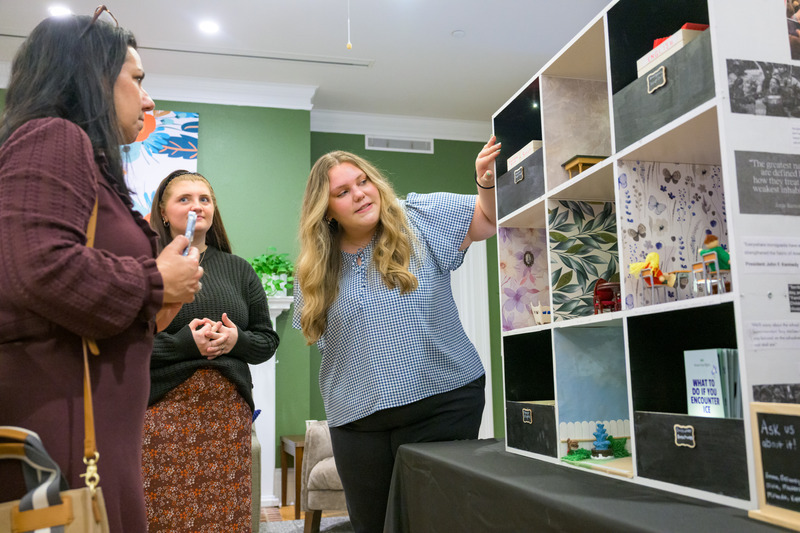
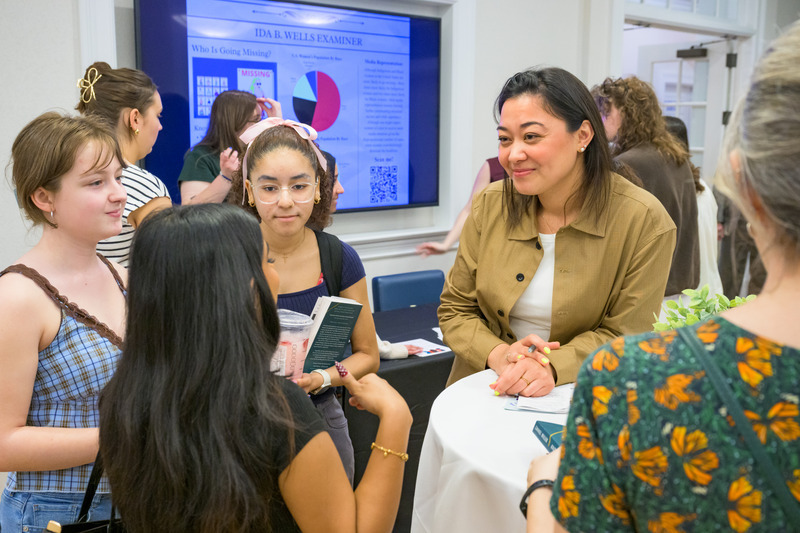
Other groups produced a scrapbook focused on intersectionality, a zine about gender and maternal health and an interactive presentation on race and missing and murdered women. Miller spent time at all of the stations and was impressed not only with the quality of the work, but also the creativity behind them as the students explored serious topics in a way that made them accessible to others.
“Creative projects like this give people more entry points into difficult conversations,” Miller said. “They're doing us such a service, because they're giving us different ways to engage with subject matter that some people might be timid or hesitant to approach.”
A few of the students were nervous and a little starstruck before meeting her, but Miller soon put them at ease.
“I feel very privileged to be here and to get to interact with her,” said Blewitt. “You read the book and it has such an impact, and then suddenly you’re here presenting work inspired by it.”
Integrated curriculum
The capstone class was one of five classes in an integrated curriculum focused on the theme of survival, trauma recovery and victim advocacy.
Stephanie Lambert is a student in the WOMS 291/HIST 291: Women's History Through Film class. She’s considering a new career in trauma therapy, and taking the course and attending the lecture are helping her figure out her path forward.
“Through this class I’ve realized that we should know something about each victim of trauma. We should know their name. We can’t forget that these things happen because they are a catalyst for what we can do to help someone else,” she said.
Maguire said that studying women and gender studies has been especially meaningful during a time when some programs around the country face political scrutiny.
“It makes me feel like there’s a bigger purpose to what I’m studying,” she said. “I feel lucky that this is something we’re still able to study here.”


