



Category: Art Conservation
Art conservation and historical lives
April 15, 2026 Written by Lisa Chambers | Photos by Karissa Muratore, Emma Reuther, and Crystal Maitland.
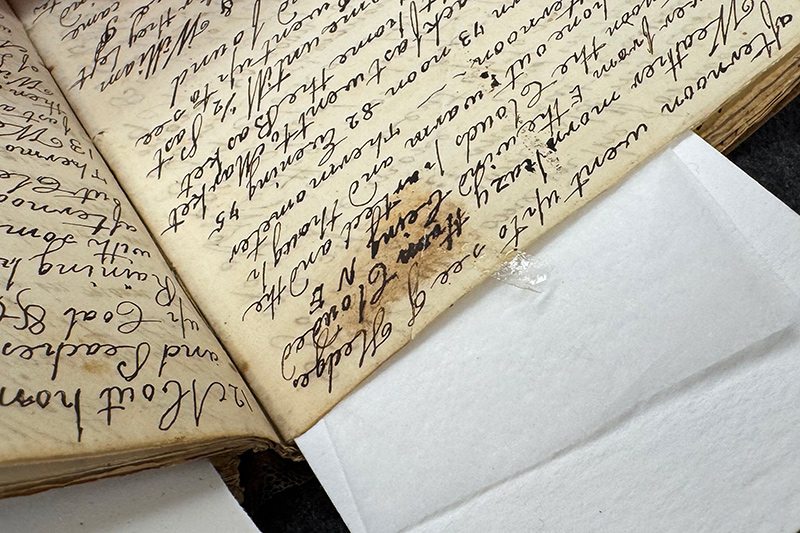
Second-year Library and Archives major and Winterthur/University of Delaware Program in Art Conservation Fellow Luke Kelly is an avid book collector. His current project is a diary kept by 19th-century ropemaker and wire weaver Joseph Stidham, bound together with found materials.
Book collecting might not seem like a competitive sport, but Luke Kelly treated it like one — and won, repeatedly. At Harvard, he took home prizes at the university’s annual competition and at the Library of Congress national competition. A standout collection was a senior-year project built around his family’s connection to President John F. Kennedy and the PT-109 incident in World War II: Kennedy had saved Luke’s great-grandfather’s life, carrying him through the Solomon Islands after their boat was destroyed.
“I still collect books all the time,” said Luke, a second-year Library and Archives major in the Winterthur/University of Delaware Program in Art Conservation (WUDPAC). He grew up on the Mississippi Gulf Coast and came to conservation through Harvard’s rare book library and a fellowship at the University of Notre Dame.
His current project is a diary kept by Joseph Stidham, a Wilmington, Delaware, ropemaker and wire weaver who recorded his daily life for more than 30 years before his death in 1870. Winterthur acquired roughly 20 volumes and Stidham “actually bound them himself, using found materials,” Luke explained. “Sometimes the spine of the book is made out of leather that came from a pair of pants or some kind of garment, and you can see the original sewing.” The one he chose had paired sewing stations that showed Stidham “was really good with a needle and thread.”
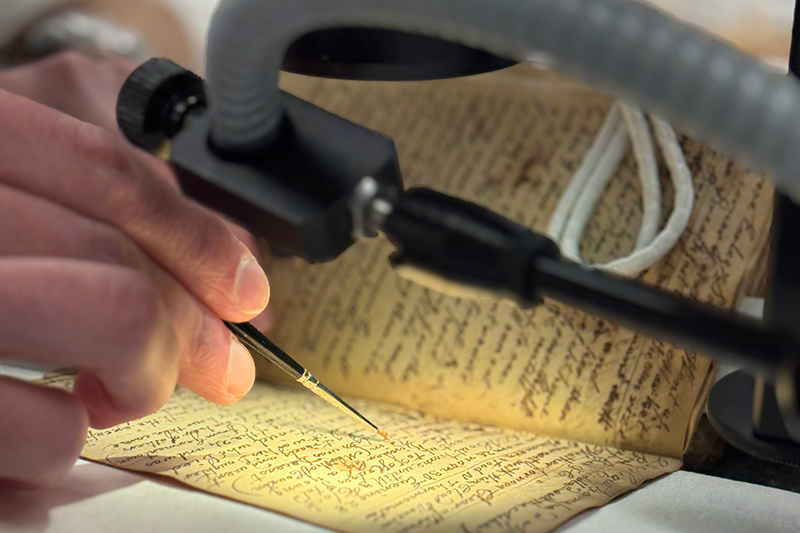
Luke’s approach was minimalistic — light cleaning, securing the covers, and mending some page tears. The diary’s entries are written in iron gall ink, like that used in the Declaration of Independence. Introducing moisture accelerates its breakdown, which can lead to iron gall dropout, where letters literally fall from the page. To mend tears without triggering that process, Luke applied an ethanol-reactivated adhesive in hair-thin strips of Japanese kozo tissue, each barely an inch long. He also used Gore-Tex and a pliable paste mixture to humidify and reset a dog-eared corner of the front cover and stabilized fraying textile on the spine with a heat-activated polyester netting.
Finally, he built the book a snug four-flap wrapper. Restraint was the point. “I just want it to be stable,” Luke said, so that future researchers can safely read a 19th-century Wilmington man’s observations about peach harvests, meteor showers and an unpaid poll tax. Luke’s passion for such collections is what drew him to conservation in the first place. “Books aren’t just text,” he said. “They’re artifactual pieces that tell a story in and of themselves.” Stidham’s diary is now ready to prove it.


