Category: Art Conservation
Student Blog: Art conservation and historical mysteries
July 25, 2025 Written by Lisa Chambers
“I love to preserve history,” said second-year fellow Zoe Avery. “That’s my passion.”
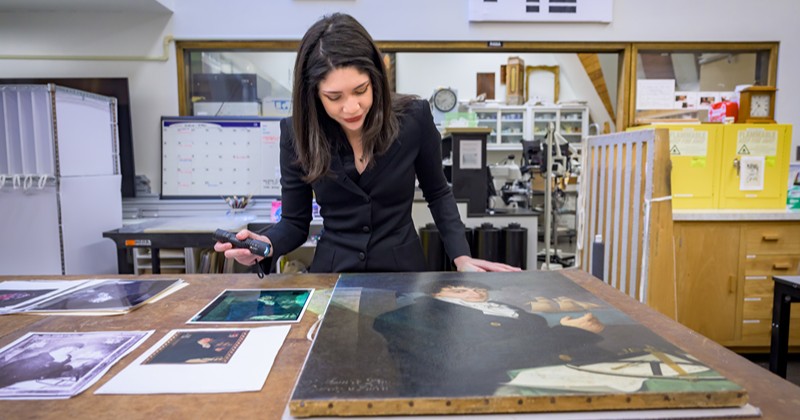
A paintings major in the Winterthur/University of Delaware Program in Art Conservation (WUDPAC), Avery’s path to conservation began with textiles. “For most of my life, I was a seamstress,” she explained, and while studying history, “I quickly realized that I needed to work with my hands in daily life, otherwise I could not function.” That passion led her into conservation and, more recently, a technical study of a complex portrait from the Spanish colonial world.
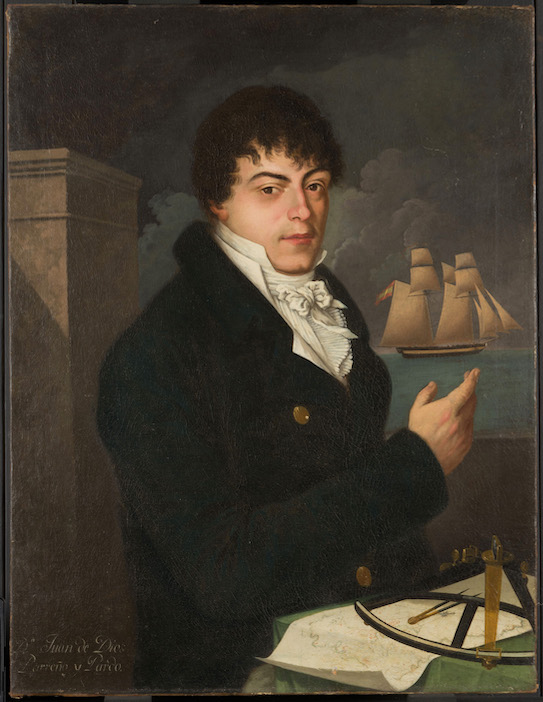
Winterthur has recently expanded its collecting focus to embrace the Americas, Avery said, broadening beyond traditional American material culture. Among the museum’s new acquisitions is a striking portrait of Don Juan de Dios Parreño y Pardo, likely a ship’s captain. Where the painting originated—Europe or New Spain—remained an open question.
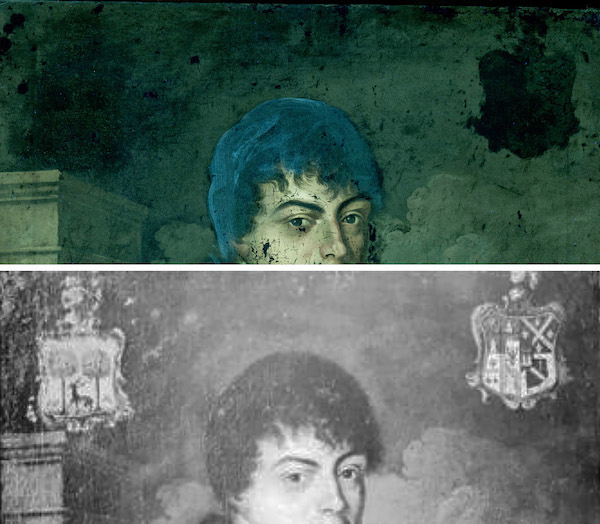
Avery’s first task was to investigate two coats of arms visible in archival photos as recently as 2007 but now missing. “I had to complete a full technical study to verify their authenticity and make sure they were still present underneath any overpaint,” she said. “When I did different analyses, I realized the coats of arms were no longer there. Someone likely scrubbed them off using harsh solvents.” The damage had been painted over, though small traces of the shields remained under magnification.
In her investigation, Avery researched Spanish heraldry and the transatlantic trade in painting materials. Working with the Barnes Foundation in Philadelphia, she used scanning X-ray fluorescence (XRF) spectroscopy to map elements in the work. Multiband imaging and X-radiography revealed extensive overpaint and offered clues to its conservation history.
While the technical study confirmed that the coats of arms were gone, an unexpected clue emerged: the canvas support was cotton. “All our textbooks on easel paintings say it is extremely rare to see cotton canvas until the late 1800s,” she said. In the Spanish viceroyalties, however, cotton was used as a painting support much earlier. Even so, Avery’s knowledge of costume history helped date the work to the early 19th century.
Infrared imaging revealed one more detail: a flag on a ship in the background had been overpainted to appear solid, but beneath it were three stripes—matching historical records of Spanish commissioning pennants, she noted—suggesting the sitter was likely commissioned for war by the Spanish Crown. After light restoration, the portrait—now better understood thanks to Avery’s efforts—will likely go on view at Winterthur in 2027.