


Category: Undergraduate Students
Art conservation and family histories
January 24, 2025 Written by Lisa Chambers
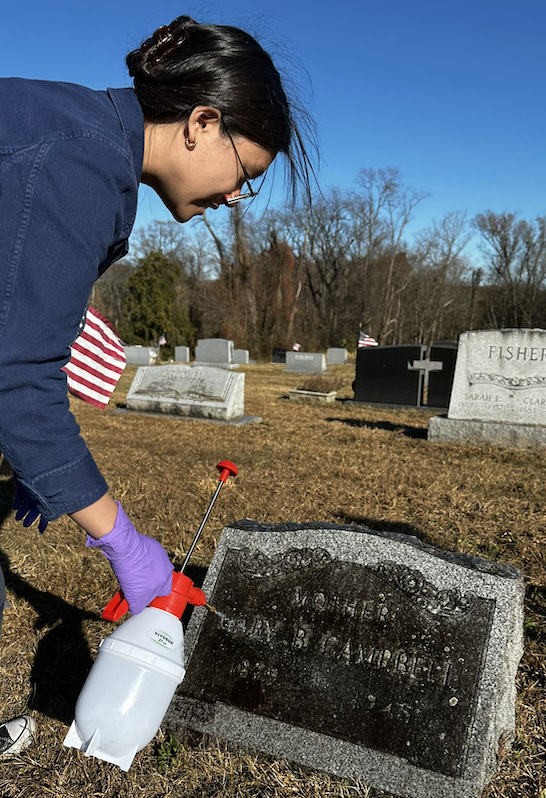
William Donnelly, associate preventive conservator at Winterthur Museum, had a question for his student, Binh-An Nguyen: Why had his family’s gravestones become so degraded—some kind of growth obscured the names and dates and how could they be cleaned? For second-year preventive conservation major Binh-An, the project “felt like a great fit,” she says.
In high school, Binh-An had been drawn to both art and science, and a cousin had suggested art conservation as a way to blend the two. “It encompassed everything I love,” she recalls, “art history, studio art, chemistry, and I thought, ‘This is perfect.’” During and after college she pursued conservation internships working with fine art, photographs and objects. The gravestones were a welcome addition to her experience.
As a preventive conservator, she says, “I like to focus on the 10 agents of deterioration, or 10 agents of change.” These include everything from pests and pollutants, to fire, humidity, or other external forces. After researching what impacts stone, she decided moisture likely was the agent causing biogrowth, or lichen—which “tend to like porous and wet environments,” she notes—to grow on the graves.
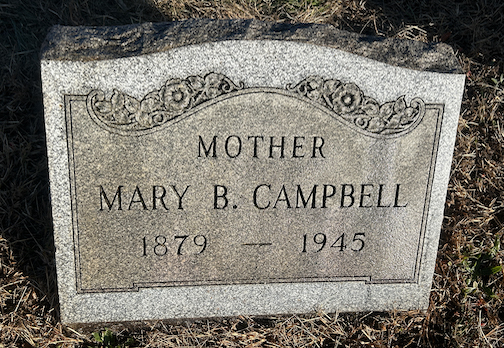
She further discovered that William’s family gravestones were made up of two different types of stone: a primary smooth stone that remained relatively free of biogrowth, and an inset on the face, that was made of a rougher stone. “Biogrowth likes the rougher areas because they hold moisture better,” Binh-An says. “It was a perfect environment for them to spawn.”
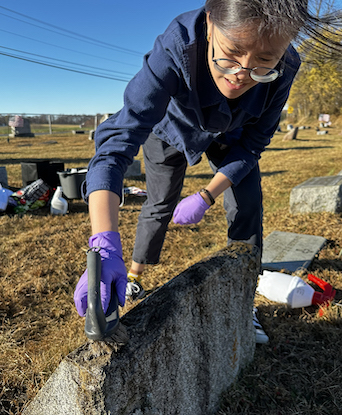
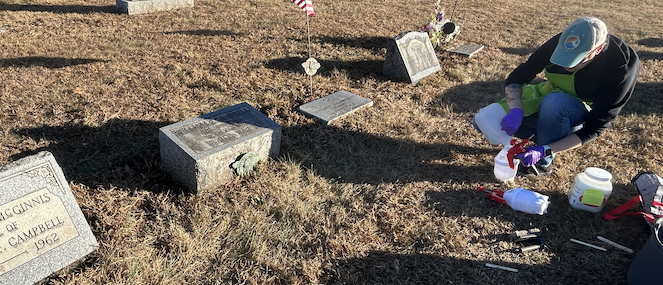
She looked to monument conservators at Arlington National Cemetery, and two recent graduates of the Winterthur program who’d worked with indigenous gravestones, to learn how they cleaned and preserved stone. “It was about wetting the surface, using a 50:50 solution of water and a biocide that kills off biogrowth,” she explains. She and William tried it on four of his family’s gravestones, and it worked, revealing a decorative motif and uncovering the obscured names. She also made recommendations to mitigate future biogrowth, involving annual cleaning. “I advised, ‘don’t do it more than once a year, because it can add to instability or wearing them away,’” she notes.
Binh-An calls the project “a favorite,” in part because it personally resonated with her. “My family and I go to my grandfather’s grave every year on the anniversary of his death, and we clean his gravestone,” she says. “His does not have this biogrowth issue because it’s a metal plaque on a stone, but it was really nice sharing this tradition with William.”