


Art Conservation (MS)

Winterthur/University Of Delaware MS Program
In Art Conservation
The Winterthur/UD Program in Art Conservation (WUDPAC) is a three-year graduate program leading to a master of science in art conservation. Jointly sponsored by the University of Delaware and Winterthur Museum, Garden and Library, the program prepares conservation professionals to examine, analyze, stabilize, treat and preserve cultural artifacts while building a broad foundation in the arts, humanities and sciences.
Faculty and students have access to 15 conservation laboratories, studios, examination rooms and workshops in the Louise du Pont Crowninshield Research Building at Winterthur, including one of the country’s largest and best-equipped museum analytical laboratories. Winterthur also offers internationally recognized collections and research resources. At UD, students have access to art studios for reconstructing historic techniques, science laboratories and a conservation laboratory.
Tours of Winterthur’s conservation laboratories are available to prospective applicants during the academic year.
Fall 2026 tours will be offered from 1:30-2:30 p.m. on the following dates:
Wednesday, Sept. 23
Tuesday, Nov. 17
Wednesday, Dec. 9
Spring 2027 tour dates will be posted in January.
To sign up for a tour or ask questions about pre-program conservation tours, contact WUDPAC fellows Malery Nguyen (she/her) and Kaylie Sagara (she/her) at WUDPACtours@udel.edu.
View program information and resources.
For other inquiries, contact WUDPACadmissions@udel.edu. The academic support coordinator will direct your question to the appropriate faculty member.
Hear from OUR WUDPAC students
Inside WUDPAC: Student Perspectives
In this episode of the Winterthur Museum, Garden & Library Podcast, WUDPAC Class of 2026 alumnae Leah Palmer and Caitlyn Fong share a behind-the-scenes look at graduate study in art conservation. Recorded in September 2024, when Palmer and Fong were second-year fellows, the conversation explores their experiences in the program and offers prospective students a glimpse into learning and working at Winterthur.
Three Paths to Art Conservation
Through the perspectives of three WUDPAC graduate students, this video explores the many paths into art conservation and the interdisciplinary nature of the field. Students share the experiences that led them to conservation, describe hands-on projects involving books, textiles, works on paper and other cultural materials, and reflect on the role conservators play in preserving objects, stories and connections to the past.
YouTube Video Link Art Conservation: Three Graduate Student Perspectives: youtube.com/watch?v=tpF7JfIyOdY
Important dates regarding the Winterthur/University of Delaware Program in Art Conservation 2027 admissions process:
- Completed application due: January 15, 2027, by 11:59pm (EST)
- Notification sent to those invited for an interview: Early–Mid February
- Virtual interview dates: March 22–25, 2027
- Decisions shared: April 8, 2027
- Final response from applicants required: April 15
- Start date for the Class of 2030: August 9, 2027
Bachelor's Degree
Applicants must have a BA, BFA, or BS (or the international equivalent) from an accredited college with an overall academic GPA (on a 4.0-point scale) of at least 2.5 and a GPA of 3.0 in their field of concentration. The latter figure is computed from the junior and senior years.
Required Courses
One course in each of the three categories below can be in-progress during the semester in which you apply.
18 undergraduate semester credits in material culture-related studies
- Some examples include, but are not limited to anthropology, archaeology, art history, history, textile history, book history, museum studies, or library or information studies. Ideally three or more will be upper-level courses.
16 undergraduate science credits (4 courses)
- General Chemistry I and II (8 semester credits): 2 courses each with an in-person laboratory.
- Organic Chemistry (4 semester credits): 1 course with an in-person laboratory
- Survey courses for nursing, medical technology students, and other health professionals are accepted, in addition to courses designed for chemistry or biology majors.
- Fourth science course (4 semester credits), with an in-person laboratory. Some examples include, but are not limited to:
- Biochemistry
- Inorganic Chemistry
- Material science
- Microbiology
- Mineralogy
- Organic Chemistry II
- Quantitative Analysis
- Physical chemistry
- Physics
- Polymer science
- Introductory chemistry courses will not be accepted
4 courses in studio art, craft or design
- Applicants may fulfill this requirement with either 3-credit academic courses or formal studio courses taught at museums or other community centers. These experiences can be enriched with additional hours at home or independently in a studio, as necessary and feasible. The goal for each studio art course is 72 hours of supervised or concentrated studio/at-home work. A distribution of at least one course in two-dimensional and one course in three-dimensional design is preferred; we will consider favorably different combinations of studio coursework. Some examples include, but are not limited to:
- Architectural drawing
- Bookbinding/book arts
- Ceramics
- Drawing
- Graphic design/CAD
- Metalsmithing
- Painting
- Photography
- Printmaking
- Sculpture
- Textile/fashion arts
- Videography
- Woodworking
Conservation and/or Collections Care Experience
Four hundred (400) hours of documented conservation experience under the supervision of a collections professional are required, which may include involvement in supervised collection care projects such as collection assessments, rehousing, and exhibition design, as well as examination and treatment of individual artifacts. Above all, applicants are expected to be thoroughly acquainted with conservation as a career option and to possess a fundamental knowledge of its philosophy, ethics and basic working procedures.
Applications must be made through the Graduate Studies Office at the University of Delaware using the online application. All application materials listed below must be uploaded electronically through this online platform. The application deadline is 11:59pm EST on January 15, 2027.
You are strongly encouraged to start your application early. You will only be able to access some of the documents below from within the application platform.
Please do not hesitate to email with questions or concerns, WUDPACadmissions@udel.edu
Letters of Recommendation
Applicants must submit 3 letters of recommendation. At least one of these letters must be from a practicing collections professional who has supervised the applicant's conservation work.
We encourage applicants to contact their recommenders at least three weeks before their application is due.
Applicants should ask recommenders to speak to some specific points below, giving examples where possible, in addition to commenting on their conservation skills and knowledge.
- Hand skills, spatial understanding
- Intellectual curiosity, problem-solving, and research skills
- Function in shared workspace (examples: work with shared equipment, clean space after using, comfort with teamwork)
- Communication skills
- Ability to give and receive constructive criticism and feedback
- Organization, attention to a focused task, multitasking, and time management
- Ability to work with others and independently
Essay – in the form of three short-answer questions, 300 to 500 words each
- How do you define material culture and why do you believe it should be preserved?
- How do you deal with adversity or challenges? This could be academic, professional, or personal.
- Describe a situation when knowledge you gained in one context proved valuable in a different setting.
Supplemental Document
The WUDPAC Applicant Additional Information Form allows you to document the required coursework you have completed, your 400 hours of conservation or collections care experience, relevant professional and volunteer activities, professional development opportunities, and memberships in professional organizations.
Transcript(s)
Transcripts from all post-high school academic institutions must be uploaded to the online application. Unofficial transcripts or scans of official transcripts may be used. Do not mail official transcripts to the University of Delaware.
Twenty-four applicants will be invited for a 55-minute virtual interview with the WUDPAC Admissions Committee. Below are general requirements for applicants selected to be interviewed. If selected, candidates will receive detailed instructions.
Conservation Portfolio
Applicants will submit 3 reports in PDF format that will help demonstrate the depth and/or breadth of your experience and your professionalism.
- One must be a conservation treatment report (including an object description, treatment proposal, and treatment report) or a conservation project report (see listing below) of a project that you will include in your interview presentation.
- The other 2 reports can come from any of the categories below and may be from the same category. For all reports, please note collaborators and/or supervisors where applicable.
- Conservation treatment report
- Conservation project report (storage project, environmental analysis, pest monitoring and eradication, survey)
- Report on historical and/or social context research
- Scientific analysis report
- Report on remote internship project
- Comprehensive annotated bibliography
- Summary of outreach activities
- Publication or poster (a sole author or major contributor)
Art Portfolio
Applicants will submit 4 full-page pdfs of images of your studio artwork. The portfolio should include four artworks and/or reproductions that you feel best display your competence and skill in a variety of studio art and/or historical craft techniques, with at least one two-dimensional and one three-dimensional work.
- For each page, please list:
- Title (if any), medium, support (include materials and techniques), year created, and size.
- A brief description of the course associated with the object's creation or a note that it was independent work.
In addition, kinetic pieces (e.g., bookbindings, garments, mobile sculptures) in the portfolio should also include a 20-second video of the piece in motion.
Applied Science Comprehension Assessment
All applicants invited for interviews will take an online Applied Science Comprehension Assessment that allows applicants to demonstrate knowledge of the fundamentals of general and organic chemistry and their connection to the structure, deterioration, preservation and analysis of cultural heritage.
Oral Presentation
A 10-minute presentation (using PowerPoint, Google Slides or other) in which the applicant discusses a portion of their conservation experience and communicates how they are already connecting to the field.
The curriculum of the first year provides students with an overview of the conservation field and its varied specialties: the history of art and artifact technology, the essential physical and chemical properties of materials, mechanisms of deterioration, the conservation treatment of cultural property, and the fundamentals of preventive conservation. At the end of the first year, students choose their major specialization. Specializations include furniture, library and archives, objects, paintings, paper, photographic materials, and textiles. Students in all specialties can also declare one additional concentration, such as preventive conservation.
In their second year, students focus on their specialty of choice with the objective of continuing to develop: basic hand skills, a thorough ability to examine and document the condition of cultural property, problem solving and ethical treatment decision making, and an understanding of the care and preservation of specialty objects.
The entire third year, or internship year, is spent under the supervision and mentoring of a conservation professional(s) at one or more host institution(s) or private laboratories, where students should function as cooperative and productive staff members. The fundamental objectives of this phase are to broaden students' exposure to specialty object problems and treatments, refine hand skills, build confidence in object assessment and decision-making, improve report-writing skills, and develop responsible professionalism.
Twelve courses, including an eleven-month internship and two 8-week summer work projects, give the student in-depth instruction in basic examination and treatment techniques. Credits, listed parenthetically after the course title, do not indicate the actual hours required to complete the course.
First Year, Science
ARTC 615 Properties and Structure of Art Materials I (3 credit hours, Fall semester)
This course explores the fundamental physical and chemical properties of art and cultural materials, ensuring a basic familiarity with their mechanical and chemical behavior, the causes and mechanisms of their deterioration, and the range of materials and processes used for their conservation and restoration. The fall semester emphasizes organic materials such as, proteins and cellulose, solvent theory, and polymer chemistry.
ARTC 616 Conservation Research Methods (3 credit hours, Spring semester)
This course explores the fundamental physical and chemical properties of art and cultural materials, ensuring a basic familiarity with their physical, mechanical and chemical behavior, the causes and mechanisms of their deterioration, and the range of materials and processes used for their conservation and restoration. The spring semester emphasizes inorganic materials such as metals, glass, ceramics, stone, pigments, plasters, and cements.
ARTC 670 Chemical and Physical Techniques Used in the Examination of Art Materials I (3 credit hours, Fall semester)
This course is designed to coordinate its content with material taught in the concurrent specialty-specific blocks, focusing on the conservation science applications most directly relevant to a specific material or discipline. Applied science topics in the fall semester may include fiber identification, alkaline reserve treatments, iron gall ink corrosion, wet-cleaning techniques for textiles, dye chemistry and analysis, and the mechanical properties of historic and modern fibers.
ARTC 671 Chemical and Physical Techniques Used in the Examination of Art Materials II (3 credit hours, Spring semester)
This course is designed to coordinate its content with material taught in the concurrent specialty-specific blocks, focusing on the conservation science applications most directly relevant to a specific material or discipline. Applied science topics in the spring semester may include corrosion chemistry, mechanisms of glass and bronze diseases, and cleaning metal, glass, and ceramics.
First Year, Block
ARTC 656 Conservation Principles 1 (6 credit hours, Fall semester)
This course is divided into a sequence of specialty-specific blocks that cover each major area of conservation plus principles of preventive conservation. During the fall semester, these typically include paper, textiles, organic objects, and books and library material. Students work with faculty members in each specialty, learn the basic techniques of object examination, study the causes of deterioration, gain experience recommending treatment options for a variety of conservation problems, and establish a foundation for general collections care. Examination and documentation techniques covered during the semester include polarized light microscopy, ultraviolet light examination, and digital photo documentation.
ARTC 657 Conservation Principles 2 (6 credit hours, Spring semester)
This course is divided into a sequence of specialty-specific blocks that cover each major area of conservation. During the spring semester, these typically include photographic materials, wooden artifacts, inorganic objects, and paintings conservation. Students work with faculty members in each specialty, learn the basic techniques of object examination, study the causes of deterioration, gain experience recommending treatment options for a variety of conservation problems, and establish a foundation for general collections’ care. Examination and documentation techniques covered during the semester include cross-section microscopy, x-radiography, and digital photo documentation.
Second Year, Science
ARTC 672 Chemical and Physical Techniques Used in the Examination of Art Materials III (3 credit hours, Fall semester)
During the second year, the student will gain a basic familiarity, hands-on experience, and fundamental understanding of the instrumental methods of analysis most commonly used in art conservation. In the first semester, specific emphasis will be placed on the spectroscopic techniques that are routinely employed in museum laboratories, including, for example, Fourier transform infrared spectroscopy (FTIR) and Raman spectroscopy. A technical analysis of an object of art will be undertaken in the second year with the student gaining individual mentoring and hands-on experience using instrumental methods of analysis to characterize the materials used to make and conserve objects of art. This will include experience interpreting data and working with complementary methods of analysis.
ARTC 673 Chemical and Physical Techniques Used in the Examination of Art Materials IV (3 credit hours, Spring semester)
During the second semester, the student will gain a basic familiarity and understanding of the chromatographic methods of analysis most closely related to conservation. Specific emphasis will be placed on the techniques that are most commonly found in museum laboratories, including, for example, gas chromatography-mass spectrometry and high performance liquid chromatography. A technical analysis of an object of art will be undertaken in the second year with the student gaining hands-on experience using instrumental methods of analysis to characterize the materials used to make and conserve objects of art.
Second Year, Major Coursework
ARTC 658 Topics in Advanced Apprenticeship and Research in Conservation I (6 credit hours, Fall semester)
This course provides one-on-one instruction in one of the major areas of specialization, which consist of the following: furniture, library and archival materials, organic and inorganic objects, paintings, paper, photographs, preventive conservation, and textiles. One minor concentration, such as preventive conservation, may also be elected. Focusing on the chosen specialty, the course continues the development of basic hand skills, establishes a thorough ability to examine and document the condition of cultural property, hones problem-solving and ethical decision-making skills in treatments, and reinforces a solid understanding of the care and preservation issues within the specialty. Original works of art and artifacts are examined, studied, and treated in consultation with the responsible curator, institution, or owner as part of the course work.
ARTC 659 Topics in Advanced Apprenticeship and Research in Art Conservation II (6 credit hours, Spring semester)
This course provides one-on-one instruction in one of the offered major areas of specialization, which consist of the following: furniture, library and archival materials, organic and inorganic objects, paintings, paper, photographs, preventive conservation, and textiles. One minor concentration, such as preventive conservation or painted surfaces, may also be elected. Focusing on the chosen specialty, the course continues the development of basic hand skills, establishes a thorough ability to examine and document the condition of cultural property, hones problem-solving and ethical decision-making skills in treatments, and reinforces a solid understanding of the care and preservation issues within the specialty. Original works of art and artifacts are examined, studied, and treated in consultation with the responsible curator, institution, or owner as part of the course work.
Second Year, Seminar
ARTC 650 Seminar in Art Conservation (1 credit hour, Fall and Spring semesters)
As a means of developing their communication skills, students will present talks and write a report on their summer projects; in the spring visiting lecturers, chosen and hosted by the students, will speak on art conservation, curatorial decisions, and science, and faculty will conduct sessions on philosophy and ethics of conservation. Fall and Spring.
Second Year, Electives
Elective Course (3 credit hours)
During the second year of study, students must choose one three-credit elective course during the fall semester and one during the spring semester. Elective courses are meant to address a student’s individual interests or apply to a minor concentration. With approval of the major advisor, electives include course offerings in art conservation or in other relevant departments/programs at the University of Delaware, such as art history, anthropology, museum studies, chemistry, or history. Alternatively, students may opt to complete an independent study of their design (see ARTC 666).
ARTC 666 Independent Study (3 credit hours, Fall or Spring semester)
This course is designed by the student, under faculty supervision, to study cultural context, material science, conservation practice or history of technology. The student must submit a proposal to be approved by the supervising faculty member who will evaluate it for appropriate academic rigor and relevance to the student’s course of study.
Summer Work Projects
Each student completes two 8-week summer work projects during the first and second summer in the program. The work project locations are approved by the program to provide additional experiences in conservation principles and practice.
All enrolled WUDPAC students receive a yearly stipend and full tuition scholarship.
Partnerships
We partner with 200+ museums, donors, and foundations to secure ongoing funding for our students.
We are grateful for the many federal agencies, foundations, corporations, membership organizations, and individuals who have generously supported the education and training of future conservation professionals. Our program is supported by grants from the Ahmanson Foundation, AKC Foundation, Annette Kade Charitable Trust, Bank of America Foundation, Bay Foundation, Brunschwig & Fils Corporation, E. Rhodes and Leona B. Carpenter Foundation, Chichester duPont Foundation, Cassman Graduate Fellow Support, Conservation Resources Inc., Crystal Trust, Eastman Kodak Company, Getty Foundation, Gould Foundation, Karen & Leo Gutmann Foundation, Mellon Foundation, National Endowment for the Humanities, National Society of The Colonial Dames of America, Nielsen Bainbridge Corporation, International Questers, Robert Rauschenberg Foundation, Samuel H. Kress Foundation, Sloan Foundation, Society of Winterthur Fellows, Stockman Family Foundation, Tru Vue, UNIDEL Foundation, University Products Inc., University of Delaware Office of Women Affairs, and many individual patrons and donors.
Questions?
Please get in touch with Debra Hess Norris, Chair Department of Art Conservation at dhnorris@udel.edu or Susan Behrens at behrens@udel.edu.
Current WUDPAC students will be provided a Policy and Procedure Guide and WUDPAC Funding Opportunities book for the current academic year in the month of August.
The University of Delaware and Winterthur Museum jointly sponsor the Winterthur/University of Delaware Program in Art Conservation. Successful completion of the degree demands that students abide by the policies and rules of both institutions.
Because professional conservators are usually awarded access to museum collections and valued cultural property of all materials, it is expected that students will demonstrate the highest standards of honor, ethics, and academic integrity as defined by the University of Delaware Student Guide to University Policies , the University of Delaware Undergraduate & Graduate Catalog, the most recently approved American Institute for Conservation (AIC) Code of Ethics and Guidelines for Practice and the Code of Ethics of The Henry Francis du Pont Winterthur Museum, Inc.
Fellows must successfully complete all the required coursework, two summer work projects, and an eleven-month advanced internship. In addition, at the end of the internship, fellows are required to submit a portfolio of their Internship work, give a 25-minute oral presentation about the internship to their advisory committee, and pass an oral examination conducted by the student's advisory committee.
WUDPAC Class of 2027
Allejandra Chavez, Major: Textiles, Minor: Preventive, 2026 summer placement: Cleveland Museum of Art (Cleveland, OH), Third-year placement: Denver Museum of Art (Denver, CO)
Sydney Collins, Major: Objects, Minor: Preventive, 2026 summer placement: Voices in Contemporary Art (New York, NY), Third-year placement: Museum of Fine Arts Boston (Boston, MA)
Elizabeth Glander, Major: Paintings, 2026 summer placement: Royal Museum of Fine Arts Antwerp (Antwerp, BE), Third-year placement: Cleveland Museum of Art (Cleveland, OH)
Anna-Colette Haynes, Major: Objects, Minor: Preventive, 2026 summer placement: Carnegie Museum of Art (Pittsburgh, PA), Third-year placement: Yale Peabody Museum (New Haven, CT)
Luke Kelly, Major: Library and Archives, Minor: Paper, 2026 summer placement: Hagley Museum and Library (Wilmington, DE), Third-year placement: American Philosophical Society (Philadelphia, PA)
Sarah Lavin, Major: Objects, Minor: Preventive, 2026 summer placement: Voices in Contemporary Art (New York, NY), Third-year placement: National Museum of Asian Art, Smithsonian Institution (Washington, DC)
Michaela Lott, Major: Photographs, Minor: Paper, 2026 summer placement: Harry Ransom Center (Austin, TX), Third-year placement: National Gallery of Art (Washington, DC)
Sarah Purnell, Major: Paper, Minor: Photographs, 2026 summer placement: The Joe and Rika Mansueto Library (Chicago, IL), Third-year placement: Virginia Museum of Fine Arts (Richmond, VA)
Emma Reuther, Major: Paper, Minor: Photographs, 2026 summer placement: National Galleries of Scotland (Edinburgh, GB-SCT), Third-year placement: Library of Congress (Washington, DC)
WUDPAC Class of 2028
Kat Baganski, Major: Objects, Minor: Preventive, 2026 summer placement: Colonial Williamsburg Foundation (Williamsburg, VA)
Adam Chin Blahnik, Major: Paper, Minor: Photographic Materials, 2026 summer placement: Amon Carter Museum of American Art (Ft. Worth, TX)
Daniella Bulack, Major: Paper, Minor: Library and Archives, 2026 summer placement: Johns Hopkins University Libraries (Baltimore, MD)
Ellie Fitzgerald, Major: Library and Archives, Minor: Paper, 2026 summer placement: American Antiquarian Society (Worcester, MA)
Yulimar Luna Colón, Major: Paintings, Minor: Preventive, 2026 summer placement: Philadelphia Museum of Art (Philadelphia, PA)
Malery Nguyen, Major: Library and Archives, Minor: Paper, 2026 summer placement: University of Michigan Library (Ann Arbor, MI)
Kaylie Sagara, Major: Textiles, Minor: Organic Objects, 2026 summer placement: Shelburne Museum (Shelburne, VT)
Amy Trompeter, Major: Paintings, 2026 summer placement: Virginia Museum of Fine Arts (Richmond, VA)
Meimei Xu, Major: Paper, Minor: Library and Archives, 2026 summer placement: Harper’s Ferry Center (Harper’s Ferry, WV)
Mara Yella, Major: Objects, Minor: Preventive, 2026 summer placement: Midwest Art Conservation Center (Minneapolis, MN)
WUDPAC Class of 2029
Rebecca Baldwin
Locus Xiaotong Chen
Jenna Gustafson
Anna Keneally
Ellie Ngo
Kenan Potter
Ella Thomas
Camille Valentine
Magdalena Wantschik
Katrina Wilson
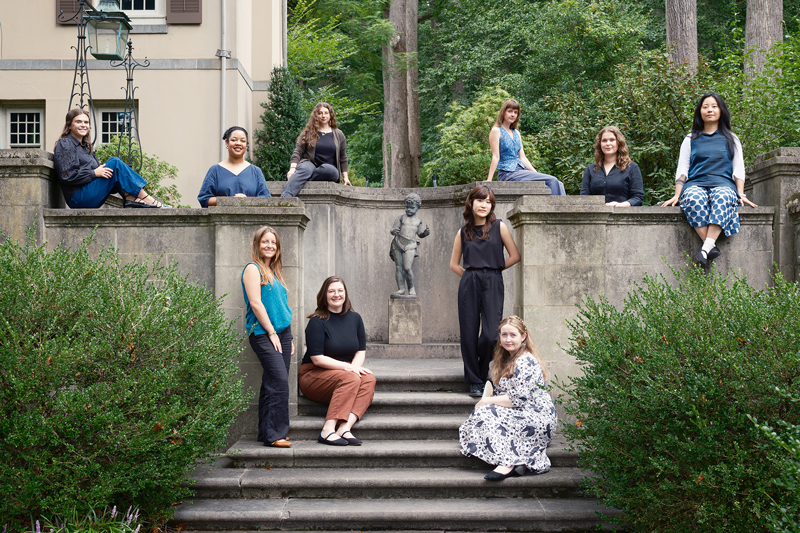
Welcome WUDPAC Class of 2029
The Winterthur/UD Program in Art Conservation (WUDPAC) welcomes 10 fellows in the class of 2029. Coming from across the United States, they bring experience in museums, libraries, private conservation practices and other settings. Their paths differ, but they share a commitment to preserving cultural heritage.
Before entering WUDPAC, the fellows worked with more than 35 institutions and practices, including museums, libraries, archaeological sites and artists' studios
History of the Program
More Than 50 Years of Art Conservation Education
The Winterthur/University of Delaware Program in Art Conservation welcomed its first class in 1974 and has since awarded Master of Science degrees in Art Conservation to more than 300 graduates.
WUDPAC alumni have advanced examination and treatment techniques, helped establish national standards for preserving cultural heritage, and cared for significant works and collections. Their contributions have influenced art conservation as well as scholarship in art history, technology, anthropology and archaeology.
A Partnership Takes Shape
Planning for the program began in the mid-1960s, when Winterthur and the University of Delaware recognized an opportunity to combine their strengths in conservation, science and the humanities. Winterthur also sought to expand collections care and prepare professionals to preserve decorative and fine arts.
In 1969, the Winterthur Board of Trustees approved the creation of a coordinated graduate program that would draw on Winterthur's conservation laboratories and the University's academic resources. The proposed curriculum included specialized study in areas such as instrumental analysis and the conservation of furniture, textiles, costumes and decorative arts.
The First WUDPAC Class
In spring 1974, the University of Delaware Board of Trustees approved the Master of Science degree program in the conservation of artistic and historic objects. Later that year, WUDPAC welcomed its first class of six students.
The program was designed to prepare conservators with a strong foundation in treatment, materials analysis, and the physical and chemical properties of art and cultural objects.


