Undergraduate Programs
the Art Conservation Major
Our Value Statement reflects our commitment to educating future professionals skilled in the analysis, treatment, and preservation of cultural heritage by connecting the arts, humanities, and sciences.
The University of Delaware's Department of Art Conservation offers the only undergraduate degree in art conservation taught exclusively by professional conservators. Our program prepares students for museum careers and graduate study in art conservation, historic preservation, museum studies, library science, and other related fields.
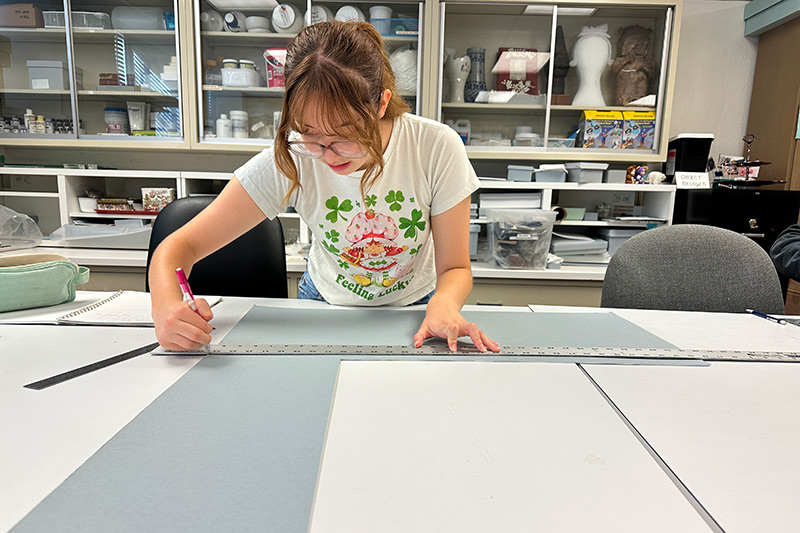
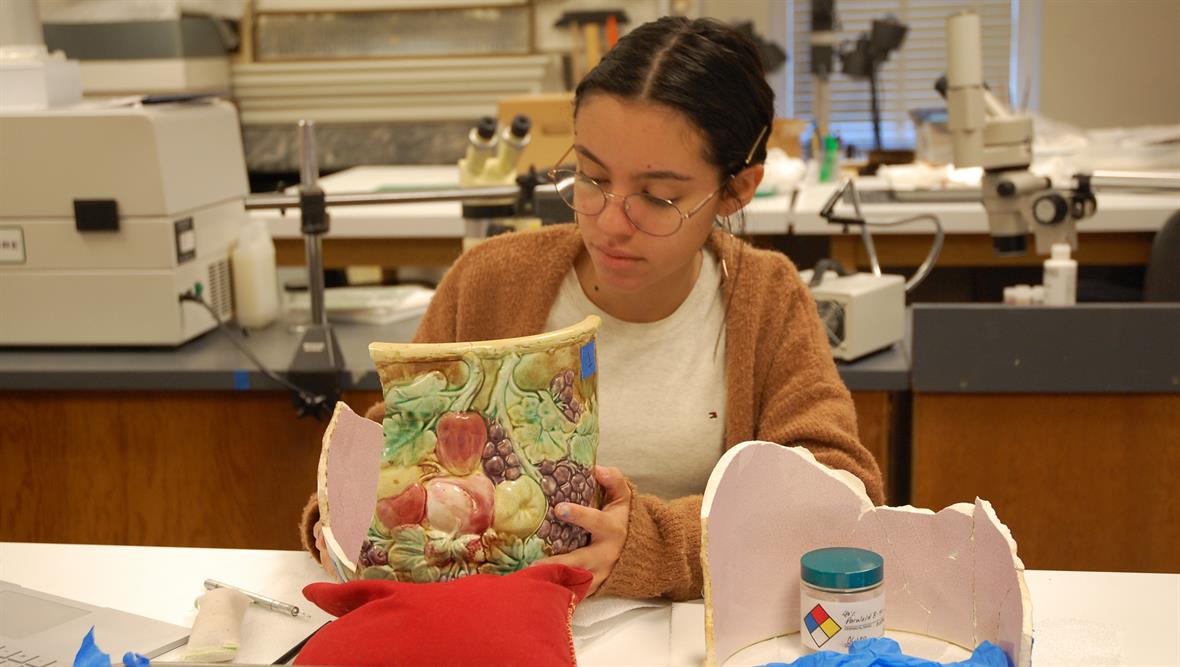
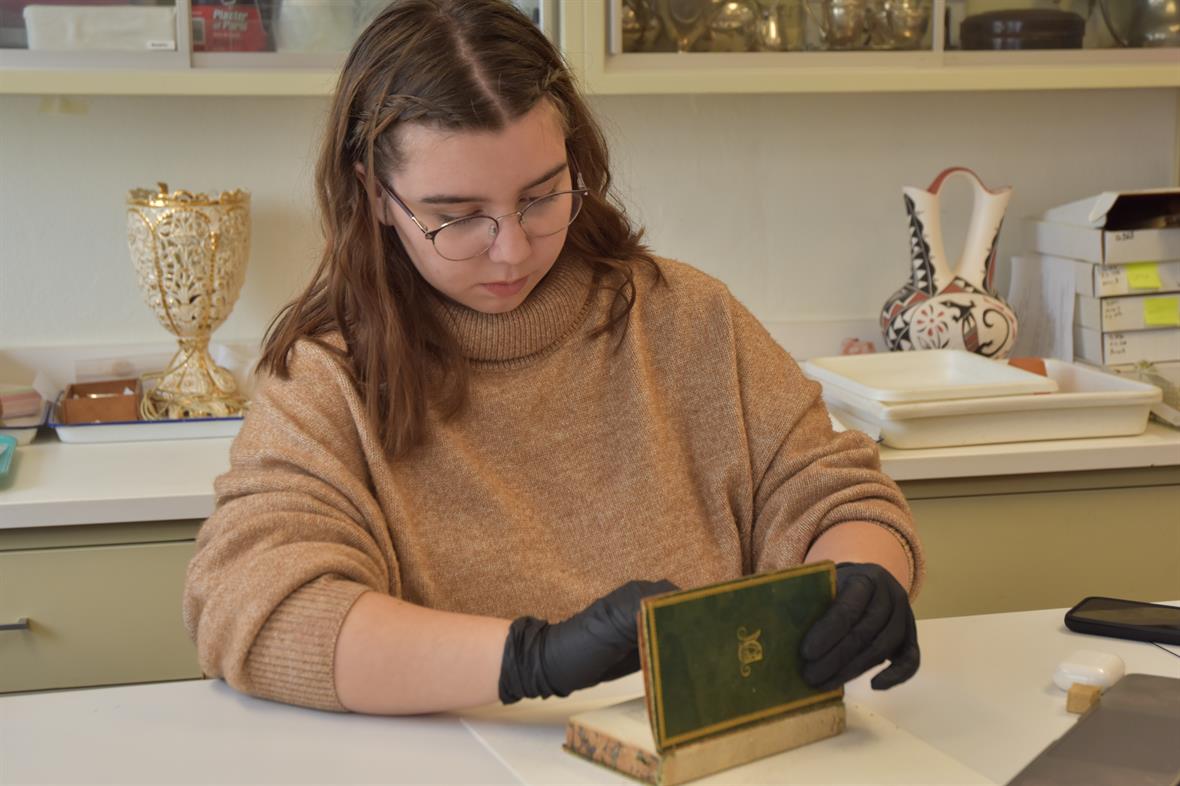
From archival documents and fine art to textiles, natural history specimens, and archaeological finds, students engage directly with the full spectrum of material culture. By working hands-on across these diverse forms of cultural heritage, they build the analytical rigor, technical experience, and critical insights required to preserve and care for human history.
Why Art Conservation?
Art conservation lives at the intersection of art, history, and science. Here, you’ll learn to analyze, stabilize, and preserve cultural heritage, uncovering the hidden stories embedded within objects and the communities who made them. Beyond technical care, conservation is a powerful tool for cultural understanding: it fosters inclusion, strengthens identity, and brings shared heritage to life.
Your Path to a Career in Art Conservation
In a field as specialized and competitive as art conservation, starting early makes all the difference. Our program gives you a distinct advantage from day one:
- Direct-to-Career Readiness: Prepare for immediate roles as a conservation technician or collections care specialist.
- Targeted Graduate Prep: Build the precise academic and technical prerequisites and portfolio required for graduate school, which is a necessary step to becoming a practicing conservator.
- Strategic Mentorship: With only five graduate art conservation programs in the United States, our tailored curriculum, hands-on access, and faculty guidance ensure your application stands out.

Where Do Our Graduates Go?
- 50% pursue graduate studies in Art Conservation
- 25% enter related fields like museum studies, registration, museum leadership, historic preservation, library sciences, and art
- 25% apply their analytical and technical skills to law, software development, business, and education
Founded in 1971 at the intersection of art history and chemistry, our program supports roughly 75 majors across all four years.
Frequently Asked Questions
Yes! As an example, entry into the Winterthur/University of Delaware Program in Art Conservation (WUDPAC) currently requires:
- A BA, BFA, or BS (or the international equivalent) from a regionally-accredited college with an overall academic index (on a 4.0 point scale) of at least 2.5 and 3.0 in your field of concentration
- At least 18 undergraduate semester credits in material culture-related studies. Some examples include, but are not limited to anthropology, archaeology, art history, history, textile history, book history, museum studies, or library or information studies. Ideally three or more will be upper-level courses.
- At least 16 credits (4 courses) in science, specifically:
- General Chemistry I and II (8 semester credits): 2 courses each with laboratory.
- Organic Chemistry (4 semester credits): 1 course with a laboratory.
- Survey courses for nursing, medical technology students, and other health professionals are accepted, in addition to courses designed for chemistry or biology majors.
- A fourth science course (4 semester credits). Some examples include, but are not limited to: Biochemistry, Inorganic Chemistry, Material science, Microbiology, Mineralogy, Organic Chemistry II, Quantitative Analysis, Physical Chemistry, Physics, or Polymer science
- 4 courses in studio art, craft or design:
- Applicants may fulfill this requirement with either 3-credit academic courses or formal studio courses taught at museums or other community centers. These experiences can be enriched with additional hours at home or independently in a studio, as necessary and feasible. The goal for each studio art course is 72 hours of supervised or concentrated studio/at-home work. A distribution of at least one course in two-dimensional and one course in three-dimensional design is preferred; we will consider favorably different combinations of studio coursework. Some examples include, but are not limited to: architectural drawing, bookbinding/book arts, ceramics, drawing, graphic design/CAD, metalsmithing, painting, photography, printmaking, sculpture, textiles/fashion arts, videography, or woodworking
- At least 400 documented hours of conservation and/or collections care experience under the supervision of a collections professional are required, which may include involvement in supervised collection care projects such as collection assessments, rehousing, and exhibition design, as well as examination and treatment of individual artifacts. Above all, applicants are expected to be thoroughly acquainted with conservation as a career option and to possess a fundamental knowledge of its philosophy, ethics, and basic working procedures.
The UD undergraduate curriculum provides all these courses and more!
UD offers several in-house conservation treatment courses each semester. Additionally, students receive help finding and funding external internships. UD's winter session presents a great opportunity to study abroad or hold an outside internship. Our students have interned in many institutions around the world. From Delaware institutions including Winterthur Museum, Garden & Library, the Delaware Museum of Nature and Science, , and Historic Odessa, to the National Museum of American History, the Buffalo Bills Center of the West, the Arizona State Museum, and the Okinawa Institute of Science and Technology, Trinity College Dublin, and the Kaymakçı Archaeological Project, a site in Turkey, to name a few.
The undergraduate art conservation degree alone does not qualify someone to be an art conservator. The art conservation profession’s terminal degree is a master's. After graduation, the majority of students either go directly to graduate school or pursue internships to prepare for graduate studies.
There are 9 full-time conservation faculty members in our department. Additionally, 13 affiliated art conservation faculty members, associated primarily with the graduate program, often provide internships and courses for undergraduate students. Professional conservators are your most important mentors to prepare you for the competitive nature of art conservation graduate programs. They help you connect the dots between art, material culture, and science. Professional conservation faculty are here to help you network within the field and provide hands-on learning experiences. Undergraduates at UD have at least 6 courses with professional conservators throughout the course of their studies. Our program is unique in providing this level of mentoring and personalized learning.
Conservation is by nature an interdisciplinary field. At UD we encourage art conservation students to pursue minors or double majors, often in art history, anthropology, chemistry, fashion and apparel studies, and museum studies. This provides students breadth, giving them the opportunity to explore related interests while combining technical conservation with soft skills, maximizing the time they spend at UD.
Examples of minors commonly chosen by art conservation undergraduates include:
Africana studies, anthropology, art history, Asian studies, chemistry, fashion history, fine art, global studies, history, the Horn Program in Entrepreneurship, interactive media, Islamic studies, languages, Latin American studies, material culture studies, materials science, museum studies, public policy, and wildlife conservation.
The UD undergraduate program is fully run and taught by art conservators. Our faculty represent a range of specialties within the field: organic and inorganic objects, library and archives, paintings, photography, preventive conservation, textiles, and conservation science. Our conservation courses will ground you in the principles of preventive conservation and foster the ethical understanding and hand skills necessary to become a successful professional conservator.
About 50% of our students go on to pursue careers and graduate training in the museum field. Because the major is so interdisciplinary, it can be applied to many different other careers. Some students discover that they are better suited towards or interested in becoming archivists, librarians, art historians, historians, anthropologists, conservation scientists, registrars, collections managers, researchers, or historic preservationists.
Some students are more suited to chemistry than others—it really depends on the student. Interestingly, sometimes art students actually do better in organic chemistry than in general chemistry because of the spatial relationships that are studied. Organic chemistry is challenging and requires your full attention and effort. The University and the Art Conservation Club have study groups and a variety of tutoring resources on campus.
Additional resources and opportunities