



Category: Languages, Literatures and Cultures
Women’s History Month: DLLC faculty share the women who inspire their teaching and research
March 17, 2026 Written by CAS Staff
Spanning archaeology, literature, journalism, music, political thought and poetry, the selections reflect the breadth of the department’s global focus and the lasting influence of women across cultures and centuries.
Among the women recognized are trailblazers who expanded opportunities for women in their fields, challenged social and political norms and helped redefine literature, music and public life.
Marci Boyd points to Harriet Boyd Hawes, the archaeologist known for discovering the Minoan site of Gournia on Crete. Boyd Hawes helped open new possibilities for women balancing scholarship, teaching and family life.
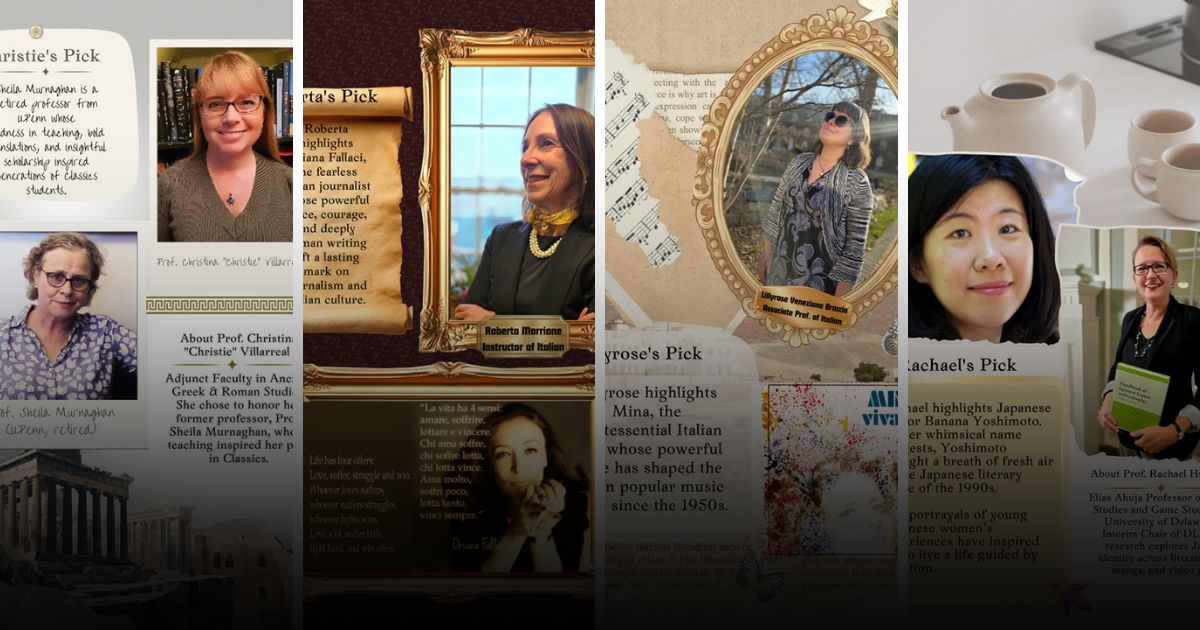
Christie Villarreal selected former University of Pennsylvania professor Sheila Murnaghan, whose kindness in the classroom, bold work in translation and influential scholarship inspired generations of Classics students.
Roberta Morrione highlighted Oriana Fallaci, the Italian journalist known for her fearless reporting, powerful voice and deeply human writing.
For Lillyrose Veneziano Broccia, the inspiration is Mina, the iconic Italian singer whose voice and artistry have helped shape Italian popular music for decades.
Deborah Steinberger chose Madeleine de Scudéry, a major figure in 17th-century French literary culture whose novels and salon elevated women’s voices in literature and society.
Rachael Hutchinson recognized Banana Yoshimoto, whose fiction brought a fresh perspective to Japanese literature and whose portrayals of young women’s lives have resonated with readers around the world.
Haihong Yang highlighted Wang Duanshu, a writer, literary critic and painter of the Ming dynasty who edited Mingyuan shiwei, an anthology celebrating poetry by women writers.
Julia Domínguez selected María de Zayas, the early modern Spanish writer whose fiction exposed violence against women and defended women’s intellect and autonomy.
Persephone Braham selected Remedios Varo, the Spanish-born painter who spent much of her life in Mexico and built a body of work shaped by the fantastic, the metaphysical and the strange. Braham points to Varo not only for her artistic vision, but also for the resilience and collaboration that defined her life, from navigating exclusion in 1930s Surrealist circles to supporting women artists and fellow creatives.
Diane Richardson chose Clara Zetkin, the German feminist, politician, teacher and journalist who proposed International Women’s Day in 1910.
Together, these selections underscore the many ways women have influenced the intellectual, artistic and cultural traditions that continue to shape the work of Department of Languages, Literatures and Cultures today.
For the department, the project offers a Women’s History Month reflection on mentorship, legacy and the power of women’s voices across time and place. Visit the faculty profiles to learn more about their work.
View this Instagram post from UD DLLC
View the post on Instagram.


