



Category: Research

Investing in the Future of Science
May 13, 2026 Written by Atif Bacchus | Evan Krape and courtesy of Alenka Hlousek-Radojcic
Senior reflects on how UD course changed his path and led him to become a published researcher
Editor’s Note: University of Delaware senior Atif Bacchus is an honors biological sciences major who started his Blue Hen career with no idea how to conduct scientific research. Now he’s graduating with publications in two different oncology journals for work he has done on breast cancer hotspots and systemic inflammation.
During his UD career, Bacchus has used cutting-edge gene-editing CRISPR technology in labs at the ChristianaCare Helen F. Graham Cancer Center, presented at national conferences and mentored other UD students as a teaching assistant.
Bacchus credits his success to the Honors Integrated Biology and Chemistry (HiBC) course he took his first semester. HiBC is a unique offering that integrates both biology and chemistry in a way that brings them to life. Bacchus said the course gave him the rigor and support he needed as a freshman to flourish in high-level research over the last three years.
Below he reflects on the class that transformed his time at UD and how it reflects the University’s commitment to the success of its students.
When universities discuss investment, the focus often turns to buildings, technology and facilities. But some of the most meaningful investments happen in classrooms and laboratories, where students discover their potential and begin shaping their futures. For me, that investment was the Honors Integrated Biology and Chemistry (HiBC) course sequence.
Now, as a senior, I have published two oncology research papers, a breast cancer hotspot case study in Journal of the National Cancer Institute Cancer Spectrum, and my thesis work on markers of systemic inflammation in Frontiers in Oncology. Four years ago, however, I had little understanding of what research was, let alone its role in advancing science. HiBC changed that trajectory entirely.
HiBC is more than a set of courses; it is an intensive interdisciplinary experience that transforms motivated students into research-ready scholars. For ambitious students considering their future at the University of Delaware, it can be a defining first step.
Building my freshman village
Like many first-year students, I arrived overwhelmed and uncertain. Sitting in the front of the class seemed to be the right approach. The rigor of the HiBC course was undeniable, but so was the sense of community it created. Within weeks, we were studying together in the residence hall lounges, solving problems collectively, and learning how biology and chemistry are deeply interconnected rather than separate subjects, a reality the HiBC curriculum intentionally reflects.
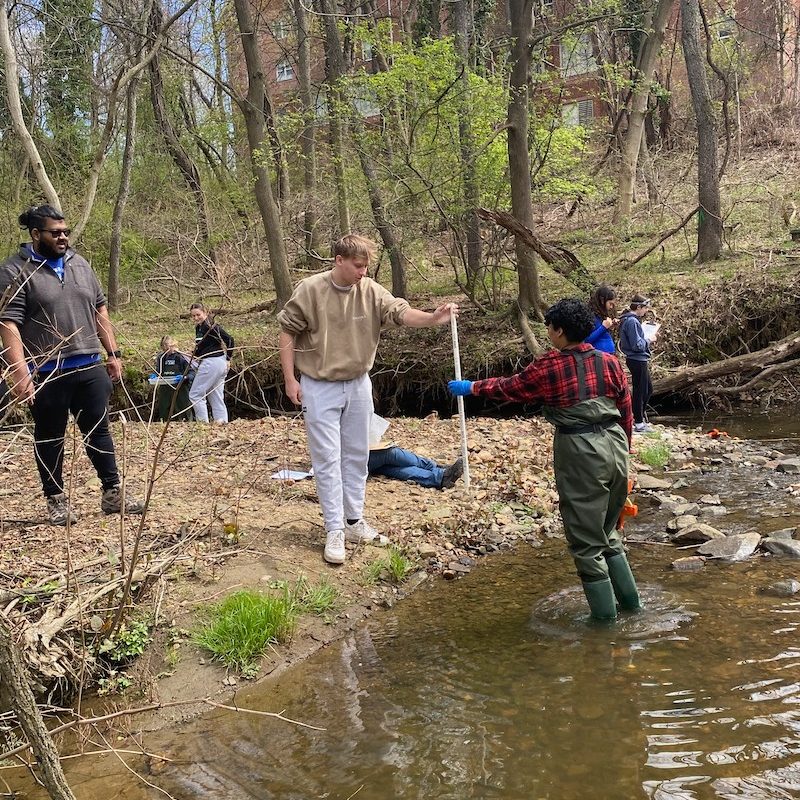
The uniqueness of HiBC lies in the sheer dedication of its teaching team: laboratory teaching assistants, studio fellows, chemistry workshop leaders, preceptors, lab coordinators and faculty. My freshman chemistry teaching assistant (TA), Shivani, herself an HiBC alum, became a model of what I hoped to achieve. I regularly attended her office hours, not just for help with lab work, but for guidance on navigating college. I also connected with our then-preceptor, Jordan Mohr, who is now a professor in the Department of Chemistry and Biochemistry, whose analytical teaching style clicked with me. Through countless conversations, I gained practical skills in statistical analysis and figure design that I still rely on in my research today. The diversity of the teaching styles within the program allowed me to seek out approaches that best supported my learning.
Our professors, Jacqueline Fajardo and Alenka Hlousek-Radojcic, were equally invested. Professor Fajardo used unconventional examples to make complex chemistry concepts stick. Professor Alenka broke down intricate biological systems through detailed visual explanations. More importantly, they paid attention. When I grew unusually quiet in class, Professor Alenka reached out with a personal email to check in. That level of attentiveness, where professors actually care for your well-being, modeled what true mentorship looks like.
Entering the world of research
HiBC immerses students in authentic academic practice from the start. We developed multi-week, interdisciplinary research projects, presented posters and translated scientific messages to journalism students in a mock press conference. These experiences sharpened my ability to communicate scientific ideas clearly, reducing the intimidation of public speaking.

A pivotal moment came during the First Annual Biology Research Day. I was nervous about presenting my work. Rather than offering generic reassurance, Professor Alenka directed me to a Hidden Brain podcast episode on overcoming stage fright. That small but thoughtful intervention sparked meaningful personal growth. It helped me transform from an anxious presenter to someone comfortable engaging with an audience, eventually allowing me to stand confidently in front of my own students as a TA.
Stepping into the lab early
By November of my freshman year, HiBC had already shifted my perspective on research. Encouraged by my laboratory TA, Shivani, I began reaching out to professors. What I discovered was that opportunity often follows initiative.
Cold emails led to lab tours and my first research experiences. These early exposures helped me realize my desire to work on a project with a stronger biological focus, prompting me to explore translational research opportunities at ChristianaCare.
In my second semester, Jennifer Sims-Mourtada, director of Translational Breast Cancer Research, was initially hesitant to take on a freshman. However, she gave me an opportunity that proved transformative. Within the weeks of attending lab meetings and learning protocols, I joined the team. The relationships I had built with my HiBC professors proved invaluable. They supported my applications and wrote recommendations that ultimately helped me secure the Delaware INBRE summer research program with Scott Siegel at ChristianaCare.
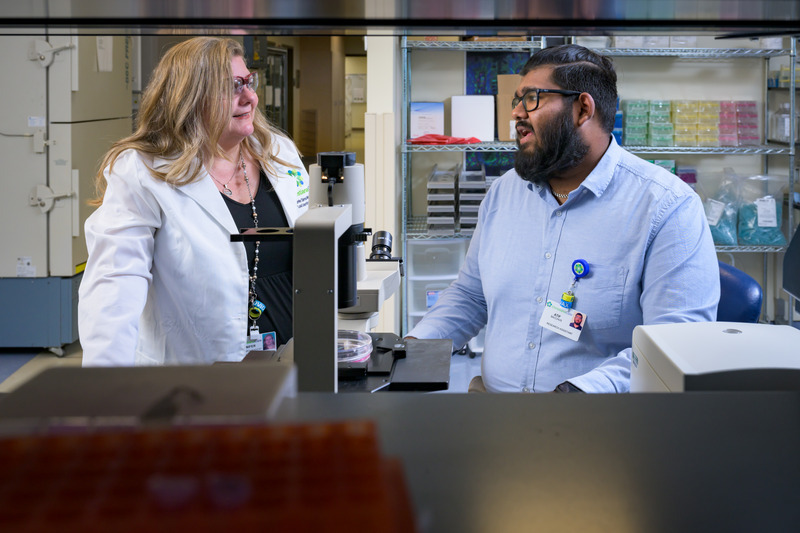
Looking back, the barrier to entry was not experience but the willingness to take the first step. At UD, faculty are willing to invest in students who demonstrate curiosity and commitment. Starting research early provided a depth of learning that no textbook could replicate and allowed me to contribute meaningfully before I even graduated.
A Full Circle
For students willing to fully engage, HiBC is transformative. It took me from a confused freshman to a published researcher, educator and leader. Returning to the HiBC laboratory teaching team over the last four semesters has been the most meaningful way to complete this circle. The faculty empowered this transition; rather than treating TAs as mere assistants, they treated us as collaborators. Instead of just teaching chemistry, I found myself replicating the support system I had relied on. I was simply extending the same mentorship I had received.
Programs like this do more than educate; they cultivate thinkers, leaders, and contributors to the community. Ultimately, the most meaningful investment a university can make is in its students — and at UD, that investment begins here.


