



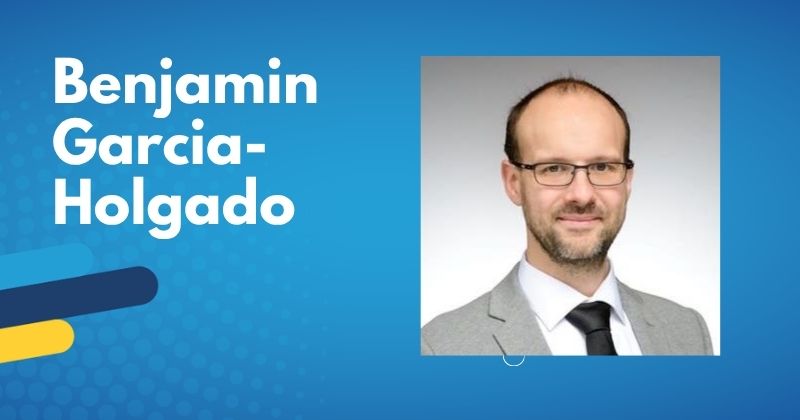
Faculty Spotlight: Benjamin Garcia-Holgado
May 01, 2026 Written by Caroline Schenk graduate students in Political Science and International Relations department
Professors in the Department of Political Science and International Relations at the University of Delaware are exceptional educators, researchers, and mentors. Dr. Benjamin Garcia-Holgado is one of these phenomenal individuals.
Dr. Garcia-Holgado earned his Ph.D. in Political Science from Notre Dame in 2023 before joining the department. His doctoral thesis earned the 2025 Edward S. Corwin Award from the American Political Science Association in public law. He is broadly interested in what makes some political regimes more or less stable and the role that individuals and collective actors play in shaping that stability. Lately, he has focused on how judges, practicing lawyers, prosecutors, and other actors enable or resist processes of democratic erosion. Dr. Garcia-Holgado is a passionate teacher, offering courses on several topics, including comparative politics, law and politics, and democratization.
I interviewed Dr. Garcia-Holgado to discuss his ongoing research, what motivates his research interests, and his advice for aspiring researchers.
What projects are you currently working on?
I am working on several projects. One is a book project with a professor from Notre Dame, explaining why Argentina experienced political regime change starting in 1983. Argentina used to have a highly unstable back-and-forth between authoritarianism and semi-democratic regimes, with very few and very short instances of democracy. After 1983, it became a relatively stable democracy. The goal is to explain why the political regime experienced such contrasting dynamics of stability across Argentina’s history.
Another project I am working on examines why populist leaders sometimes appoint justices with personal ties, rather than based on similar ideologies. I ask what possible consequences those choices have on democratic stability.
Lastly, I am working to develop a new way of conceptualizing democratic erosion and democratic backsliding. Democracy has many components, and the relationships among those components are complex. When we look at current measures of democratic erosion, the focus is on whether democracies decline over time across all of those components as one concept. This project is meant to develop a more accurate measure of democratic decline that looks at each of those components more separately.
What motivated you to conduct research in this subject area?
That is a very good question. I think in my case, it has to do with my family history. My father was born in Madrid, Spain, in 1934, three years after the proclamation of the Second Spanish Republic in April 1931. Between 1936 and 1939, Spain went through a horrible civil war. My grandfather and uncle were killed, and other family members were killed. The war ended in 1939, with the victory of General Francisco Franco, the leader of the Nationalist faction. My grandmother, father, and two aunts were forced to flee Spain in the 1940s.
I believe this experience had a significant impact on me. It made me realize the importance of defending liberal democracy as a fundamental goal and emphasizing how vital its rules and procedures are for everyday citizens. Sadly, most people aren’t truly excited by liberal democracy itself. Instead, they care about tangible issues like abortion, equality of goods, and taxation levels. I understand why people feel passionate about these topics and view liberal democracy as something abstract and difficult to grasp. But, often, they don’t realize or appreciate the extremely negative effects that the gradual loss of individual rights and free elections can have on their lives. Losing these protections can mean life or death, detainment, or exile.
Dr. Garcia-Holgado’s “one-sentence” advice for future researchers is: “Choose a topic that really interests you, and that is connected to big and significant social and political questions.”
Caroline Schenk is a PhD student in the Political Science and International Relations department - contact: caschenk@udel.edu
Dr. Garcia-Holgado is an Assistant Professor in the Department of Political Science and International Relations - contact: bgarciah@udel.edu


