



Category: Sociology and Criminal Justice

Mackenzie Niness: Graduate Student Spotlight
March 03, 2026 Written by Chiu-Yin Mak | Photos courtesy of Mackenzie Niness
Mackenzie Niness, a doctoral student in criminology at the University of Delaware, presented a proposal for a research project at the Arnold Ventures Criminal Justice and Public Safety Ph.D. Research Workshop in Houston, Texas, in October 2025. The workshop brought together doctoral students from across the country to present emerging research ideas and receive feedback from peers and leading scholars in the field.
Niness’s project examines the effectiveness of gender-responsive prison programs across multiple outcomes, including measures valued by both the criminal legal system and incarcerated individuals. It builds on work she conducted for her master’s thesis, which explored prison programming experiences and definitions of reentry success from the perspectives of formerly incarcerated cisgender women.
That work gave Niness insight into the philosophy behind gender-responsive programming as understood by correctional institutions, while also hearing directly from women about what aspects of programming were helpful, what fell short, and what was missing altogether.
“Their ideas of success often did not align with the correctional and gender-responsive goal of avoiding recidivism,” she noted.
These insights shaped the research questions Niness brought to the workshop, which consider how programs might better support people of all gender identities in achieving reentry success as they define it, while also placing greater responsibility for change on institutional structures rather than solely on participants.
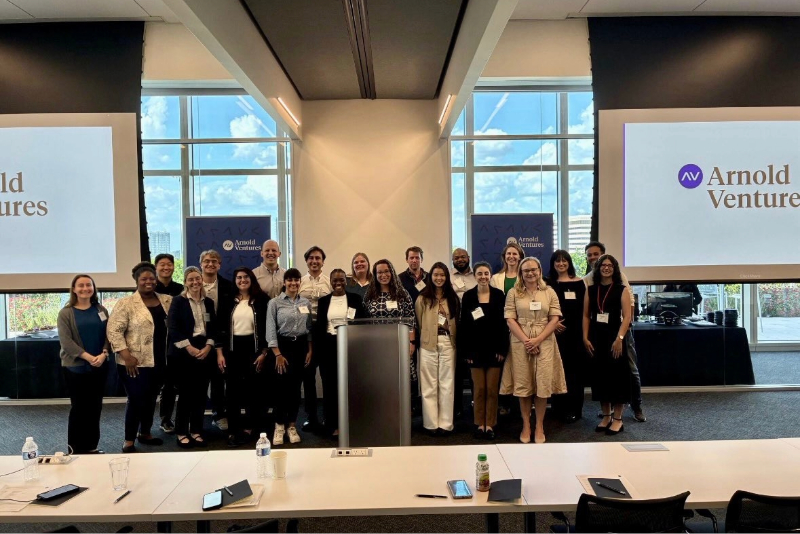
Presenting in Houston played an important role in her professional development. Niness emphasized how valuable the workshop feedback was to her development as a scholar.
“Their feedback, coupled with that of those funding research grants at Arnold Ventures, gave me confidence that my project is valuable to the field as well as those who can be impacted by the results; that my questions are timely and there is a need for this type of insight,” she said.
The workshop also broadened how Niness thinks about her methodological approach. While she had previously seen herself primarily as a qualitative researcher, the experience encouraged her to consider the strengths that causal methods can bring to the study of prison programming and to think more expansively about how her work might advance the field while also producing tangible, real-world benefits for current and formerly incarcerated people.
Niness hopes her work will shape policies and programs that better support people of different genders in the justice system. While she questions some common ideas in current gender-focused approaches, she believes research can help improve how prisons and related programs work and bring about broader social change. She imagines a new way of thinking about gender-responsive programs that not only helps people currently in the justice system but also challenges systems that criminalize marginalized communities. In this way, these programs can promote fairness and justice, rather than just focusing on preventing repeat offenses.


