



Category: History
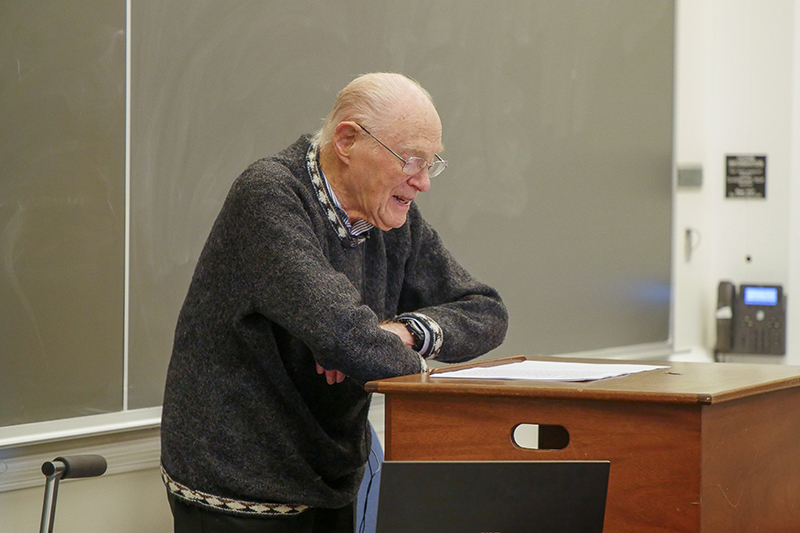
Living history
March 13, 2026 Written by CAS Communication Staff | Photos by: Zoe Pawliczek and Polly Zavadivker
History students have the rare opportunity to hear a Holocaust survivor’s life story first hand
The dramatic events of Jan Rocek’s life happened long ago, but time hasn’t diminished the impact of his story. A Jewish teenager growing up in Prague in the 1930s, Rocek survived Nazi persecution in the Terezín Ghetto and Auschwitz-Birkenau concentration camp, and after the war he escaped Communist Czechoslovakia with his wife and young children to begin a new life in America.
Rocek spoke with students in Polly Zavadivker’s course HIST254: Jewish Holocaust 1933-1945, providing a deeply personal human perspective to this terrifying chapter in history.
Zavadivker, associate professor in the Department of History in the College of Arts and Sciences, explained that students spend the semester reading and interpreting historical literature and primary texts, but having a survivor speak is an invaluable experience.
“With extreme historical events like the Holocaust, the scale of inhumanity and suffering can be difficult to fathom. Jan was a witness,” she said.
Seeking connection
Rocek is now over 100 years old, but he still shares his story to help students understand the importance of freedom and human rights.
He described being separated from his mother and sister on arriving at Terezín, the hunger and disease that killed more than 20% of people sent to the camp, and the constant fear of brutality. When the Nazis closed the ghetto, almost 90,000 Jews were deported to other ghettos and death camps. Rocek and his family were sent to Auschwitz in 1944, where his parents and sister died in the gas chambers.
Yet, he also told students that there was an active intellectual life there.
“Terezín was full of highly educated and creative people,” Rocek told students, describing lectures, music and discussions that took place after long days of forced labor.
Hearing directly from a survivor made the course material more immediate and meaningful for students.
Senior history major Liam Trageser said Rocek’s ability to reflect on both hardship and resilience left a lasting impression.
“In a way, it reflects human nature,” Trageser said. “Regardless of our conditions, people attempt to lead a normal life and pursue avenues that interest them.”
That normal life at Terezín included Rocek meeting and falling in love with his future wife, Eva, who died in 2015, a marriage he called “as close to perfect as possible.”
“While some people would have given up under these circumstances, Jan flourished and made the most of it,” Trageser said.
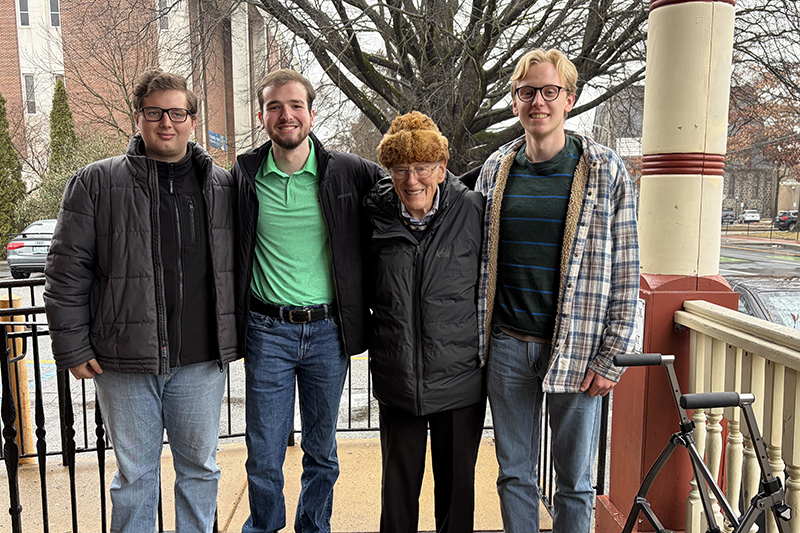
Education and freedom
For sophomore Robin Archangelo, an honors double major in international relations and history, Rocek’s reflections on education were particularly powerful. Rocek is Emeritus Professor of Chemistry at the University of Illinois, Chicago, but as a young man he didn’t realize the value of learning until the Nazis banned Jewish students from public schools.
“Only then, when the Nazis condemned me into ignorance, did I realize how important education was to me,” Rocek said.
Rocek was determined to keep learning despite the obstacles, taking a job in a machine shop and learning chemistry.
“The little I learned there saved my life,” Rocek said, because it gave him the skills to work in less grueling jobs in the ghetto.
“Dr. Rocek's statement in particular made me recognize how education is a vital human right and is often one of the first rights to be restricted or completely taken away in the wake of oppression or tyranny,” Archangelo said.
Rocek admitted that during the war he believed only Germans were capable of committing the unspeakable crimes of the Holocaust, but he cautioned the students against such thinking.
“People of any sort, given power and no accountability, can commit horrible crimes,” he said.
Ryan Shaivitz, sophomore honors student majoring in civil engineering, took the course in spring 2025. He found it so powerful that he asked to be the TA this semester.
“It is incredibly important for people to learn about the Holocaust, as it is not only an important part of history but it also serves as a reminder of what can happen when hatred is politicized, militarized and weaponized,” he said.
After the Communist takeover of Czechoslovakia, Jan and Eva Rocek made the brave decision to escape, jumping overboard with their children from a ferry boat in the Baltic Sea and swimming to Denmark.
They chose to leave so their children could grow up in a society where they could speak freely.
“I just could not face my two sons having to grow up in a system where they would constantly have to repeat lies and never express their own views without fear,” he said.
Their son Thomas Rocek, who was only four years old at the time, is a professor of anthropology at UD.


