Category: Sociology and Criminal Justice

Beyond the Textbook: When History Has a Voice
February 25, 2026 Written by Chiu-Yin Mak | Photos courtesy of Bernice Petit
Robben Island visit reshapes criminology doctoral student’s view of resilience
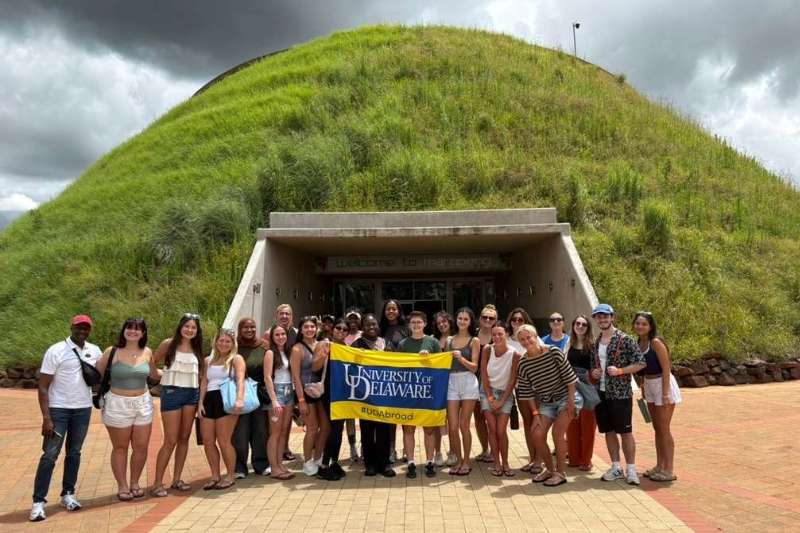
Bernice Petit, a second-year doctoral student in criminology, recently participated in the winter study abroad program in South Africa as a program assistant, an experience that blended academic learning with direct community engagement. Throughout the program, students examined the history and ongoing impact of HIV and AIDS alongside broader issues of crime, health and social inequality through coursework and immersive field experiences. The experience had a significant impact on her academic pursuits.
The group spent multiple days on excursions exploring the legacy of apartheid and the life of Nelson Mandela, including visits to Constitutional Hill, the Union Buildings, Freedom Park and Soweto, connecting South Africa’s political history to present-day social conditions. The program offered a powerful combination of academic instruction, historical engagement and hands-on service, leaving students with meaningful insight and lasting memories.
One of the most impactful experiences for Petit was visiting Robben Island, where Nelson Mandela was imprisoned for 18 years. The tour was led by a former political prisoner who had participated in the 1976 Soweto student uprising, who reminded the group that while Mandela’s name draws many visitors, thousands of others also endured suffering on those same cold floors.
For Petit, the experience challenged her to think beyond a single famous narrative and to recognize the countless lives affected by apartheid. “It really instilled in me that places hold memories, and the things we pay to see and tour were individuals’ lived experiences,” she said, noting that having the tour led by someone who survived the brutality of the prison provided a deeper and more honest understanding of the past.
Petit explained that the visit changed the way she thinks about historical sites. She shared that it reminded her how resistance to injustice was often met with severe punishment and how many who simply demanded change were imprisoned or killed. The experience reinforced for her that these locations are not simply attractions but spaces marked by real human suffering and resilience. Listening to someone who personally endured those conditions, she said, brought a clarity that no textbook could provide.
The program significantly shaped Petit’s academic goals and personal outlook. She now hopes to pursue comparative studies of prison systems in the United States and South Africa, particularly in relation to race, inequality and rehabilitation. During the trip, Petit also learned about the South African philosophy of Ubuntu, meaning “I am because we are,” a principle that deepened her understanding of shared humanity and collective responsibility.
“The trip further instilled in me that the past may be painful, but to move towards a better future, we must never forget from whence we came,” she said. “We need to always remember the past in order to create a better life for ourselves and others.”
Petit is thankful that she had the opportunity to visit South Africa, and she hopes to be able to visit again in the future.