



Category: Undergraduate Students
Measuring Trust in Political Media
February 24, 2026 Written by Natasha Kapadia | Photo by Jessica Burns
Editor’s note: Every year, hundreds of undergraduates at the University of Delaware pursue research under the guidance of a faculty mentor. Such experiences provided by UD — a nationally recognized research university — can be life-changing, introducing young scholars to a new field, perhaps even the path to a future career, as they uncover new knowledge. Natasha Kapadia is a senior communications and political science double major who spent Winter Session 2026 working with communication professor Lindsay Hoffman.
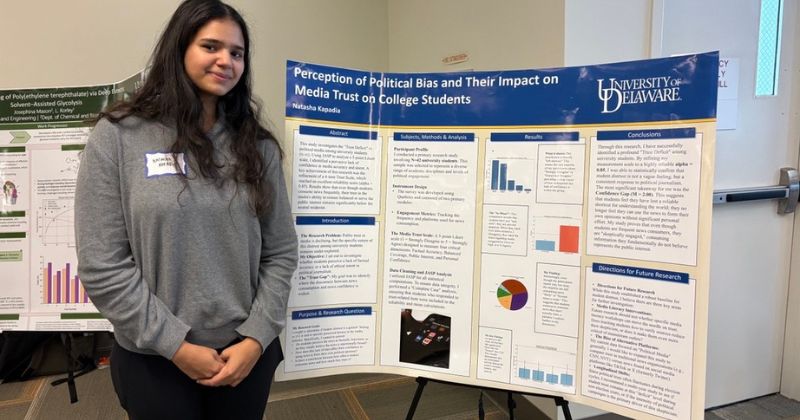
Winter Fellows research explores student media trust
I first learned about the Winter Fellows program through the Department of Communication and decided to pursue my project under Lindsay Hoffman, with whom I had taken COMM301: Introduction to Communication Research Methods. That class introduced me to media research and sparked my interest in how people evaluate political information.
At the same time, I kept hearing classmates say they didn’t trust the news, even though they followed it constantly. I wanted to know whether this skepticism was just casual talk or something that could be measured systematically.
This was my first time conducting an independent research project from start to finish. I designed a digital survey in Qualtrics and asked 42 university students to rate their agreement with statements about political news on a five-point scale. The survey measured whether students viewed the media as accurate, balanced, acting in the public interest, and useful for forming their own opinions.
After collecting responses, I analyzed the data, refined my measurement by removing two questions that did not fit well and calculated averages for each trust area. The results showed a clear trust deficit, with all scores falling below the neutral mark.
The biggest takeaway for me was realizing how much persistence research requires. There were moments of confusion, technical frustration and revision before the findings became clear. This experience strengthened my confidence and showed me that complex problems become manageable when broken into steps.
One piece of advice I would give other students is to start early and give yourself more time than you think you need. Research almost always takes longer than expected, especially when you are learning new tools and methods along the way. Having extra time allows you to revise, ask for feedback and not feel rushed during the process.


