



Category: Jewish Studies Program

Jewish Studies in Special Collections at UD
February 10, 2026 Written by Mark Samuels Lasner, Senior Research Fellow, University of Delaware Library, Museums and Press | Photos courtesy of University of Delaware Library
Israel Zangwill: An Anglo-Jewish Author
When he died a century ago, Israel Zangwill (1865–1926) was the most famous Jewish writer in the English-speaking world, if not the entire planet. Famous then and remembered today for his 1908 play, The Melting Pot (it gave us the term), he was successively and simultaneously a journalist, novelist, dramatist, mystery writer, occasional poet, activist for women’s suffrage and one of the most important figures in Jewish and Zionist politics of his time.
The son of immigrants from Latvia and Poland, Zangwill was born in East London and became a teacher after being educated in the Jews’ Free School, then gaining a degree from the University of London. His writing career began with contributions to periodicals and, by the early 1890s, Zangwill was editing his own magazine, Ariel, or The London Puck, at the same time producing volumes of humorous stories and sketches and The Big Bow Mystery (1892), an early “locked room” mystery.
In 1891, the newly established Jewish Publications Society of America commissioned from Zangwill a novel intended to tell the story of contemporary Jewish life in London. The result was Children of the Ghetto (sometimes subtitled “A Study of a Peculiar People”). Critically acclaimed and a bestseller for decades, called “a powerful book” by fellow novelist George Gissing, this was Zangwill’s breakthrough, placing him in the top rank of British authors, giving him financial security, and facilitating his entrance into literary society, where he came to know not only Gissing, but such figures as Thomas Hardy and H. G. Wells.
Further fiction on Jewish themes followed, with Zangwill being praised as “the Dickens of the Ghetto,” but he also published novels and short stories of a more “secular” nature and worked in other genres, including travel accounts, a volume of verse and a series of plays—several of which found success in London’s West End and on Broadway.
After meeting Theodore Herzl in 1897, Zangwill soon allied himself to the Zionist cause, participating in the movement’s conferences and controversies, becoming in a sense the spokesperson for his British co-religionists. While supporting the idea of a homeland for Jews, Zangwill was—and remained—opposed to settlement in Palestine. Instead, he founded the Jewish Territorial Organization (JTO), which sought alternative geographical locations in Africa, Canada, Latin America and elsewhere. The JTO eventually emigrated Jews from Eastern Europe to the United States, most successfully to Texas under what was known as “The Galveston Plan.” After the turn of the century, Zangwill’s public activities expanded to encompass women’s suffrage (in which he aided his wife, Edith Ayrton, a writer and ardent feminist) and other causes.
By the 1920s his output—and to some extent his literary reputation—began to decline. Academic interest, however, has continued to grow, thanks to scholars of Jewish literature and of the Zionist movement, as well as those working on the British fin de siècle. Some of his books have been reprinted, notably Children of the Ghetto, which was edited by his biographer, Meri-Jane Rochelson, and he features prominently in Rachel Cockerell’s family memoir, The Melting Point: Family, Money, and the Search for a Promised Land (2025).
Publications by Israel Zangwill at UD Library
Special Collections in the UD Library holds several printed works, autograph letters and other items connected to Israel Zangwill. Most are in the Mark Samuels Lasner Collection, which focuses on British literature and art of the period 1850 to 1900, including the Pre-Raphaelites and the writers and illustrators of the 1890s. Below are brief descriptions of some of the highlights. (As with everything in Special Collections, anyone is welcome to come and see the items in person.)
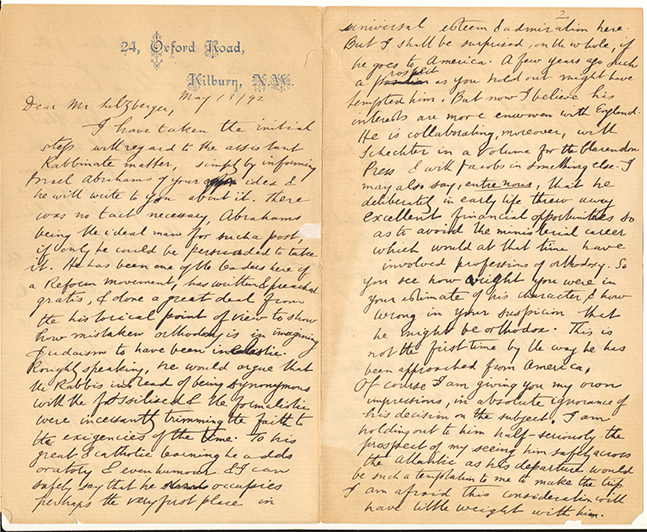
Of the letters in the collection, two from Zangwill to Meyer Sulzberger (1843–1923)—a Philadelphia judge and nationally renowned leader of the Jewish community in the United States—who led the Jewish Publications Society of America, are among the most interesting. Writing on May 13, 1892, when Children of the Ghetto was nearing completion, Zangwill comments on Orthodox Judaism, before discussing the book at length over six pages, giving his own views and those of his characters on contemporary Jewish life, and also suggesting publication arrangements.
A later letter, dated April 10, 1901, offers a look at the busy author at work, as he reports on possible volumes of short stories, essays, and verse and on his dealings with the firms of Harper and Macmillan. Other correspondents include Zangwill’s literary agent, William Morris, and the author and newspaper editor, William Henry Rideing.
Children of the Ghetto
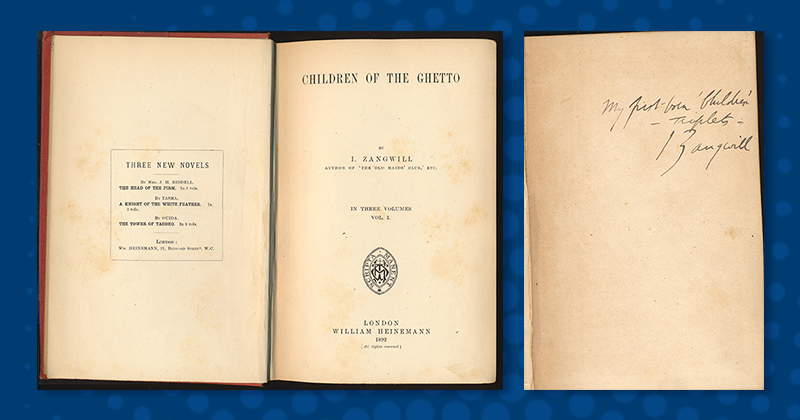
Children of the Ghetto, although commissioned by an American organization, was initially published by William Heinemann in London. The first edition in three volumes, which appeared in September 1892, is extremely rare, as most of the copies went into libraries and did not survive heavy use by readers. The copy now in the Mark Samuels Lasner Collection, which is rare in the original cloth binding, is enhanced by having signed inscriptions in each volume. These are examples of Zangwill having fun at the expense of the “triple-decker” format (which was already in decline by the early 1890s). He calls the volumes “My first-born ‘Children’—Triplets I Zangwill”; “The second child IZ”; and “The third of the brood IZ.” The collection also has first editions of other Zangwill books with Jewish themes, such as The King of Schnorrers (short stories, 1894) and The Master (a novel, 1894), both with Stars of David as part of the binding designs.

The Melting Pot
When The Melting Pot premiered in Washington, D.C., in October 1908, the audience included Theodore Roosevelt and his wife. The President was reputed to have shouted, “That’s a great play, Mr. Zangwill!” (Zangwill and his wife were in attendance and were invited to the White House shortly thereafter.) Controversial but critically acclaimed, this play with its plot touching on immigration, assimilation and marriage was then successfully staged in New York and proved popular in London, as well.
Its title soon came into the language as a phrase applied to the United States ever since. Oddly, The Melting Pot did not appear in print until almost a year after the inaugural performance, when the first edition was published by Macmillan in New York in October 1909. This is a surprisingly uncommon book, and the UD Library was fortunate recently to acquire a copy for a bargain price, considering the association interest.
On the front endpaper is an inscription: “Sept 1909 To Margaret from Israel Zangwill.” “Margaret,” the recipient, turned out to be his name for the writer Mabel E. Wotton (1863–1927), one of Zangwill’s closest friends. Zangwill derived the nickname from the character “Margaret Engelborne” in his 1900 novel, The Mantle of Elijah—a book we do not yet have in Special Collections. (For the identification, I am indebted to Meri-Jane Rochelson’s article, “The Friendship of Israel Zangwill and Mabel E. Wotton: ‘Faithfully yours, Margaret,’” English Literature in Transition, 2005.)
Among other unusual Zangwill items in the collection is his pro-women’s suffrage propaganda pamphlet, One and One are Two, distributed in 1907 by the Women’s Social and Political Union, and two volumes from his library, Richard Le Gallienne’s Prose Fancies and John Davidson’s Ballads & Songs, both published in 1894 and presented to Zangwill by their authors. Finally, to give an idea of what Zangwill looked like, here is his portrait by the noted American photographer, Alvin Langdon Coburn (1882–1966). This photogravure was published in Coburn’s 1922 book, More Men of Mark, but taken nine years earlier, in October 1913.


