



Following a Passion for International Relations
August 12, 2026 Written by Chiu-Yin Mak | Photos courtesy of Srinjay Mukherjee
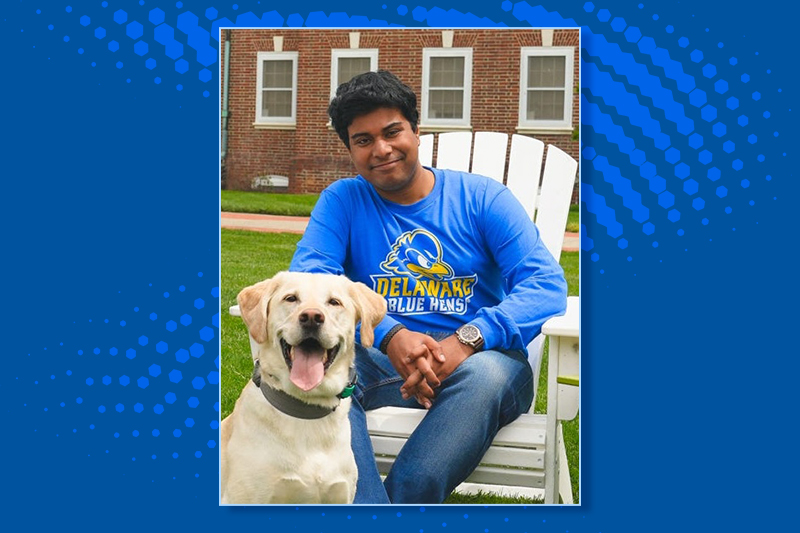
For University of Delaware student Srinjay Mukherjee, studying international relations has never been simply about understanding diplomacy or foreign policy. It is about making sense of a world he has experienced firsthand.
A sophomore international relations and economics double major, Mukherjee has lived in multiple cities in India and abroad, and has published a book on India’s global identity. At UD he conducts undergraduate research on international treaties and will serve as a teaching assistant for POSC 240: Introduction to Global Politics this fall. His journey can be traced to one decision he made years ago: choosing to follow his passion.
Growing up in India and traveling extensively, Mukherjee developed an early interest in the forces that shape relationships among countries.
“I came to realize that the world isn’t a set of isolated nations, but an interconnected system shaped by history, power and incentives,” he said.
That curiosity took a more tangible form when Mukherjee was 16, during his junior year of high school. At his father’s suggestion, he spent months researching and writing essays on India’s national identity and place in the international system, eventually compiling them into a book, India’s Kaleidoscope: Looking Inward, Outward and Forward.. A publisher accepted the manuscript without requesting changes, a surprising milestone for a first-time author. Through the book, Mukherjee sought to offer readers a deeper understanding of India’s history, foreign policy and evolving role in global affairs.
When it came time to choose a university, Mukherjee knew he wanted to study in the United States. The flexibility to combine majors, and exposure to diverse perspectives and opportunities to build professional connections all appealed to him.
Hoping to pursue internships in Washington, D.C., or New York City, he focused his college search on universities along the East Coast. The University of Delaware quickly stood out.
Mukherjee expressed that UD’s strong international relations program and connections to Washington, D.C., and New York City made it an ideal fit for his academic and professional goals.
One of the people who has played an important role in Mukherjee’s experience at UD is Robert Denemark, professor of political science and international relations. From his first semester in the classroom to undergraduate research, Denemark has been both a teacher and mentor, encouraging Mukherjee to pursue his interests and deepen his understanding of international relations.
As an international student, Mukherjee found his first semester at UD overwhelming at times. Determined to engage rather than fade into the background, he actively participated in POSC 240: Introduction to Global Politics, a lecture course with more than 200 students, and regularly attended Denemark’s office hours to continue conversations beyond the classroom.
Recognizing Mukherjee’s enthusiasm, Denemark encouraged him to take POSC 362: Diplomacy, where students tackle real-world international conflicts through simulations, negotiations, debates and policy briefs. The experience challenged Mukherjee to apply theory to practice and further strengthened his connection with Denemark.
That relationship continued through undergraduate research and will extend into the classroom again this fall, when Mukherjee returns to POSC 240 as a teaching assistant.
“I’m incredibly excited to work with Professor Denemark again and help first-year students navigate the intricacies of international relations and political science that first captivated me,” he said.
Research has become one of the most rewarding parts of Mukherjee’s undergraduate experience. He worked alongside Denemark and Alice Ba of the University of Delaware and Hasan Yönten of Neumann University to catalog bilateral and multilateral treaties involving India from 1970 to 1991. The research revealed a shift in India’s treaty behavior during the period. While early agreements leaned heavily toward bilateralism and reflected Cold War strategic considerations, later treaties increasingly emphasized multilateral cooperation and international organizations, with growing attention to trade, economics, communications and transportation.
“Working on the research project taught me how meticulous data work can uncover broader patterns in state behavior,” Mukherjee said. “It strengthened my ability to think critically about how countries navigate power, institutions and strategic choice.”

Outside the classroom, Mukherjee has embraced opportunities to serve the UD community through leadership.
He will serve on the International Student Advisory Committee, representing the perspectives of international students and helping advocate for campus initiatives that support them. This summer, he is also welcoming the newest Blue Hens as a New Student Orientation Leader, helping first-year students navigate the same transition he experienced only a year ago. His involvement in Phi Chi Theta, a professional co-ed business fraternity at UD, has further strengthened his teamwork, professional development and commitment to service.
Together, these experiences have reshaped his understanding of leadership.
“I’ve learned that a great leader isn’t necessarily the loudest voice in the room,” Mukherjee said. “It’s the person who creates an environment of trust for everyone else to succeed.”
Looking ahead, Mukherjee plans to pursue graduate study in international political economy, international affairs or a related field before building a career analyzing geopolitical and economic risk. He hopes to advise organizations on international investment strategies through geopolitical consulting or institutions such as the International Monetary Fund.
As he reflects on his journey so far, Mukherjee is grateful for the mentorship he has found within the Department of Political Science and International Relations.
“The Department has been remarkably supportive,” he said. “My professors have always been ready to lend a hand and help me identify where my true passions lie while developing a deeper understanding of the world.”
His advice for current and prospective students, especially fellow international students, is simple: take advantage of every opportunity available. He encourages students to attend office hours, build relationships with professors, alumni and classmates, and begin networking early through platforms such as LinkedIn.
“Opportunities rarely just fall into your lap,” Mukherjee said. “You have to actively build your own momentum.”
That philosophy has guided Mukherjee from choosing his academic path in India to conducting research, publishing a book, mentoring new students and preparing for a career in international affairs. For him, every opportunity has begun with the willingness to take the first step.


