



Category: Center for Global and Area Studies

Learning the Sacred Harp
August 27, 2026 Written by Megan M.F. Everhart | Photos by Maria Errico and courtesy of Rachel Herway
Rachel Herway’s summer research led her to communities practicing a long-standing American singing tradition
Sitting down to watch the 2020 film adaptation of Jane Austen’s Emma means immersing yourself in Regency era fashions, witty dialogue and, of course, love stories. For aspiring ethnomusicologist Rachel Herway, the virtual visit to the drawing rooms of the 19th century inspired her interest in a type of singing she’d never heard before.
The film includes a brief clip of “How Firm a Foundation,” a song from the West Gallery musical tradition, which evolved into the American tradition of Shape Note singing.
Herway, a senior honors global studies major with minors in musical studies and Latin American and Iberian studies, was intrigued by the song’s distinct tonality, and she spent the summer researching it through UDs’ summer research fellows program.
A singing tradition
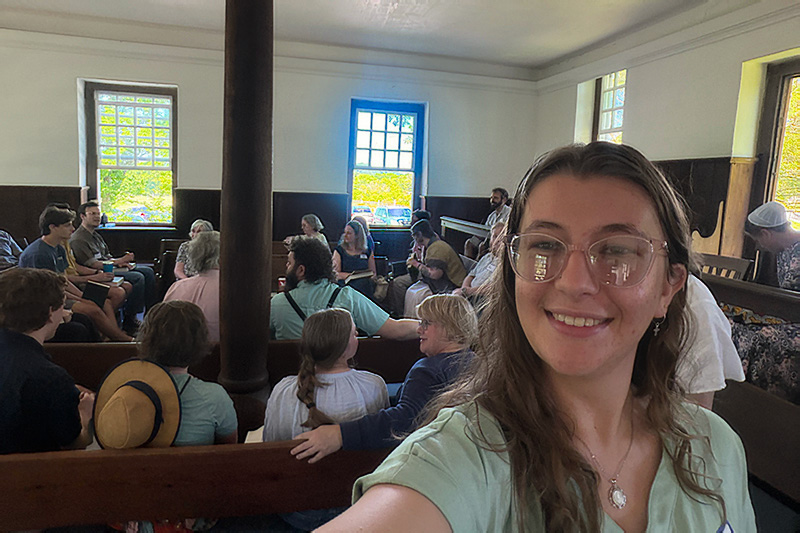
Shape Note singing combines a unique written style with a unique physical arrangement of the singers. Based on solfege (think “do re me fa so la ti do”), it uses shapes as a visual aid to identify notes. Do is represented by a triangle, re by a circle, mi by a diamond, and so on…
The singers sit on four sides of a “hollow square,” with one voice part on each side. A leader stands in the hollow square, but there is no rehearsal and no audience. The singing is done for the experience of communal singing. During a singing event, groups first “sing the notes” to learn the intervals before adding words to a song.
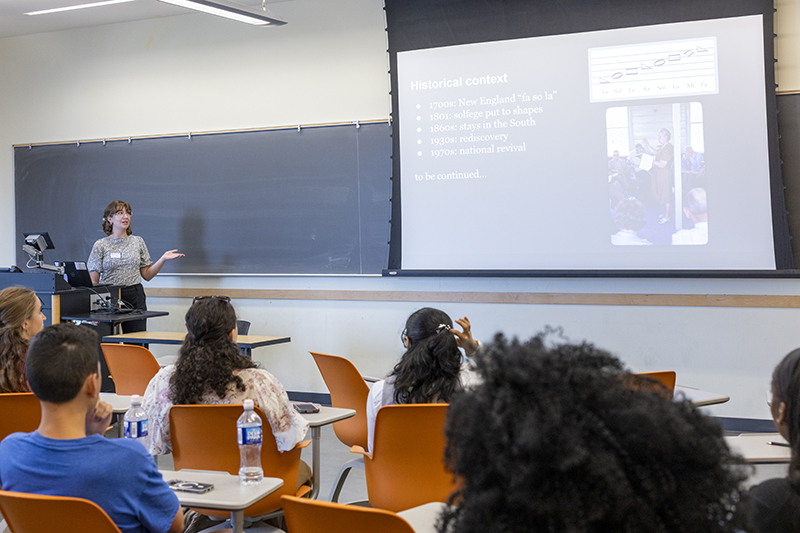
The Shape Note singing tradition began in the 1700s in small churches in England, according to Herway. It migrated to the New World a century later. Traveling singing schools spread the Shape Note singing to rural communities, where it flourished, especially in the American South. In 1844, The Sacred Harp hymnal was published, a collection of shape note hymns in four part harmony. Today the terms “shape note” and “sacred harp” are used interchangeably to describe the tradition.
Shape Note had a resurgence in the 20th century folk music revival, and today, while it is no longer tied to specific church congregations, there are communities and families throughout the country that keep the tradition going.
Learning the notes
Herway’s research also focused on the culture of shape note communities and how they function, as well as understanding the musical process.
“I researched how people acquire fluency in Sacred Harp,” she said. “I wanted to know how newcomers become old-timers. How hard is it? What barriers are there? Do the shapes make it easier?”
She conducted field research, including attending an all-day singing with the Philadelphia FaSoLa sacred harp society and a shape-note wedding in Alabama. She introduced herself to community leaders, and jumped right into things by volunteering to be a song leader - even before she knew what she was doing.
“I first led the wrong way,” she said. “I was facing the trebles because that's the part I sing. You're not supposed to do that. So the next time I faced the tenors, but I sang treble - also not supposed to do that. People are super honest and will tell you how to do it correctly, and that's how you learn.”
She also found that consistency is key. By going back and immersing herself in singings, Herway gained confidence and experience, which she will carry with her as a member of the UD Concert Choir.
She also gained research skills that she will carry with her as she finishes her senior year at UD and prepares for graduate school.
“The opportunity to be subsidized to work full-time on research for three months is an invaluable practice that UD offers students,” she said. “And the summer symposium prepared me for future thesis defenses and public speaking about my research.”


