



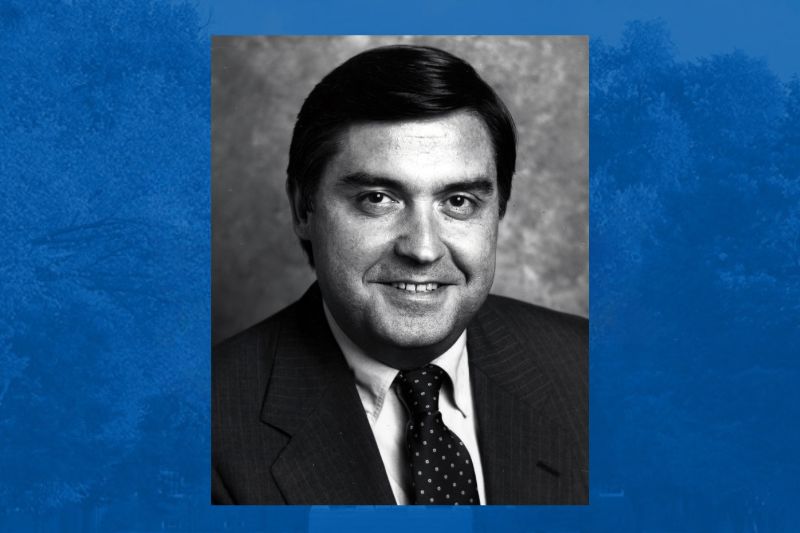
In Memoriam: James K. Oliver
August 19, 2026 Written by CAS Communication Staff
James K. Oliver, Emma Smith Morris Emeritus Professor of Political Science and International Relations, known for his thirst for knowledge, scholarship and inspiration to his students, passed away on July 12, 2026.
A Florida native who received his undergraduate and master’s degrees at Florida State University, Dr. Oliver earned his doctorate in international studies at The School of International Service at American University.
A renowned scholar in multiple interest areas — international relations theory and organization, American foreign and defense policy, and international political economics, among others — Dr. Oliver retired from UD in 2004 after nearly 35 years. He held a joint appointment in what was then called the College of Marine Studies.
Dr. Oliver co-authored several influential books, including United States Foreign Policy and World Order, which was used as the foundational text in political science classrooms across the country in the late 20th century.
In addition to his work at UD, Dr. Oliver served as a consultant to the U.S. State Department, U.S. Information Agency and the Department of the Navy. Under their auspices he travelled extensively in Europe, the Soviet Union and Russia, lecturing on American foreign and defense policy.
At UD, Dr. Oliver served on the University Faculty Senate, the editorial board of UD Press and multiple committees. He was co-chair of the University’s Commission to Promote Racial and Cultural Diversity from 1989-1991. He served as faculty director of UD’s London Semester program in 1991.
But Dr. Oliver is best remembered for the impact he had as a teacher and mentor to hundreds of students. He received two Excellence in Teaching awards during his UD career - one from the University and the other from the Mortar Board honor society. His students have gone on to become lawyers, economic analysts, polling experts, marine scientists, public servants, intelligence agents, diplomats, assembly-people, civil rights activists, senators and governors, including former New Jersey governor Chris Christie.
Tony Eksterowicz is emeritus professor of political science at James Madison University (JMU). He cited American historian Henry Adams’ observation that “a teacher affects eternity; he can never tell where his influence stops,” in his reflection of Dr. Oliver.
“Like so many others my life was transformed the minute I walked into his classroom,” he said. “I wanted to do what he was doing. Over the years, with his help and encouragement, I managed to succeed. All my achievements in life were directly attributable to him. There could have been no finer mentor.”
Dr. Oliver was a guest speaker in many of Eksterowicz’s classes and a visiting professor at JMU. Several JMU students came to UD for their graduate degrees.
“Perhaps my most precious memory was Jim’s contribution to our edited work, The Presidency and Foreign Policy: Chief Architect or General Contractor,” Eksterowicz said. “Jim’s article appears directly after my former student Kirby Goidel of Texas A&M’s article.This was the linking of three generations of scholars, indicative of Henry Adam’s observation. Jim’s direct and indirect influence will be felt well into this century.”
Dr. Oliver is survived by Carol, his wife of 61 years.
Remembering Dr. Oliver
Many former colleagues and students shared remembrances.
Robert Denemark, former faculty colleague
I have always considered Jim Oliver to be one of the great gentlemen of our field. He was chair of the department when I was being hired and I found him to be an important role model in several respects. His teaching was compelling at both the undergraduate and graduate level. He always took his students seriously. His research was importantly oriented and intellectually careful as it addressed both academic and policy issues. As chair, and with me as a new faculty member, he took extra time to explain some of the broader issues involved in the day-to-day dealings in our department. I recall him with great fondness.
Robert DiPrizio, former doctoral student
Jim Oliver was a wonderful man and an exemplary mentor to me and countless others. From day one of my doctoral studies, he was a constant source of encouragement and support. We hit it off immediately, spending hours in his office discussing courseware, contemporary events and how to navigate the challenges of graduate school. Jim served as my dissertation committee chair and offered invaluable insights into the writing process. One piece of advice in particular that I now pass on to my own students is that writing is far more about perspiration than inspiration. He warned me about that fine line between exhaustive research and procrastination; whenever I fell down an academic rabbit hole, he was there to pull me out and put me back on track. Without his guidance, I might still be writing the darn thing.
Jim was that rare professor who was both brilliant and genuinely capable of making complex ideas accessible to students. He was approachable, supportive, and kind—qualities I strive to emulate in my own teaching career, which Jim was seminal in launching. He will be deeply missed by many.
John Doble, former student
Dr. Jim Oliver was an outstanding teacher as well as a treasured friend for over 50 years. At UD, I took every foreign policy course he taught. Later, after moving to New York and becoming research director at Public Agenda (a not-for-profit co-founded by Dan Yankelovich and Cyrus Vance), and working with the Kettering Foundation led by former HEW Secretary David Mathews, then at my own consulting group, Doble Research, Jim’s preparation made me feel confident and qualified to present my research on subjects like US-Soviet Relations, nuclear proliferation, the nuclear arms race and Americans’ views about China to ranking foreign officials in St. Petersburg and Beijing and people like Daniel Ellsberg and Zbigniew Brzezińsk.
After Jim and his wife Carol moved to Vermont, my wife, Elizabeth and I, would annually vacation with the late UD professor Henry Reynolds and his wife Lisa. Each time we’d see the Olivers where we climbed many a mountain, shared many meals and spent long evenings talking about politics, public policy and current events. Jim’s encyclopedic wisdom and his booming laugh when Henry or I said something humorous were both unforgettable and infectious. He was a vitally important, shaping force in my life both as a mentor and as a kind, humanistic role model. I miss him deeply.
Ed Freel, former student, current senior fellow at the Institute for Public Administration, UD’s Joseph R. Biden, Jr. School of Public Policy
I met Jim Oliver in the fall of 1969 and enrolled in his National Security course in the summer of 1970. National Security at 8 a.m. five days a week in the summer can be a grind. It sure wasn't. It was the most energized and exciting class I took at UD as I pursued my master's degree. The next semester I did a one-to-one special problem with Dr. Oliver, the finest academic experience of my education experience. Dr. Oliver became a life-long friend and mentor. For the rest of my career, he was my go-to person on national security policy as I worked as a congressional staffer in the U. S. House and the Senate.
Jim Oliver will be remembered as a great intellect, teacher and mentor and an even greater person. Jim, rest in peace.
Nien-Tsu Alfred Hu, former doctoral student
When I look back now, I realize that my relationship with Professor Oliver changed as I grew older.
When I was a doctoral student, I saw him as my mentor, my dissertation advisor and an extraordinary scholar. He guided my academic work, shaped my thinking and helped develop my academic judgment. But when we had both grown older, and I had become a professor and later served as director of the Graduate Institute of Marine Policy [at National Sun Yat-sen University in Taiwan], I began to see him differently. I began to understand not only what he had taught me, but what he had given of himself.
I learned that a truly great teacher does not simply impart knowledge. He invests his own life in students whom he believes are worth cultivating. And when necessary, he is willing to stand between his student and the risks that the student may not yet be able to see for himself.
That is the kind of teacher Professor Oliver was. And that is the kind of teacher I have tried to be.
I have given my students my time, my experience and my best effort to guide and encourage them, regardless of whether they would eventually remember or appreciate what I had devoted to them. I did so because Professor Oliver had shown me, by his own example, that this is what a teacher does.
As a doctoral student, I learned from his scholarship and his mind.
As a professor myself, I learned from his life and from the way he devoted himself to his students.
And perhaps this is the most enduring legacy a teacher can leave: not simply the students he taught, but the teachers those students eventually become.


