



Category: Graduate Students
Art history learning experiences
April 15, 2024 Written by Megan M.F. Everhart
Doctoral students in the Department of Art History share their Summer and Winter Session activities
Victoria Kenyon
In mid-January, Victoria Kenyon participated in the National Humanities Center's virtual institute Podcasting for Humanities Graduate Students: Storytelling for a Modern Audience. This five-day program began with Zoom sessions with staff at both the National Humanities Center and the Digital Humanities Center at San Diego State University, wherein they provided guidance in topics from storyboarding and script-writing to soundscaping and editing.
These sessions, as well as conversations with the hosts of popular podcasts and among the participants, also focused on how podcasting can be harnessed to reach a broad audience, and specifically how it could be used to advance humanities scholarship. Prior to the program, the organizers sent out toolkits that included a professional-quality desktop microphone, headphones and a copy of the book Emergent Strategies by activist adrienne maree brown.
Using these physical materials as well as the frameworks for understanding collaboration and communication that brown provides, participants worked together in small groups that created a full twenty-minute podcast episode throughout the week. The participants were graduate students across a wide variety of humanities disciplines, and they were randomly placed into cohorts together, leading to collaborative work.
The experience helped deepen Kenyon's appreciation for the curatorial potential of audio storytelling. “In this post-Covid and increasingly digital environment, with museums adapting to new ways of reaching the public, podcasting as a medium feels especially relevant. Multiple institutions such as the Met and the Smithsonian have already delved into podcast storytelling as a platform for art historical research. In the very near future, I have the opportunity to apply my new skills toward an oral history project centered around Old College Hall, on which the graduate students in Dr. Rujivacharakul's ARTH 633 seminar will be collaborating," she said.

Megan Baker
The 2023 Summer Institute for Technical Studies in Art (SISTA), hosted by Harvard Art Museusm and sponsored by the Mellon Foundation, was organizaed around the theme of color. This made SISTA particularly compeling to art history doctoral student Megan Baker, whose dissertation investigates why pastel painting became an important medium in North America around the time of the American Revolution.
Over two weeks in June, Baker and 14 other participants met with curators, conservators and material scientists, as well as artists and makers, which helped to provide participants with a new vocabulary for asking technical questions about artistic materials.
“Beyond all the knowledge gained through the institute, it is wonderful to now know so many colleagues who are interested in similar questions about materials, color, and technical art history," said Baker.
The SITSA program included hands-on workshops where participants became familiar with different materials and techniques. Experiences included learning how to make watercolor paints using pigments, gum Arabic and maple sap with the painter Anong Beam; patinating bronze at Sincere Metal Works; making glass paperweights and jewelry at the Bubble Factory; and participating in raku firing at the Harvard Ceramics Project. A cochineal dying workshop hosted by Porfirio Gutierrez, an expert Zapotec weaver and dyer, concluded the program.
“Experiencing different kinds of hands-on learning—from performing torchwork, and mulling cochineal to running microfade tests and looking at objects under UV light—was incredibly helpful in demonstrating various modes of bodily knowledge and expertise," said Baker.
Working with paintings conservators, the group also used 17th-century artistic treatises to replicate historical approaches to painting. The experience of working from documents to implement reconstruction as a methodology provided Baker with a new approach to her dissertation. She spent the fall procuring pigments, chalk and binding agents, ultimately crafting her own pastels in the same manner as 18th-century makers would have.
Natalie Giguere
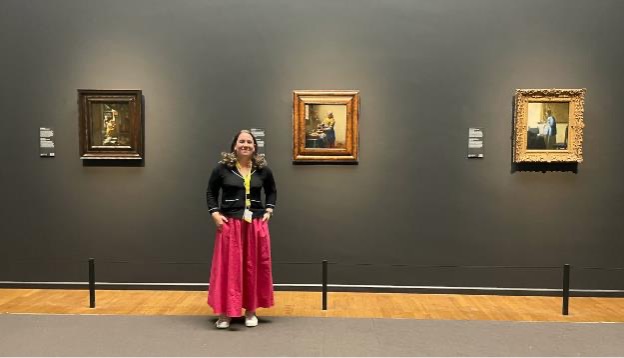
Last summer, UD Ph.D. candidate Natalie Giguere had the privilege of being one of 16 graduate students and early career professionals selected to participate in the Summer Institute for Netherlandish Art. This institute is a collaboration between the Rijksmuseum, Netherlands Instituut Voor Kunstgeschiedenis (RKD), The Center for Netherlandish Art at the Museum of Fine Arts in Boston, and the Harvard Art Museums.
Over the course of the two-week intensive in Amsterdam and Boston, Giguere got the opportunity to discuss her current dissertation project and study materials and artworks in some of the biggest collections of Dutch art in the world with curators and other researchers. Highlights included access to the collections of the MFA Boston and the Rijksmuseum after hours, as well as hours spent with a variety of artworks in study rooms and conservation labs.
Giguere was able to take part in the program due to funding support from the graduate college, which was generously matched by the Department of Art History.

Emily Beeber
In 2023, Ph.D. candidate Emily Beeber was a Summer Institute Fellow at the Museum of Early Southern Decorative Arts (MESDA) in Winston-Salem, North Carolina. This one-month program focused on the art and material culture of the Lowcountry, a region that includes coastal South Carolina and Georgia. Beeber had the opportunity to engage in hands-on study of ceramics, furniture, paintings and works on paper, and she was even able to try her hand at historic craft techniques.
The Summer Institute included a field study component, and Beeber travelled to museums and historic sites in Charleston, Savannah and beyond. One of the most memorable parts of the study trip was taking a ferry to Sapelo Island, located off the coast of Georgia.
In addition, each fellow completed an original research project on an object from MESDA's collection, and they presented their work during a symposium at the conclusion of the Summer Institute. Beeber's talk was titled "Legacy of Labor: An Eighteenth-Century Coffin Stool and the Miles Brewton House."


