


Our Alumni
- About Us
- Undergraduate Programs
- Graduate Programs
- Our Alumni
- Our People
- Research Programs
- Resources
- Make a Gift
-
Leading the mathematics community
August 05, 2026 | Written by CAS communication staffAlumna presents lecture at international conference -
Launching research careers
July 15, 2026 | Written by Jamie WashingtonSix CAS graduate students and alumni earn prestigious National Science Foundation Graduate Research Fellowships -
Laura Carlson inaugurated as UD’s 29th president
April 18, 2026 | Written by Amy WolfCampus-wide celebration highlighted University’s forward-focused chapter driven by shared purpose and community.
Alumni Spotlights
The Department of Mathematical Sciences at the University of Delaware takes pride in the outstanding accomplishments of its undergraduate and graduate alumni. Our graduates leverage their strong mathematical foundation to excel in diverse fields, from academia and research to industry and beyond. Many of our undergraduate alumni pursue advanced degrees at top institutions or embark on successful careers in technology, finance, education and government.
Our graduate alumni, after years of rigorous coursework, teaching and research, have made significant contributions to mathematical sciences, earning prestigious awards, faculty positions and leadership roles in industry. Their innovative research and problem-solving skills drive advancements in data science, as well as pure and applied mathematics.
This page highlights the success stories of our alumni, showcasing their achievements and inspiring current students to follow in their footsteps. We celebrate their impact and the ways in which they continue to represent the excellence of the University of Delaware.

Jan Ahmed | 2024
Jan completed bachelor of science degrees in applied mathematics and computer science.
I was born in Dallas, Texas, but I spent most of my childhood in the Czech Republic. In high school, I wasn’t too good at purely memorizing material. In fact, I was better at deriving an answer, which naturally drew me to math. Usually all I needed was to memorize a couple of definitions, and the rest I was able to derive. This is what really fascinated me about mathematics and is the reason why I decided to continue my studies in math. After graduating from high school, I pursued a degree in financial mathematics at Charles University in Prague. However, I always dreamed of returning to the U.S. During my first semester in Prague, I took the SATs and applied to the University of Delaware as a math and computer science double major. I was thrilled to be accepted at UD.
When starting at UD, I couldn’t have imagined how many opportunities I would have received and how much I would’ve achieved. After my freshman year, I did research on mathematical billiards with Christopher Cox. In the following years, I did research on graph theory with Sebastian Cioaba. I also spent some time working on the longest increasing subsequences of random permutations with Naya Banerjee. One highlight was publishing a paper in Chaos: An Interdisciplinary Journal of Nonlinear Science and submitting another to arXiv. On the side, I co-founded the Competitive Programming Club, tutored mathematics, and participated in math competitions and hackathons. I believe that I made use of the resources provided to me at UD to their fullest.
Today, I’m working as a software engineer at Amazon Web Services on the AWS Organizations Policies Data Plane team. AWS Organizations is a service that allows users to centrally manage and govern their accounts in a tree-like structure. From day one, I was able to use my math and computer science skills to quickly understand the team’s work. Currently, I’m developing an operational tool designed to efficiently traverse any organization’s tree and report information about its nodes. I’ve found that the problem-solving and critical thinking skills I gained from studying math, along with the technical skills I developed in computer science, have been invaluable in tackling complex problems and delivering solutions.
— Jan Ahmed, AS24 and EG24
Gautam Aishwarya | 2021
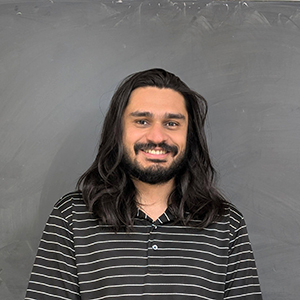
Gautam received his Ph.D. degree from the University of Delaware in 2021.
I completed my Ph.D. in mathematics at UD in 2021 under the supervision of Mokshay Madiman, after five formative years as a graduate student in the Department of Mathematical Sciences. Since then, I have held postdoctoral positions in Israel, at Tel Aviv University and the Technion – Israel Institute of Technology, and more recently at Michigan State University. My research is centered on convexity in geometry and analysis, and I love using tools from information theory and optimal transport in this pursuit.
I started my Ph.D. at UD in 2016, after completing bachelor’s and master’s degrees in India, where I am originally from. It was also my first time living abroad and meeting people from all over the world. Roughly half of my cohort was international and half was domestic. We mixed with each other very well, and many of us remain closely connected to this day. In a diverse environment, being warm and enthusiastic while also showing respect and sensitivity is not trivial, but I am proud of the supportive culture we built together. I fondly remember the crucial role played by the members of the math department in fostering this welcoming community, especially the late Francisco-Javier Sayas, who was the graduate director at the time, and the late Deborah See, who was the graduate academic support coordinator.
I came to UD knowing that I wanted to be Mokshay’s student, though with only a vague idea of the kind of mathematics I wanted to do. An unmistakable imprint of his mathematical style and taste is evident in my work. What may be less visible from the outside, but is also essential, is how much my research and teaching have been influenced by the classes I took at UD and by the perspectives of the professors who taught them. Mathematical education is a cultural experience, almost like growing up. Even when one follows an independent path, the surrounding traditions of thought leave their mark.
Another important part of this cultural experience came from attending seminars. For five years, I regularly attended the analysis seminar and the discrete math seminar. When I started the program, I understood almost nothing in many of these talks. Over time, I began to recognize ideas, follow arguments and eventually ask questions. That gradual change was one of the most reassuring markers of my growth in graduate school. I strongly recommend that graduate students attend one or two seminars regularly, even when much of the material initially feels inaccessible.
My last year and a half at UD was during COVID. This time was less harsh for me than it was for many people because of my wonderful graduate colleagues. Several of us lived in the same neighborhood. While the lights in Ewing Hall were shut for a bit, the coffee kept brewing and the carpet kept soaking up chalk dust in my apartment, as we would hang out to discuss math and life almost every day. This math department-in-exile phase is also an integral part of my UD memories, and one that I cherish.
Now, almost five years after graduating from UD, I expect to begin a new phase in my academic life as a tenure-track assistant professor at the Technion in fall 2026. As much as I am excited about furthering my research program, I am also looking forward to mentoring students. As a UD graduate, my own experience as a graduate student serves as both a source of gratitude and a model for the kind of intellectual generosity I hope to offer my own students. I remain deeply thankful to UD for the people, the mathematics and the sense of community that shaped me during those five years.
— Gautam Aishwarya, Ph.D. 21

Nick Basilio | 2024
Nick completed a bachelor of science degree in actuarial science.
I am a proud 2024 graduate of the University of Delaware. Probably like many of you, I found mathematics to be my favorite subject in high school, but business concepts also intrigued me. Therefore, I determined there was no better major than actuarial science! The actuarial program at UD does an exceptional job of preparing students for actuarial exams, offering specialized courses that directly supported exam preparation. To deepen my engagement with the field, I joined the Actuarial Science Club, where I had the privilege of serving as vice president for two years. Being part of the club was an incredibly rewarding experience—not only because of the networking opportunities with guest speakers but also because of the camaraderie I shared with friends as we studied for exams over pizza. The club fostered a collaborative environment that played a key role in my success. It was through this involvement that I secured an internship during the summer of my sophomore year, which eventually led to a full-time position. My experiences with the Actuarial Science Club, combined with the strong foundation provided by UD, were instrumental in helping me succeed both in my exams and in the early stages of my career.
Many people often wonder what an actuary does. Actuaries specialize in managing risk and uncertainty by applying mathematical, statistical, and financial methods. In my role as a Health Valuation Actuary, my responsibilities revolve around analyzing risks associated with claims. On a typical day, I update Excel models to ensure the accuracy of financial data related to claims, helping to provide a clear picture of our financial standing.
— Nick Basilio, class of 2024

James Ling Mou | 2025
During my time at the University of Delaware, several experiences made decisive impacts on my academic direction and career decision. One of the most influential was the Groups Exploring the Mathematical Sciences (GEMS) summer research program, which was incredibly resourceful and gave me exposure to a wide range of computational tools and collaborations. It was my first real opportunity to work with faculty and active professionals in the field, experiencing mathematics culture firsthand and tackling projects on supercomputers. Altogether, it shaped my understanding of what data science and mathematical work look like in practice.
Another cornerstone experience was taking a graduate-level machine learning course during my senior year. That class pushed me beyond the standard undergraduate curriculum and encouraged me to pursue more open-ended projects. For my final project, I developed a Deep Q-Learning model for pair-wise stock trading—my first substantial step into combining mathematics, algorithms and applied machine learning. That project ultimately influenced the kind of work I continued to do after graduation and helped guide my path toward graduate study.
I also benefited a great deal from the problem-solving culture of my program's capstone course. I enjoyed leading a small team where we studied geometric optimization in circle packing based on earlier competition-style problems. It was the first time I had the chance to explore a topic independently, build intuition from the ground up and cooperate with my peers through a creative mathematical investigation.
— James Ling Mou, class of 2025
Joseph Nakao | 2023
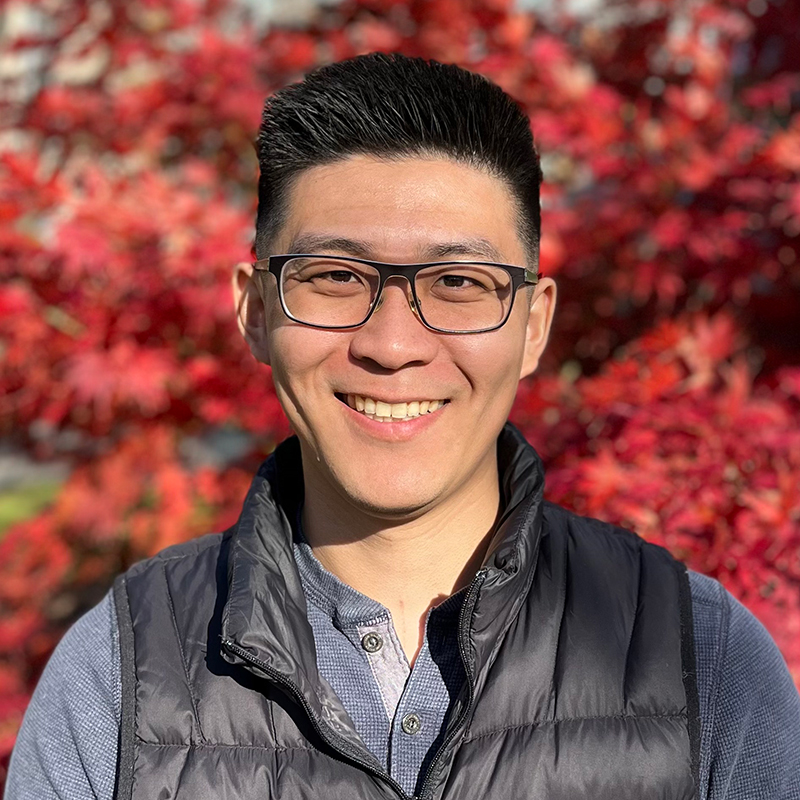
Joseph received his Ph.D. degree from the University of Delaware in 2023.
I received my Ph.D. in 2023 from UD Department of Mathematical Sciences, which helped me achieve my dream of becoming a tenure-track professor at a small liberal arts college. I am currently an assistant professor of mathematics at Swarthmore College, right outside Philadelphia. In this short piece, I want to share my mathematical journey, my experience in graduate school, and the exciting work that I’ve started at Swarthmore.
I received my B.S. in applied mathematics from Seattle University, and it was there that I found my passion for teaching and interdisciplinary research. Although I started as a mechanical engineering major, my first research experience with Katie Oliveras in applied mathematics inspired me to switch majors. For three years, I worked with Katie Oliveras on the mathematical theory of shallow water waves. However, by an ironic turn of events, I found myself back in mechanical engineering when I joined a second research project with Yen-Lin Han developing mathematical models with biomechanical heat transfer applications. Working with professors in both applied mathematics and engineering gave me an appreciation for both theory and application. What’s more, I immediately realized my dream was to become a professor that could offer the same high-quality one-on-one research experience to the next generation of undergraduates.
This led to applying for graduate school in applied mathematics. I ultimately chose UD for two reasons: My undergraduate professors spoke highly of UD’s reputation for applied mathematics, as well as UD’s reputation within the mathematics community for providing an extraordinary quality of teaching and mentorship for graduate students. I chose to study under Jingmei Qiu because of her interdisciplinary work with aerospace and fluid applications. In the end, I experienced all the wonderful things I’d heard about UD … and more! My classmates and cohort-mates became (and still are) my best friends, every professor I had the privilege to take a class with went above and beyond to ensure I received the highest quality education, and my advisor Jingmei Qiu supported me in every definition of the word. I have particularly fond memories of bonding with my cohort during the prelim prep sessions, working late into the night on homework for our first semester of real analysis and vector spaces, and gathering for my annual friendsgiving each November to enjoy good food with friends. In addition, I’ll always remember the office hours that started with asking a homework question, only to evolve into an exciting mathematical discussion, sometimes completely orthogonal to the homework question originally asked. Of course, there are many other wonderful memories that I could list, but ultimately it was the amazing people I met and the experiences with those people that defined my graduate school experience.
I was fortunate enough to get a tenure-track position straight out of graduate school, but much of the credit goes to my advisor and the department. In the past two years, several other students and alumni have also received tenure-track offers. So many alumni obtaining tenure-track positions in an incredibly competitive academic job market is a testament to the standards and quality of teaching and mentorship at the UD Department of Mathematical Sciences.
I’ve been at Swarthmore College for two years, and I am grateful to work at an institution that values both undergraduate teaching, as well as research. Despite being a small liberal arts college, the research expectations are high, relatively speaking. This balance of undergraduate teaching and research is what I sought. I have started new collaborations, began mentoring undergraduate students (my team is quickly growing), and enjoyed the positives that come with an undergraduate-only school that embodies a well-rounded education. I am the department’s fourth applied mathematics hire, and I’ve been busy contributing to and expanding their applied and computational mathematics curriculum. This is my first semester teaching partial differential equations, a class that I’ve wanted to teach for several years. Looking forward, I’m hoping to add courses or directed reading groups in numerical linear algebra and low-rank tensor decompositions, as well as organize teams to compete in the Mathematical Contest in Modeling.
In all, UD was the best fit for me. I am proud to tell others about my education and experience at UD, and I encourage my own students to consider UD for graduate school. Luckily, I’m a short 50-minute drive from Newark, so I can easily visit my former professors!
— Joseph Nakao, Ph.D. 23

Kerry Olivers | 2025
Kerry earned an honors bachelor of science in actuarial sciences with a minor in economics.
I am a proud 2025 graduate of the University of Delaware, where I earned my honors bachelor of science in actuarial sciences with a minor in economics. I have always enjoyed math and problem-solving, which naturally led me to actuarial science, a field that combines analytical thinking with financial insight.
At UD, I gained a strong actuarial foundation through courses aligned with the Society of Actuaries exams and passed Exam FM during my junior year. I served as president of the Actuarial Science Club for two years and involved myself in several other campus organizations, including the University of Delaware Student Alumni Ambassadors (UDSAA), where I later became president. During my senior year, I was honored to receive the T. Muncy Keith Award from the University of Delaware Alumni Association in recognition of my leadership and contributions to the campus community.
I’m deeply grateful to the University of Delaware for providing me with the resources, knowledge and connections that have shaped my career path. The actuarial science program and club gave me valuable opportunities to network with industry professionals and build meaningful relationships with peers who shared my goals. I now work in an actuarial role at a benefits consulting company, where I am continuing on the exam track with their support. The experiences I had at UD thoroughly prepared me to succeed in this next chapter.
— Kerry Olivers, class of 2025
Marydol Soto Santarriaga | 2026
Marydol received her Ph.D. degree from the University of Delaware in 2026.
I received my Ph.D. in 2026 from UD Department of Mathematical Sciences.
During the final year of my graduate program, I participated in the Emerging Talent Program at JPMorgan Chase, a year-long internship available to graduate students from various programs at the University of Delaware. I was part of a data science team that focuses on machine learning and artificial intelligence projects.
Working as a data science intern was an incredible experience, showing me how the analytical skills we develop in the math department translate to the industry, especially with all the new developments such as AI implementation.
Most of my work focused on generative AI, particularly working on Retrieval-Augmented Generation (RAG) architecture and prompt design. It was a cool opportunity to participate in the data science side of an AI project, where I worked on experimentation, focusing on how the system retrieves information and processes logic.
One of the best parts was collaborating with the tech team and data analysts to improve the quality of the AI tools we design. Seeing how different teams come together to refine a project really showed me how much goes into building reliable solutions at an enterprise scale.
Beyond the projects, I really enjoyed the chance to get involved in the broader community at the bank. I got to participate in internal hackathons and present my work at poster sessions. It was a very collaborative environment, and it was rewarding to see how a mathematical mindset helps when building these kinds of complex systems.
— Marydol Soto Santarriaga, Ph.D. 26

Zachary Villamor | 2026
Zachary received his bachelor of science in actuarial sciences from the University of Delaware in 2026.
I graduated from the University of Delaware in 2026 with a bachelor of science degree in actuarial sciences and minors in computer science, economics, statistics and management information systems.
Actuarial sciences is a unique discipline with a career path that differs from most other majors. Once I committed to pursuing this field, I spoke with several family friends who had experience as actuaries. From them, I learned about the actuarial exam process and the importance of internships, which helped me establish a timeline and set goals for advancing my career.
I passed Exam P during the summer after my freshman year, a milestone that significantly strengthened my candidacy for internships. That achievement helped me secure a remote internship with Brighthouse Financial for the summer after my sophomore year. This role gave me my first exposure to the daily responsibilities of an actuary. I used tools such as Excel and Prophet to analyze reserve movements in the company’s annuity department.
During that same summer, I also passed Exam FM. Taking MATH247 in the spring of my sophomore year was instrumental in passing this exam.
With two exams and internship experience completed, I was able to accept an internship the following summer with MetLife in New York City. Working in a hybrid environment broadened my understanding of actuarial work and introduced me to new software tools, including VBA and Alteryx, which I used in various projects. During this period, I also completed my third exam, Exam SRM.
My exams, internship experiences and leadership roles — such as serving as president of the Actuarial Science Club — gave me a strong foundation for actuarial interviews. Ultimately, these experiences helped me secure a full-time offer with MetLife, where I will begin working after graduation.
If I could offer advice to current or prospective actuarial students, I would emphasize the importance of starting exam preparation early, especially by making use of winter and summer breaks. I also encourage students to apply for internships as early as possible, as the interview process itself provides valuable experience and insight into what employers seek. Additionally, getting involved in on-campus organizations, such as the Actuarial Science Club, is beneficial since many companies value leadership experience.
Overall, my time at UD has prepared me well for a career in the actuarial field, and I would be happy to support any student interested in pursuing this path.
— Zachary Villamor, class of 2026


