



About Us

Chair
Welcome from the chair
Welcome to the University of Delaware Department of Political Science and International Relations (POSCIR). We are excited about what is happening here, and we think you will be, too.
- Excellence in teaching and research: Our faculty are nationally and internationally recognized scholars who publish with leading academic presses and journals and earn awards for both research and teaching. Our political science and international relations programs are highly respected: CollegeFactual ranks our department 44th out of 591 schools for political science and government.
- Academic focus: We offer undergraduate majors in political science and international relations, as well as minors in legal studies, politics and social justice, international relations, political communication and political science. Students can also apply to a 4+1 program to earn a B.A. in political science and an M.P.A. from the Biden School in five years. Students interested in crossing disciplinary boundaries will find opportunities to explore global governance, political psychology, democratic backsliding, gender and politics as well as social justice.
- Experiential learning: Experiential learning is central to the undergraduate experience in our department. Through extensive internship programs, research opportunities and funding to support those experiences, students connect classroom learning with work beyond the classroom. The legal studies program connects students with lawyers, and several courses offer a taste of law school. Alumni support opportunities for students to visit the United Nations in New York City and travel to Washington, D.C., to see government in action.
- Graduate studies: Our Ph.D. program provides rigorous training in two fields, along with research and teaching opportunities. Students may choose American politics, comparative politics or international relations as a first field. Those three fields, along with political theory and political methodology, are available as second fields. We have particular strengths in political psychology, including U.S. and comparative politics, as well as gender and politics, international security and international relations theory. We also collaborate closely with the Department of Communication’s Ph.D. track in political communication. Our international graduate student community works closely with faculty, presents at national conferences and gains valuable teaching experience. Graduates pursue careers in academia, the private sector, nonprofit organizations, research and government around the world.
- Student success: POSCIR students graduate on time at rates higher than University averages, with smaller disparities among groups. Our department’s hands-on advising reflects our commitment to student success. In recent years, POSCIR students and alumni have received Fulbright awards as well as other University and external honors. Our graduates go on to leading law schools, careers in sectors including technology, finance and government and positions with nongovernmental organizations (NGOs) around the world.
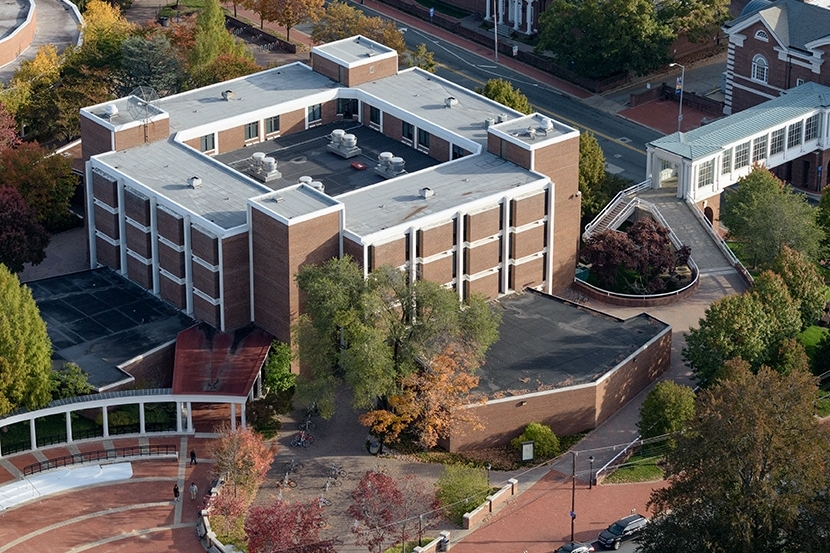
We appreciate your interest in our department and the University of Delaware. We hope you will visit us in person and explore our website. Stop by 347 Smith Hall to meet our community and learn more about the opportunities available to you. We look forward to welcoming you.
Matthew S. Weinert, Ph.D.
Chair
Visitor Information
The University of Delaware campus is located in Newark, Delaware, which is about 20 minutes away from Wilmington, an hour from either Philadelphia or Baltimore, two hours from Washington D.C., and two and a half hours from New York City.

The UD Department of Political Science and International Relations Our Values and Commitment to Diversity
As an academic department responsible for the education of students and the advancement of knowledge, we are motivated by our commitment to four central values:
- Methodological pluralism
- Interdisciplinarity
- Diversity
- Excellence
Our values strongly influence how we pursue our goals and how we measure excellence. Methodological pluralism, interdisciplinarity and diversity mean we value research of all kinds, as long as it demonstrates excellence and contributes to the discipline. Some of us do work widely considered mainstream, others do work that might be considered more niche. Respecting diversity and methodological pluralism means valuing both kinds of work, recognizing that the distinction between “mainstream” and “niche” is itself is largely a matter of taste, that diversity of perspectives inherently means including less popular or common ones, and that this distinction may in part reflect discrimination (unconscious or otherwise) against the perspectives or concerns of racial, sexual and other minorities. Many of us also believe that searching for intersections between more “niche” and “mainstream” considerations is the way to achieve creative success.
We value the many and varied experiences of our colleagues and students, and seek to incorporate and extend this diversity in all that we do. We have adopted a plan focused on a set of core principles on which we intend to continue to build on this diversity in many ways. These principles are:
- Principle I: Recruiting, developing, retaining and promoting a diverse faculty and staff.
- Principle II: Continuing to create and retain a diverse student body at both graduate and undergraduate levels.
- Principle III: Being attentive to issues of diversity in the curriculum, encouraging regular reflection on the courses, authors and subjects taught at the undergraduate and graduate levels.
- Principle IV: Committing to ongoing professional development to improve our ability to provide a welcoming educational space.
- Principle V: Contributing to the intellectual discussion around diversity issues by engaging with university projects and paying greater attention to diversity in the selection of speakers and events.
- Principle VI: Working to increase our broader community engagement, particularly as the university is considerably less diverse than the surrounding community.
The College’s Commitment to Diversity, Equity and Inclusion
Diversity, equity, and inclusion are significant parts of the University of Delaware's College of Arts and Sciences values and goals. The college's commitment to these values is not just evident in its student body but also in its faculty, staff, and curriculum, ensuring a fully inclusive experience. Through this steadfast dedication to diversity and inclusivity, the college continues to enrich its educational offerings, allowing each student to benefit from a wide array of viewpoints and experiences.


